Do you ever think back to a carefree time in your life and remember hanging out with your friends and maybe even your teachers? That sounds like Rebbe’s experience in his youth:
“Rabbi Yehuda HaNasi said: When we would study Torah with Rabbi Shimon in Tekoa, we would carry to him oil and a towel from the courtyard to the roof and from the roof into an enclosure similar to a courtyard, and from one enclosure to another enclosure, until we reached the spring in which we would bathe” (Menachot 72a)
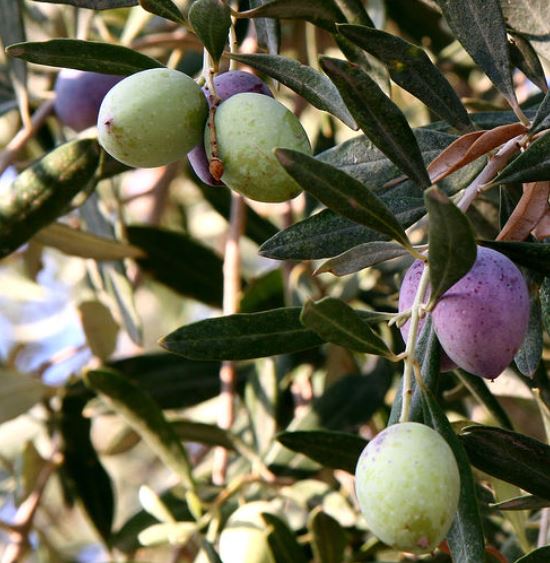
But where was this bet midrash of Rabbi Shimon? Just a few pages later in our masechet we hear about Tekoa again, this time in the context of its superior olive oil:
“MISHNA: Tekoa is the primary source of oil” (Menachot 85b)
Tekoa is a place that is familiar to Tanakh students. It was the home of the prophet Amos and the place where he earned his living:
“The words of Amos, who was among the herdsmen from Tekoa, who prophesied concerning Israel in the reigns of Kings Uzziah of Judah and Jeroboam son of Joash of Israel, two years before the earthquake”.(Amos 1:1)
It was one of the fortified cities that Rehoboam the son of Solomon built on the frontiers of his Judean kingdom:
“Rehoboam dwelt in Jerusalem and built fortified towns in Judah. He built up Bethlehem, and Etam, and Tekoa,” (Divrei HaYamim 2 11:5 – 6)
In an evocative verse the prophet Jeremiah calls on the people of Tekoa to blow the shofar to tell of the enemy’s arrival; in Hebrew the words are an alliteration:
הָעִ֣זוּ ׀ בְּנֵ֣י בִנְיָמִ֗ן מִקֶּ֙רֶב֙ יְר֣וּשָׁלַ֔͏ִם וּבִתְק֙וֹעַ֙ תִּקְע֣וּ שׁוֹפָ֔ר וְעַל־בֵּ֥ית הַכֶּ֖רֶם שְׂא֣וּ מַשְׂאֵ֑ת כִּ֥י רָעָ֛ה נִשְׁקְפָ֥ה מִצָּפ֖וֹן וְשֶׁ֥בֶר גָּדֽוֹל׃ “
Flee for refuge, O people of Benjamin,
Out of the midst of Jerusalem!
Blow the horn in Tekoa,
Set up a signal at Beth-haKerem!
For evil is appearing from the north,
And great disaster.” (Jeremiah 6:1)
And with the return of the Judeans under Persian rule, Tekoa sends one of the groups of builders that repair the walls of Jerusalem:
“Next to him, the Tekoites repaired,” (Nehemiah 3:5)
All these references to Tekoa are clearly about a place within the borders of the tribe of Judah. Jeremiah is calling out to regions around Jerusalem, Rehoboam’s cities are all on the edges of Judah and the returnees in the Persian period only lived in the areas of Jerusalem and Benjamin. But where in Judah is Tekoa? Amos’ imagery refers to places on the edge of the desert, between the mountains and the Judean desert, a place where flocks grazed and rain could come down on one hill while the sun shone on another:
“I therefore withheld the rain from you three months before harvesttime:
I would make it rain on one town And not on another;” (Amos 4:7)
This region is the ספר המדבר, the edge of the desert (see here). It was a place of refuge as well as a bulwark against invaders. King Herod followed in the footsteps of Rehoboam and built his fortress/palace of Herodion in this area. It was also a route to the desert for those who needed to escape enemies, like the Maccabee warriors:
“Then Jonathan, and Simon his brother, and all that were with him, perceiving that, fled into the wilderness of Tekoa . . .” (Maccabees 1 9:33)
Today we know exactly where this Biblical Tekoa was. In the southern Judean desert, near the modern settlement of Tekoa (founded 1975) is an Arab village called Tukua, the remains of ancient Tekoa.
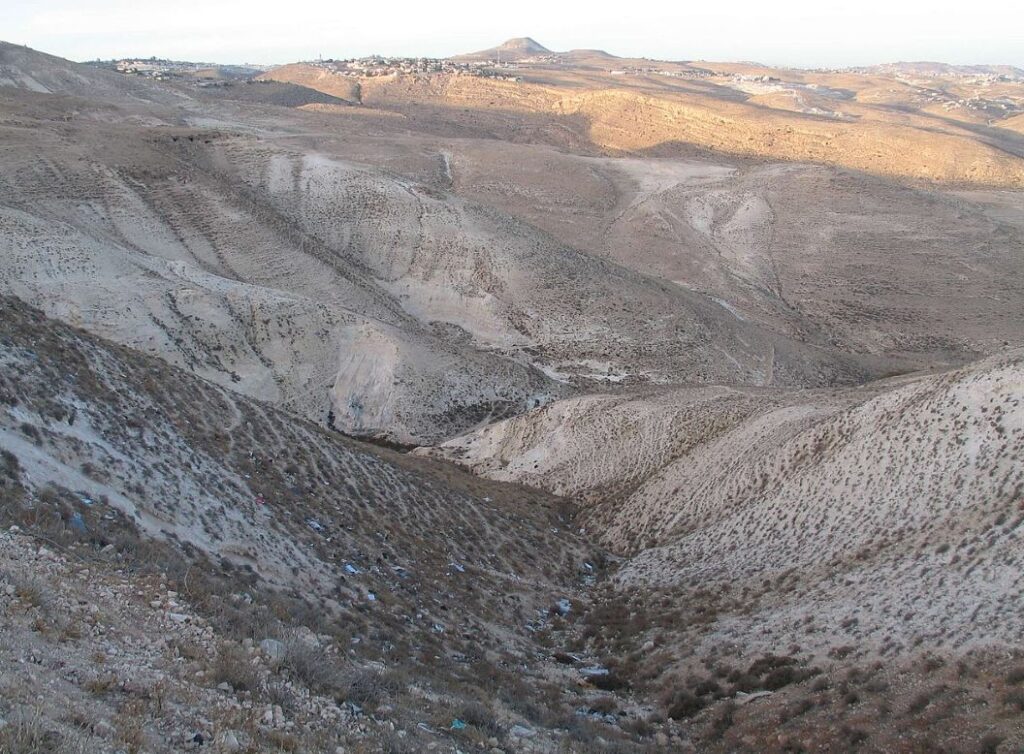
The desert near Tekoa
Bukvoed, CC BY 4.0 <https://creativecommons.org/licenses/by/4.0>, via Wikimedia Commons
However, is this the Tekoa that the Mishna is referring to when it says that Tekoa is the place of the best olive oil? The edge of the desert is prime grazing land, a place of refuge and beauty but it is not known for its wonderful agriculture, and certainly not for the bountiful olive oil described in Menachot 85b.
A different area of Israel has the distinction of being the olive oil capital: the land of the tribe of Asher in the north. Both Jacob and Moses in their respective blessings to the tribes, single out Asher’s olive oil bounty:
“And of Asher he said: Most blessed of sons be Asher;
May he be the favorite of his brothers, May he dip his foot in oil.” (Devarim 33:24)
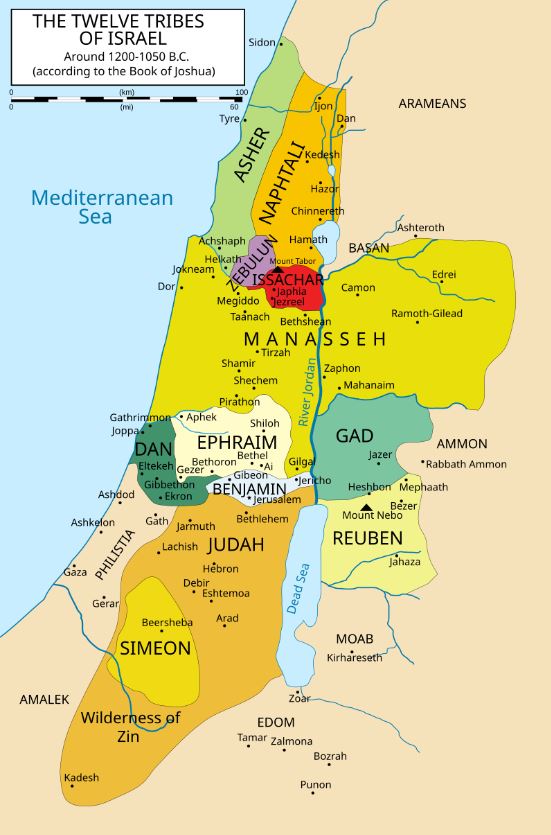
12 tribus de Israel.svg: Translated by Kordas12 staemme israels heb.svg: by user:יוסי12 staemme israels.png: by user:Janzderivative work Richardprins, CC BY-SA 3.0 http://creativecommons.org/licenses/by-sa/3.0/, via Wikimedia Commons
A Galilee location seems more likely than the deserts of Judea for olive oil. A Tosefta that lists Tekoa alongside another upper Galilee town, Gush Halav, as the places where olives grow the latest, is another proof for this suggestion:
“They may eat olives until the last ones are gone from Tekoa. Rabbi Eliezar ben Ya’akov says, even on account [of the olives] of Gush Chalav” (Tosefta Shviit 7:12)
So there were two Tekoas, one in the Judean Desert in the south and one in the Upper Galilee:
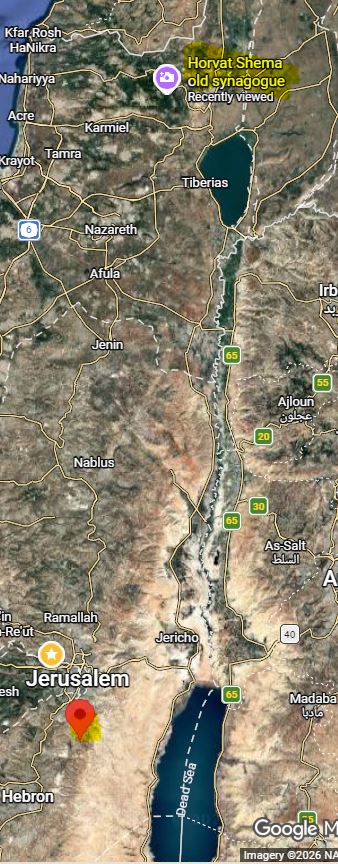
Judean Tekoa is the red marker, Galilean Tekoa is highlighted towards the top of the map
Was Rabbi Shimon’s Tekoa in Judea or the Galilee? From other traditions about Rabbi Shimon’s life: hiding in the cave in Pekiin, his grave in Meron – the Galilee location seems more likely. Also, according to Rebbe’s testimony, at the bottom of the hill in this Tekoa is a spring and there is no spring in Judean Tekoa.
Can we identify the location of the Galilean Tekoa? Scholars have tried. One popular suggestion is a site called Hirbet Shama by Nahal Meron, below the ancient (and modern) community of Meron. An ancient synagogue, as well as a spring, would seem suggest that this might be the place. There is even a suggestion that the name, Shama, comes from Shimon (or perhaps Shamai, whose grave is said to be there).
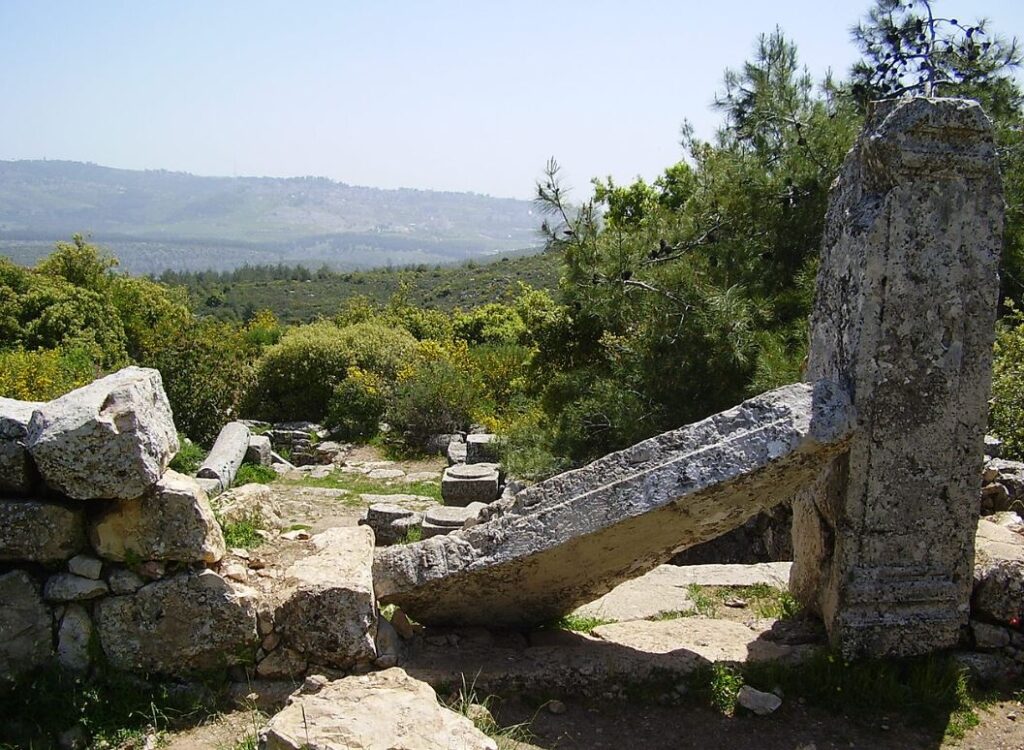
The remains of the ancient synagogue at Hirbet Shama
Dr. Avishai Teicher Pikiwiki Israel, CC BY 2.5 <https://creativecommons.org/licenses/by/2.5>, via Wikimedia Commons
Another suggestion, made by Yitzchak Ben Zvi (yes, the second president of Israel) is Pekiin, the traditional site of Rabbi Shimon’s hideout cave. There is also a spring here, and the name Pekiin is a distortion of the name Beka, which became Tekoa.
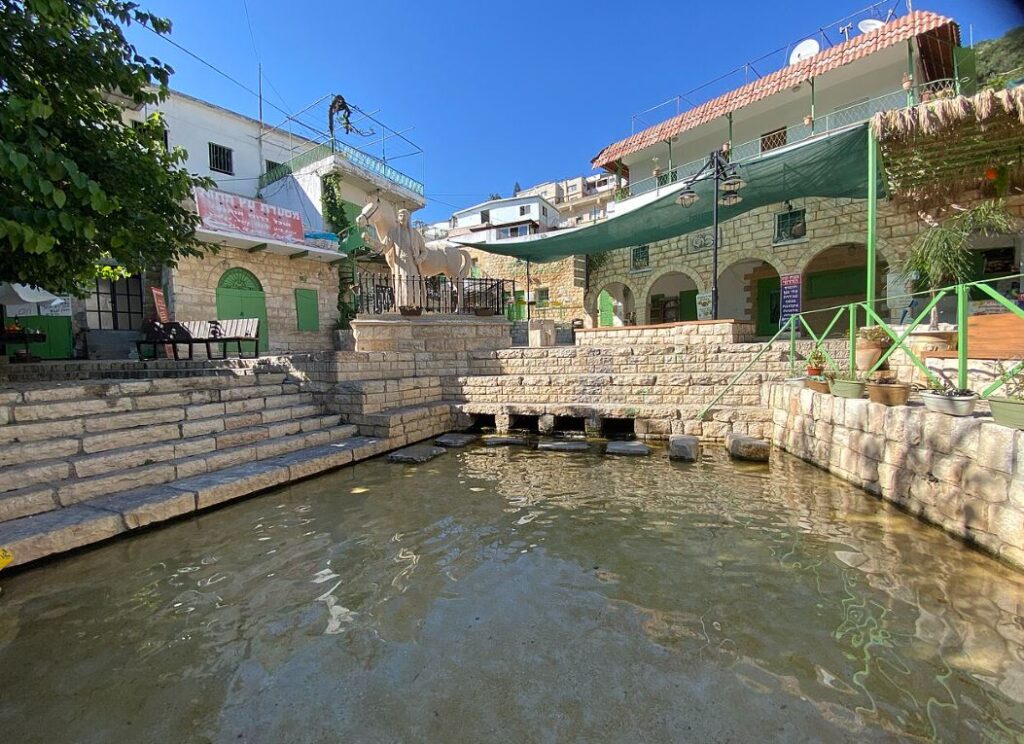
The spring in the village of Pekiin
Roded Shlomo Pikiwiki Israel, CC BY 2.5 <https://creativecommons.org/licenses/by/2.5>, via Wikimedia Commons
Finally, we have another Tekoa conundrum. In the story about King David’s estrangement from his son Avshalom, we hear about a woman from Tekoa who is sent by Yoav to speak to David:
“So Joab sent to Tekoa and brought from there a wise woman. He said to her, “Pretend you are in mourning; put on mourning clothes and don’t anoint yourself with oil; and act like a woman who has grieved a long time over a departed one.” (Shmuel Bet 14:2)
Which Tekoa is this wise woman from? The logical choice in the context of the story would be the Judean Tekoa, close to King David and Jerusalem. However, the Gemara, in a corollary to the Mishnah’s praise of Tekoa for its quality oil, says that olive oil makes you smart, that is why the woman (and presumably all residents of Tekoa) were wise. If only we were wise enough to know which Tekoa was which.