When is an altar not an altar? Or in other words, do you need to sacrifice on a built altar or can a rock be considered an altar for the purposes of inappropriate sacrificing? Our Mishnah discusses this question:
“Rabbi Yosi adds: And one is liable only once he offers it up at the top of an altar. Rabbi Shimon says: Even if he offered it up on a rock or on a stone, he is liable.” (Zevachim 108a)
Rabbi Yosi and Rabbi Shimon respectively prove their points by citing sacrifices from the Bible. Rabbi Yosi mentions Noah, who built an altar and sacrificed on it. Meanwhile Rabbi Shimon takes an example from centuries later and use Manoah, the father of Samson, as his prooftext:
“Rabbi Yoḥanan said: What is the reason of Rabbi Shimon? As it is written: “And Manoah took the kid with the meal offering, and offered it up upon the rock, to the Lord” (Judges 13:19).” (Zevachim 108b)
No matter who is right, both Tannaim are talking about sacrifices that are done outside the confines of the Mishkan or the Temple. What is the Torah attitude towards these “off the grid” sacrifices? On the one hand, Moses cautions against acting like the Canaanites who sacrifice on all the high places:
“You must destroy all the sites at which the nations you are to dispossess worshiped their gods, whether on lofty mountains and on hills or under any luxuriant tree.” (Devarim 12:2)
On the other hand, from Cain and Abel (and according to the Midrash, from Adam), man has offered sacrifices to God outside the boundaries of a Temple and the Torah seems to approve of these bamot (outside altars). We hear about sacrifices offered by Abraham (Bereshit 12:7 and multiple other places), Jacob (Bereshit 33:20 and 47:1), Joshua (on Mount Eival, Joshua 8:30), Samuel (Samuel I 9:12) and Manoah. We even have an unintended bama. Gidon asks the angel visiting him for a sign that he has been sent by God. The angel instructs Gidon to pour out his food on a rock and the angel then ignites the food – voila, an impromptu bama:
“The angel of GOD held out the staff that he carried, and touched the meat and the unleavened bread with its tip. A fire sprang up from the rock and consumed the meat and the unleavened bread. And the angel of GOD vanished from his sight” (Shoftim 6:21)
Why is a bama permitted and even encouraged in some situations and forbidden in others? The answer lies in the timing and the intention. Obviously bamot dedicated to idols are always forbidden, as we see here in this prophecy of Jeremiah:
“They have built shrines (bamot) to Baal, to put their children to the fire as burnt offerings to Baal—which I never commanded, never decreed, and which never came to My mind.” (Jeremiah 19:5)
But even a bama to God is forbidden in a period when there is a central worship place. This is explained in the Mishnah in Zevachim:
“Until the Tabernacle was established, private altars were permitted and the service was performed by the firstborn. And from the time that the Tabernacle was established, private altars were prohibited and the sacrificial service was performed by the priests.” (Mishnah Zevachim 14:4)
Looking at these rules, we come to an obvious question. The stories in the book of Shoftim (Gidon, Manoah) as well as the dramatic tale of Eliyahu building an altar on Mount Carmel (Kings I 18) take place when the the Mishkan is standing in Shilo or, in the case of Eliyahu, when the Temple already exists. How are those bamot permitted? The Gemara explains these situations as a a temporary command because of circumstances, a הוראת שעה (for example, see Zevachim 119b about Manoah).
Even when bamot were permitted, there were different kinds. An individual could have a bamah where he or she offered up personal donations. These individual bamot had much more relaxed rules as we see in the Mishnah:
“And what is the difference between the altar of an individual and the public altar? [on a private altar] there is no placing of hands, no slaughter in the north, no placement of blood around, no waving of meal offerings, and no bringing of meal offerings . . . And no priesthood, no service vestments, no service vessels, no pleasing aroma to God, no partition for the blood and the priest’s washing of hands and feet” (Mishnah Zevachim 14:10)
In contrast, a public or large altar במה גדולה has more rules. Where were there public altars? The most famous one was in Givon, where King Solomon has a vision when he first begins to rule:
“The king went to Givon to sacrifice there, for that was the largest shrine; on that altar Solomon presented a thousand burnt offerings. At Givon GOD appeared to Solomon in a dream by night; and God said, “Ask, what shall I grant you” (Melachim I 3:4-5)
There seem to have been many bamot all over the country, and they do not disappear after the Temple is built, they just become outlawed. Have archaeologists found any of them? Yes! Bamot have been discovered ranging from small rocks like our Mishnah describes, to massive altars. Just one hill away from the Mishkan in Shilo is a site called Givat Harel with a stone with horns carved into it. Its dimensions are similar to the size of the altar in the Mishkan, about two and a half meters by two and a half meters (five amot by five amot). The fact that it was made in proximity to the Mishkan shows how people disregarded the rules and desired their own private worship places.
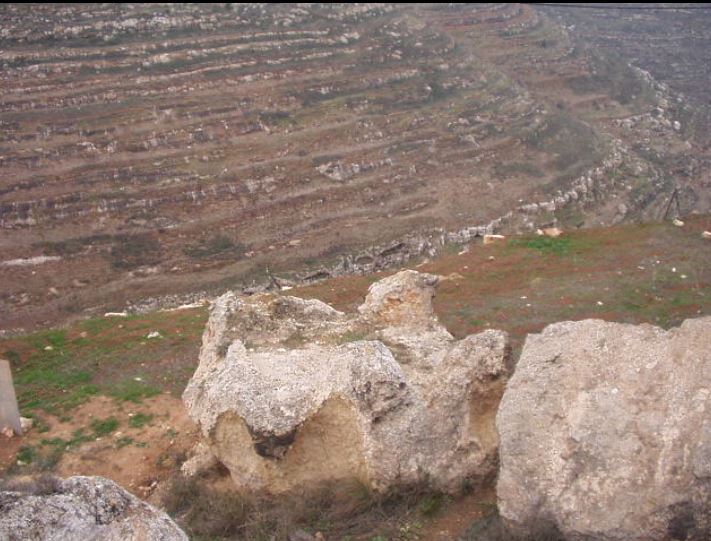
Yair Shiloni, CC BY-SA 4.0 <https://creativecommons.org/licenses/by-sa/4.0>, via Wikimedia Commons
An intriguing find near today’s Bet Shemesh industrial zone is a stone called “Manoah’s Altar,” This stone, which also has similar dimensions to the altar described in the Torah is near the ancient town of Tzora, Samson’s hometown. Holes at the corners may have been for water or wine offerings to drip down. Is this the stone described in Shoftim and in our masechet?
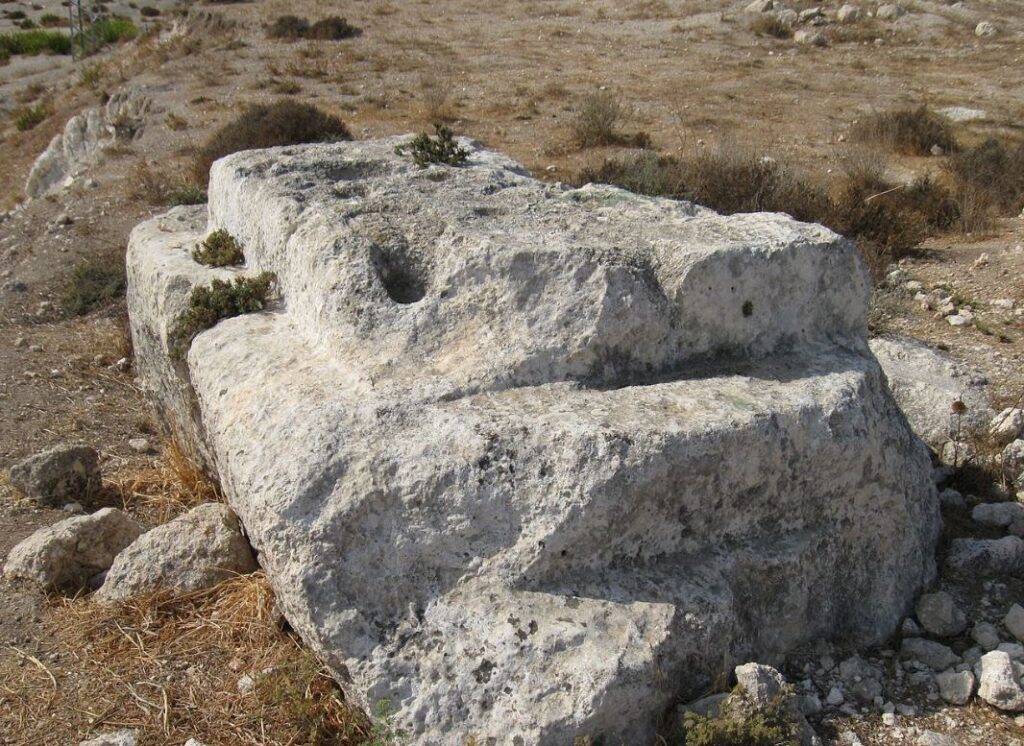
Daniel Ventura at Hebrew Wikipedia, CC BY-SA 3.0 <http://creativecommons.org/licenses/by-sa/3.0/>, via Wikimedia Commons
At a site in the Jordan Valley identified with the Biblical Gilgal is a round bama, the site dates to the period of Joshua:
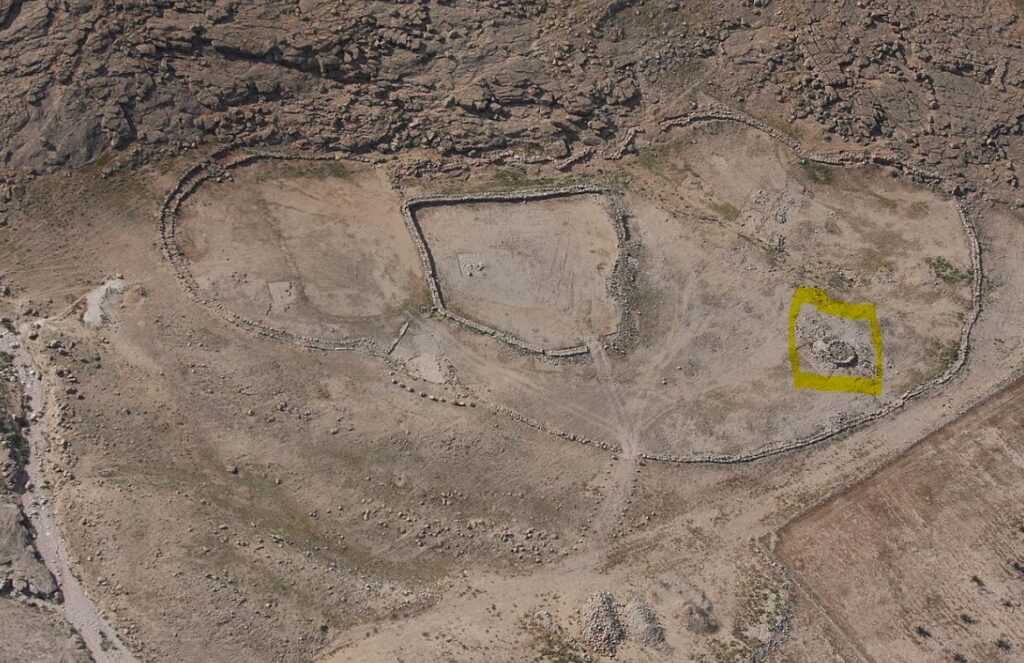
The highlighted area is the bama at Gilgal Argaman
Adam Zartal אדם זרטל, CC BY-SA 3.0 https://creativecommons.org/licenses/by-sa/3.0, via Wikimedia Commons
Bamot that were illegitimate according to Torah law have been discovered in many major Israelite and Judahite towns: Tel Sheva, Arad, Lachish, Tel Dan and others.
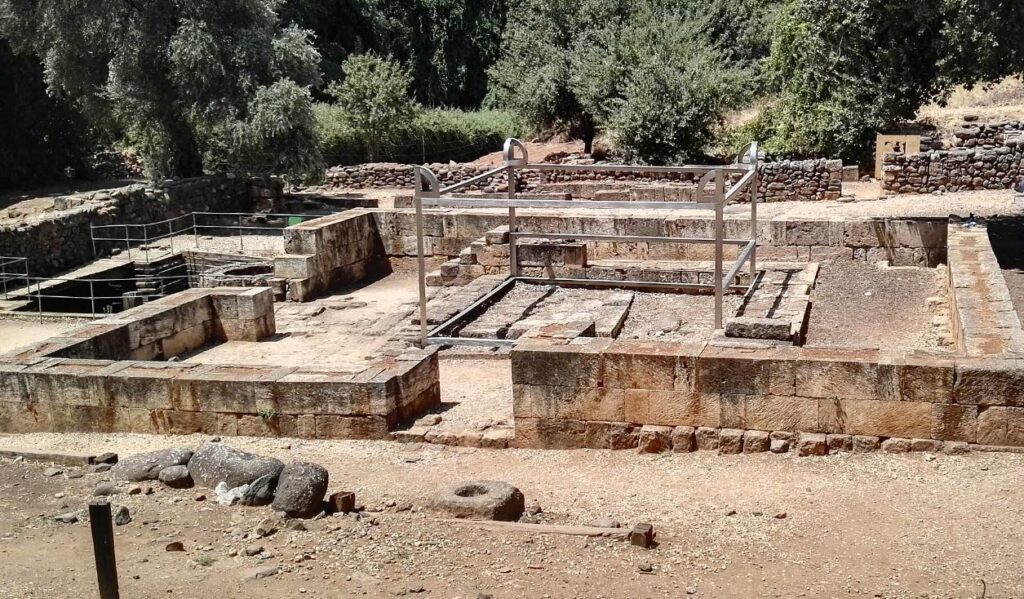
Reconstruction of Tel Dan altar
Bukvoed, CC BY 4.0 <https://creativecommons.org/licenses/by/4.0>, via Wikimedia Commons
And what about the “large” bama at Givon? So far nothing has been found at Givon itself, but at Nebi Samuel, just a few kilometers away, and looking down on Biblical Givon, is a decorated platform that perhaps was the area for sacrifices made famous by the story of King Solomon.
Today we no longer worship at bamot but we have a vestige of the word and of the idea of worshipping from a height: the bima in the synagogue, from where we read the Torah:
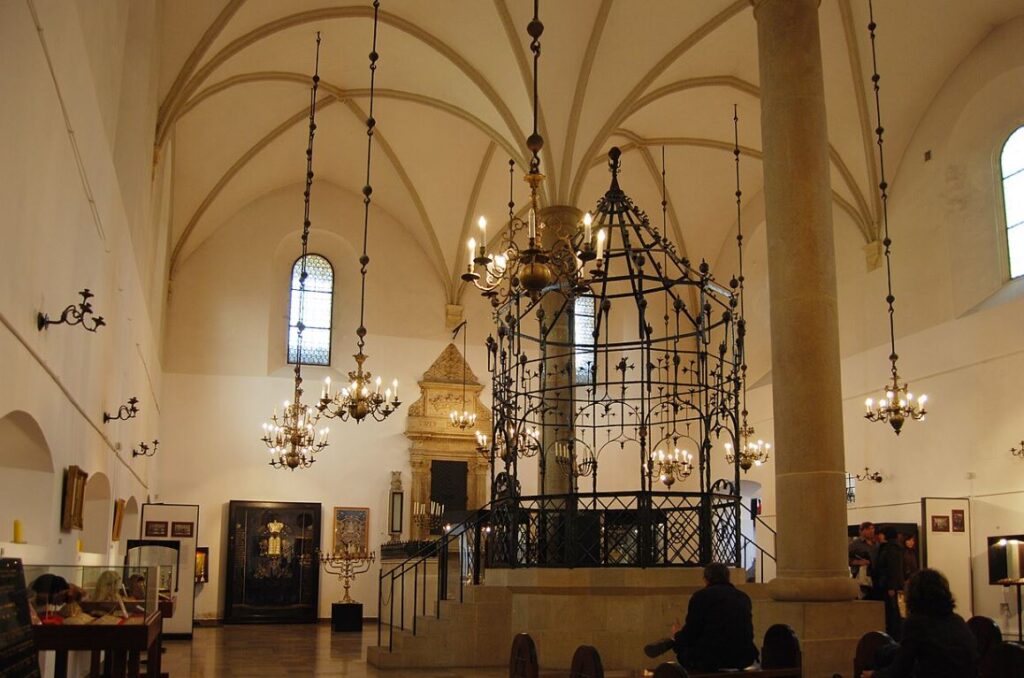
Bima of the Old Synagogue in Krakow
Bart Van den Bosch (Wintermute314), CC BY-SA 3.0 http://creativecommons.org/licenses/by-sa/3.0/, via Wikimedia Commons