So what’s the problem with the book of Ezekiel?
One of the major prophets, led the first Diaspora Jewish community in Babylonia, a holy and ascetic visionary – doesn’t that sound like an ideal Tanakh character? And yet his book was clearly considered problematic, so much so that a teacher named Hanina ben Hizkiyah needed to do some serious apologetics to save it:
“Rav Yehuda says that Rav says: That man is remembered for good, and Ḥanina ben Ḥizkiyah is his name. As were it not for him, the book of Ezekiel would have been suppressed because its contents contradict statements of the Torah. What did Ḥanina ben Ḥizkiyah do? He brought up three hundred jugs of oil and he sat in the upper story and did not move from there until he homiletically interpreted all of those verses” (Menachot 45a)
The main issue that the Gemara discusses are the contradictions between the laws, mainly Temple and priest related, taught by Ezekiel and those in the Torah. How could Ezekiel instruct the people to bring sacrifices that the Torah did not command, or seem to imply that only kohanim have to stay away from dead animals? There must be a way to reconcile his statements with those of the Torah.
A different issue, not mentioned here but discussed in other places, are Ezekiel’s wild and revealing divine visions. Are these appropriate to be taught to the general public? The answer of the Mishnah is no. The Gemara provides further details of the dangers of learning “Maaseh Merkavah,” the vision of the Divine Chariot:
“But wasn’t there a certain youth who expounded the chashmal [of the Divine Chariot], and fire came out and consumed him,” (Hagigah 13a)
Finally, many of Ezekiel’s prophecies are extremely harsh, even crude denunciations of Jerusalem and the Jewish people. One opinion in the Mishnah (Megillah 4:10) takes issue in particular with these difficult prophecies; here is one example:
“You built your mound at every crossroad; and you sullied your beauty and spread your legs to every passerby, and you multiplied your whoredoms.” (Ezekiel 16:25)
All of these factors: halachic contradictions, secret mystical knowledge and attacks on the Jewish people, contributed to a certain unease about the book, one that Hanina attempted to fix.
Ezekiel prophesied during a crossroads in Jewish life. He was exiled from Jerusalem in the first Babylonian exile, during the time of King Yehoyachin (597 BCE):
“On the fifth day of the month—it was the fifth year of the exile of King Jehoiachin—
the word of GOD came to the priest Ezekiel son of Buzi, by the Chebar Canal, in the land of the Chaldeans.” (Ezekiel 1:2-3)
This exile included the elite of Judah, the craftsmen, the warriors, the cabinet ministers and the king. As the book of Kings tells us, only the poor were left behind:
“He exiled all of Jerusalem: all the commanders and all the warriors—ten thousand exiles—as well as all the artisans and smiths; only the poorest people in the land were left. He deported Jehoiachin to Babylon; and the king’s mother and wives and officers and the notables of the land were brought as exiles from Jerusalem to Babylon” (Kings II 24:14-15)
From that moment, Jewish life exists as a split screen. The community in Babylonia is led by Ezekiel; meanwhile a community continues to exist in Judea, under the leadership of the prophet Jeremiah. Ezekiel’s prophecies also have a split quality to them. Until his eleventh year in exile, the Temple in Jerusalem is still standing and he uses his prophecies to attack the sins of the people. But once he hears of the destruction of Jerusalem (Ezekiel 33:21), he changes his tone and prophesies consoling visions about the future building of the city and the Temple. As the rabbis said in discussing the order of the prophetic books:
“Since Kings ends with the destruction [of the Temple], and Jeremiah deals entirely with the destruction, and Ezekiel begins with the destruction but ends with consolation, and Isaiah entirely with consolation, we juxtapose destruction to destruction and consolation to consolation” (Bava Batra 14b)
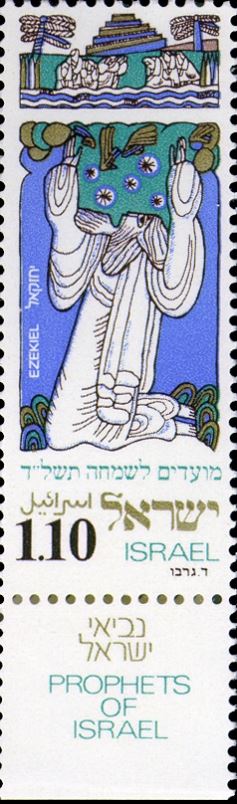
דויס גרבו לדואר ישראל, Public domain, via Wikimedia Commons
Ezekiel is the first to create a virtual tour – he ”travels” to Jerusalem and sees the Temple in a vision (Ezekiel 8). The most famous of Ezekiel’s prophecies are the Divine Chariot in chapter 1 and his vision of the dry bones in chapter 37. The incredible prophecy of the dead and dried up people of Israel coming back to life is a powerful picture that we have seen fulfilled many times in Jewish history, certainly in the creation of the State of Israel after the Holocaust.
“And I was told, “O mortal, these bones are the whole House of Israel. They say, ‘Our bones are dried up, our hope is gone; we are doomed.’ Prophesy, therefore, and say to them: Thus said the Sovereign God: I am going to open your graves and lift you out of the graves, O My people, and bring you to the land of Israel.” (Ezekiel 37: 11-12)
The sage who “rehabilitates” Ezekiel is also an interesting figure. We do not know much about Hanina ben Hizkiyah except that he lived when the Temple was still standing, as did his son Elazar. According to Masechet Shabbat (13b) Hanina also wrote an important Second Temple period text, Megillat Tannit, which records many fast and feast days, most of which we no longer commemorate. His home was also the location for a memorable meeting of Sages where certain laws were decided in favor of Bet Shammai.
“And these are among the halakhot that the Sages, who went up to visit him, said in the upper story of Ḥananya ben Ḥizkiyah ben Garon. [When the Sages] were counted, [the students of] Beit Shammai outnumbered [the students of] Beit Hillel, and they issued decrees with regard to eighteen matters on that day” (Shabbat 13b)
Did Hanina’s apologetics work? It seems so. The book of Ezekiel was not hidden away but occupies a prominent place in our Bibles. And despite suggestions that we should not read aloud the section about the Merkavah, it became the haftorah for Shavuot, a day of mystical revelation on Mount Sinai. Ezekiel himself was a revered figure. His tomb in Iraq was a site of pilgrimage for Jews for centuries. They would traditionally visit it on Shavuot, because of the connection to the haftorah. The site was also holy to Muslims who had a mosque there. With the founding of the State of Israel, Jews faced persecution in Iraq and were kicked out of the site. More recently, Jews have begun to return and there is a synagogue there again.
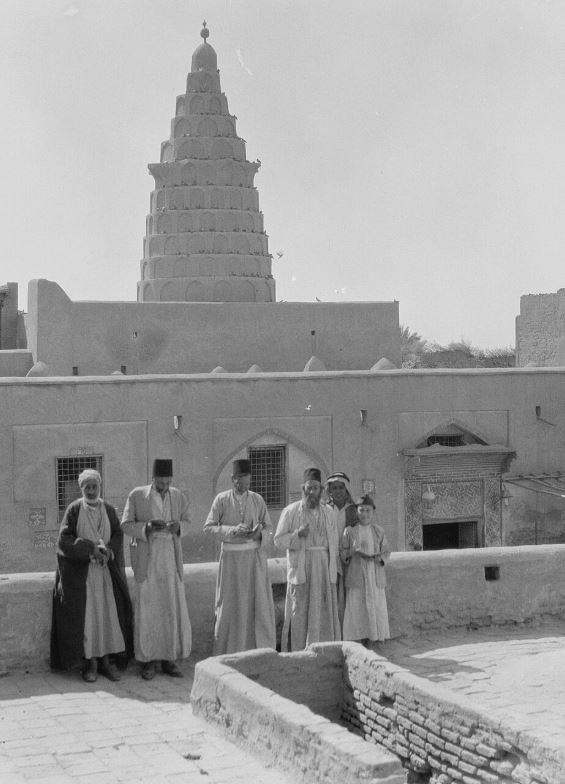
Ezekiel’s tomb 1932
American Colony (Jerusalem). Photo Dept., photographer / Eric and Edith Matson Photograph Collection., Public domain, via Wikimedia Commons
Perhaps Ezekiel’s most enduring legacy for modern Jews today is the name of the site where Ezekiel had some of his prophecies.
“And I came to the exile community that dwelt in Tel Aviv by the Chebar Canal, and I remained where they dwelt.” (Ezekiel 3:15)
The name, with its resonance of old (a mound, or tel) and new (spring) was adopted as the Hebrew title for Herzl’s book AltNeuland, Old New Land. It eventually became the name of the new Hebrew city on the coast. So even if you have never read the book of Ezekiel, you know about his namesake city.

A different Tel Aviv by a different river (the Yarkon)
Ilan Costica, CC BY 3.0 <https://creativecommons.org/licenses/by/3.0>, via Wikimedia Commons