Sometimes an immigrant can be completely integrated in her new society and yet. . . she will always be something of an outsider. She might even have a nickname that indicates that status: the American, the Russian. On our daf we meet such an outsider:
“Ḥanan the Egyptian says: even if the [sacrificed goat’s] blood is already in the cup, one brings another goat to pair with it” (Menachot 59b)
Hanan the Egyptian is not the only rabbi to be described by his place of origin. We also have Natan the Babylonian, Rabbi Yosi the Galilean and others. A title like this means that this person now lives somewhere else – Rabbi Yosi spent his time in Yavneh, far from the Galilee – but still is identified by his birthplace. Similarly in a later time period, we find scholars in Spain and in the Ottoman Empire whose surname is Ashkenazi or Frank, referring back to where they came from.
Hanan the Egyptian was a third generation Tanna. He is grouped with other junior scholars who never received Rabbinic ordination:
“They deliberated before the Sages, this is referring to Shimon ben Azzai, and Shimon ben Zoma, and Ḥanan the Egyptian, and Ḥananya ben Ḥakhinai.” (Sanhedrin 17b)
Hanan was a contemporary of Rabbi Akiva and his students. The only statement we have in his name is this one in Menachot, which also appears in Zevachim and Yoma, namely that if the goat for Azazel dies or is lost, one brings a substitute instead.
While we know of many Jewish scholars from Babylonia, we hear less in the Gemara about personalities from Egypt. What is the Jewish connection to Egypt? We know that it dates back to our very beginnings as a people. The Patriarchs and Matriarchs go down to Egypt when food is scarce in the Land of Israel. This is because of Egypt’s unique ecosystem, one that is so different from the Land of Israel:
“For the land that you are about to enter and possess is not like the land of Egypt from which you have come. There the grain you sowed had to be watered by your own labors, like a vegetable garden; but the land you are about to cross into and possess, a land of hills and valleys, soaks up its water from the rains of heaven.” (Devarim 11:10-11)
Egypt is sustained by the Nile which never runs out of water. The land of Israel is nourished by rain and springs. Therefore, the book of Deuteronomy warns the Israelites that their reality as farmers will be different than the way agriculture works in Egypt. They have the advantages and disadvantages of the rain – it comes down without any labor from them, but it can also be scarce, as opposed to Egypt which will always have a water source.
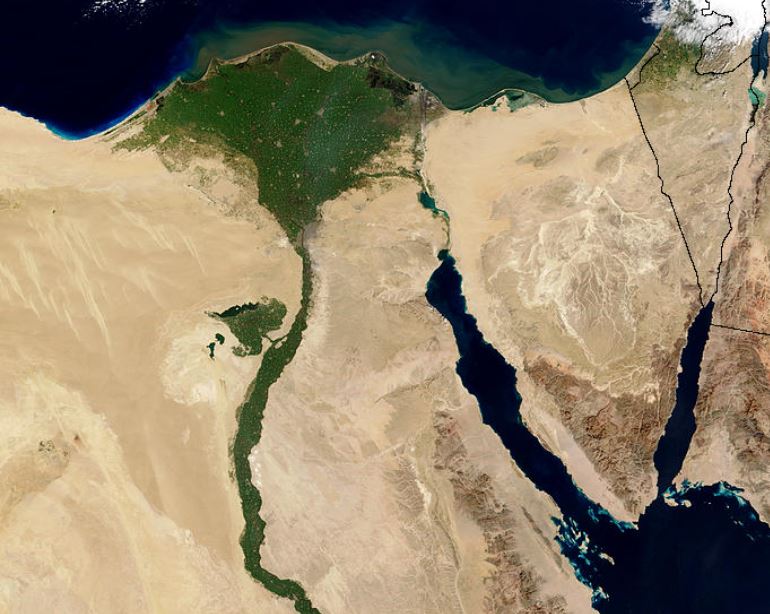
Life in Egypt is along the Nile Delta
Jacques Descloitres, MODIS Rapid Response Team, NASA/sh, Public domain, via Wikimedia Commons
Egypt was a major power in the centuries before the Exodus. Pharaoh Thutmose III conquered much of Canaan in the 15th century BCE. The city states of the land: Megiddo, Gezer, Bet Shemesh etc, were directly dependent on Egypt and did not have ties with the other local kings. This situation is reflected in the book of Joshua, where the kings form very local coalitions and do not join together as one to battle the Israelite threat.
Israel and Egypt: there is a constant push and pull between them. Egypt was (and still is) a massive presence in the Middle East. Our relationship with Egypt ranged from dependence, as in the Bereshit stories, to allies, like King Solomon and his father in law Pharaoh (Kings I 9:17) to enemies, like with the invasion of Pharaoh Shishak (Kings I 14:25)
While the Torah instructs is not to return to live in Egypt (Devarim 17:16), by late First Temple times we hear of a Jewish community in the south, on the Nile island of Elephantine (Yeb) near Aswan. These were Jewish mercenary soldiers who fought for the Egyptians, guarding their southern border against invaders. They left behind an archive: letters and documents that tell us about their community. These date to the fifth century BCE. One particularly fascinating document is to the Persian ruler of Yehud (Judea), asking for his help in rebuilding the Elephantine Jewish temple. It seems to have been destroyed by local Egyptians. Was it built when the First Temple was still standing in Jerusalem? Was it a temple to God or also to idols? These questions are disputed but the fact that a faraway outpost of soldiers wanted to continue to serve the God of Israel shows the depth of their connection to their nation.
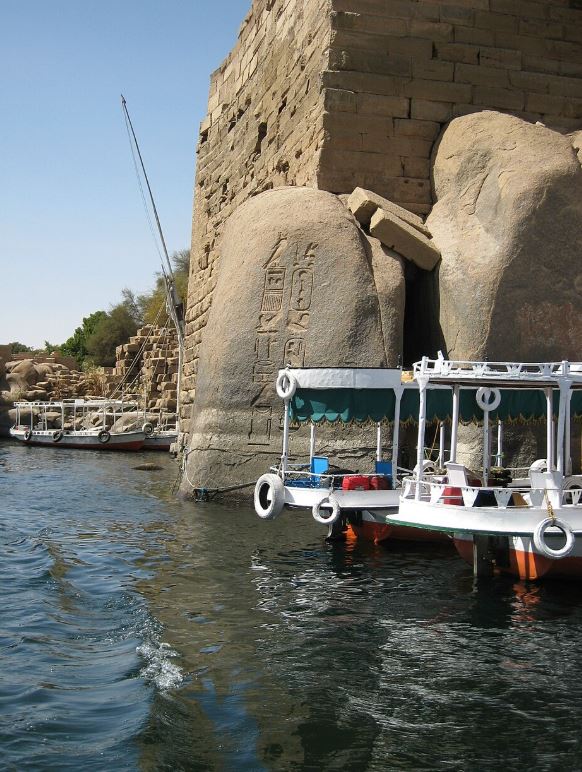
Nilometer (ancient device to measure the Nile) on Elephantine island
Karen Green, CC BY-SA 2.0 <https://creativecommons.org/licenses/by-sa/2.0>, via Wikimedia Commons
By the Hellenistic period (fourth century BCE and on) there was a well-established Jewish community in Alexandria, on the Mediterranean coast. Alexandria was founded by its namesake, Alexander the Great, in 331 BCE, and was a center of Hellenistic culture. Jews became one of the most prominent groups in the city. Sources tell us that two out of five of the city quarters had a Jewish majority, and the community built an enormous synagogue whose fame reached to the Land of Israel:
“Rabbi Yehudah said, anybody who did not see the double stoa of Alexandria did not ever see the glory of Israel. It was like a large basilica with a stoa inside a stoa. Sometime there were there twice as many as left Egypt. . . A wooden platform was at the center and the congregation’s officiant stood on it. If one of the congregation came to read in the Torah the official waved cloths and they answered after him “amen”. . .And who destroyed it? Trajanus the evil one.” (Yerushalmi Sukkah 5:1)
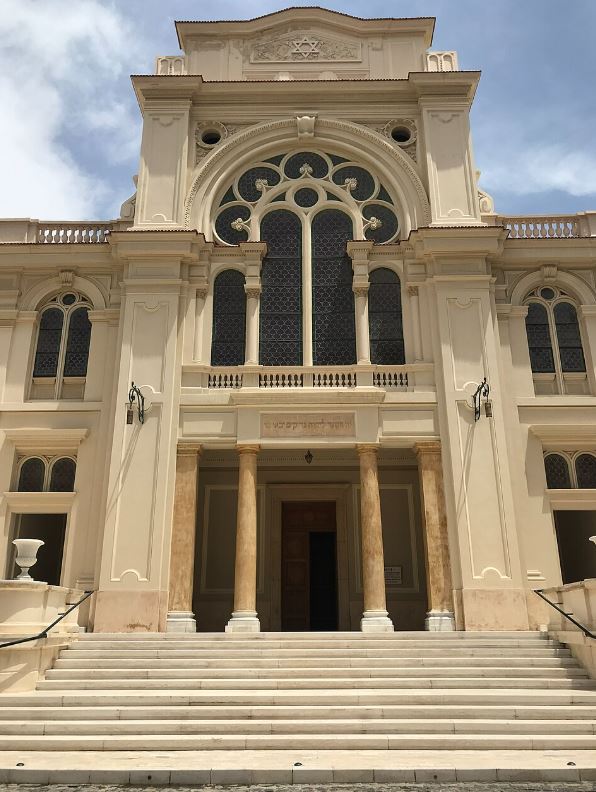
Eliyahu HaNavi synagogue in modern Alexandria (NOT the Great Synagogue)
Marsupium, CC BY 4.0 <https://creativecommons.org/licenses/by/4.0>, via Wikimedia Commons
The end of this text tells us the fate of Alexandria’s Jews. Like many Diaspora communities, here too the Jews were charged with dual loyalties and sometimes denied the full rights of citizens. A bloody battle in the first century BCE about granting Jews citizenship rights was the first blow, later in the Trajan Revolt of the second century CE the Great Synagogue was destroyed and the community massacred. Perhaps this is why our Hanan left his homeland to start a new life in the Land of Israel.
Eventually, the Jews returned and rebuilt. Two of the great teachers and leaders of medieval Jewry were tied to Egypt: Rabbi Saadia Gaon came from there, though he eventually moved to Babylonia. Maimonides settled there and practiced medicine, while leading the Jewish community and writing his monumental works of halacha and philosophy.
Egypt and Israel – neighbors, friends, enemies, always connected, even today.
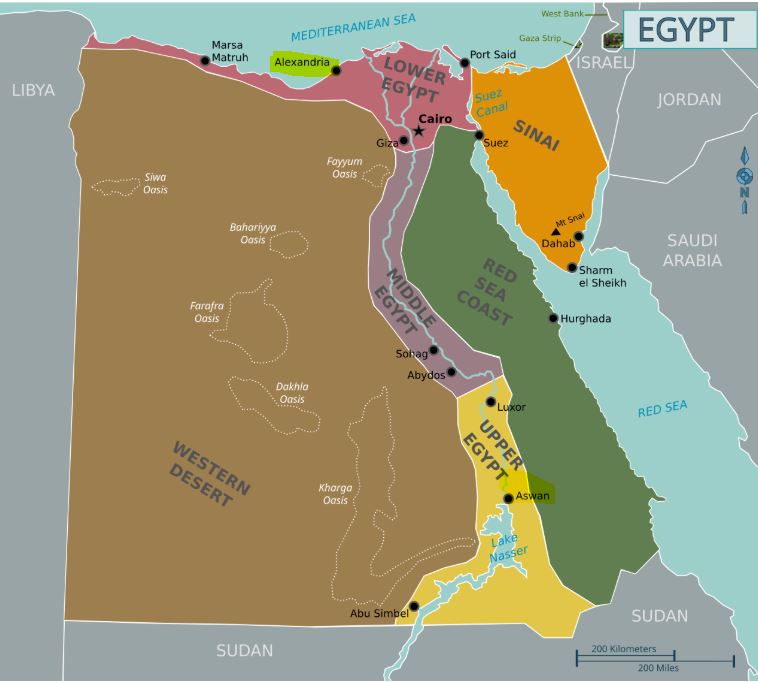
Cacahuate, French translation by Joelf, CC BY-SA 4.0 <https://creativecommons.org/licenses/by-sa/4.0>, via Wikimedia Commons