








Zevachim 120

Share this shiur:
Masechet Zevachim
Masechet Zevachim is sponsored by Esther Kremer in loving memory of her father, Manny Gross on his third yahrzeit. “He exemplified a path of holiness and purity, living with kedushah in his everyday life.”
Want to dedicate learning? Get started here:

Summary

- For the text of the Hadran ceremony, click here.
- For more information about What is a Siyum, click here
Rabbi Zeira raises the question of an offering designated for a private altar: if it was slaughtered on the private altar, then brought into the Tabernacle, and afterward taken back out, must it now be returned to the Tabernacle and treated like a public‑altar sacrifice with all its associated requirements? Initially, the Gemara suggests that this issue might hinge on the dispute between Rava and Rav Yosef regarding high level sanctity offerings that were slaughtered in the South instead of the required Northern area and were then mistakenly placed on the altar. Ultimately, however, the Gemara distinguishes between the two cases and rejects the comparison.
Another discussion concerns a sacrifice slaughtered at night on a private altar. Rav and Shmuel disagree about whether such an offering is valid.
Rav and Rabbi Yoḥanan also dispute whether burnt offerings brought on private altars require hefshet and nituach – flaying and cutting into pieces – just as they do on the public altar.
Although private altars operate with fewer restrictions, several laws apply equally to both private and public offerings. A braita entertains the possibility that time‑based limitations might not apply to private‑altar sacrifices, just as spatial limitations do not. However, a verse is cited to demonstrate that time restrictions indeed remain binding even for offerings brought on private altars.
Today’s daily daf tools:
Masechet Zevachim
Masechet Zevachim is sponsored by Esther Kremer in loving memory of her father, Manny Gross on his third yahrzeit. “He exemplified a path of holiness and purity, living with kedushah in his everyday life.”
Siyum Zevachim is sponsored by the Shuster family in loving memory of Mrs. Molly Rotman, Malka bat Yisroel, aunt of Ozer Shuster, mother of Yisroel Rotman and mother in-law of Masha Rotman. “She loved Torah and mitzvot and loved the company of those devoted to Torah and mitzvot.”
Zevachim 120
שֶׁהִכְנִיסָהּ לִפְנִים וְהוֹצִיאָהּ לַחוּץ – מַהוּ? מִי אָמְרִינַן: כֵּיוָן דַּעֲיַילָא – קָלְטָה לַהּ מְחִיצְתָּא; אוֹ דִלְמָא, כֵּיוָן דַּהֲדַר – הֲדַר?
that one brought inside and subsequently took outside, what is the halakha? Does it have the status of a sacrificial item of a public altar? The Gemara clarifies the question: Do we say that once it was brought in the partition has already absorbed it, and all halakhot of sacrificial items of a public altar apply; or perhaps once it returns, i.e., was taken outside again, it returns to its prior status as an offering of a private altar?
לָאו הַיְינוּ פְּלוּגְתָּא דְּרַבָּה וְרַב יוֹסֵף? דִּתְנַן: קׇדְשֵׁי קָדָשִׁים שֶׁשְּׁחָטָן בַּדָּרוֹם – מוֹעֲלִין בָּהֶן, וְאִם עָלוּ לֹא יֵרְדוּ.
The Gemara asks: Isn’t this issue a disagreement between Rabba and Rav Yosef? As we learned in a mishna (Me’ila 2a): With regard to offerings of the most sacred order, e.g., a sin offering or a guilt offering, that were slaughtered in the south of the Temple courtyard, and not in the north as dictated by halakha, and are therefore disqualified, one who derives benefit from them is liable for misuse of consecrated property, and despite the fact that they should not ascend the altar, if they ascended they shall not descend.
וְאִיבַּעְיָא לְהוּ: יָרְדוּ, מַהוּ שֶׁיַּעֲלוּ? רַבָּה אָמַר: לֹא יַעֲלוּ, וְרַב יוֹסֵף אָמַר: יַעֲלוּ.
And a dilemma was raised before the Sages: If they did descend the altar, what is the halakha with regard to ascending again? Rabba says: They shall not ascend, and Rav Yosef says: They shall ascend. Consequently, they disagree with regard to the issue of whether an item that is not fit to be sacrificed in a consecrated area acquires the sanctity of that area even if it is removed from there.
תִּיבְּעֵי לְרַבָּה, תִּיבְּעֵי לְרַב יוֹסֵף. תִּיבְּעֵי לְרַבָּה: עַד כָּאן לָא קָאָמַר רַבָּה – אֶלָּא בְּמִזְבֵּחַ; דַּחֲזֵי לֵיהּ מְקַדֵּשׁ, דְּלָא חֲזֵי לָא מְקַדֵּשׁ; אֲבָל מְחִיצָה, אַף עַל גַּב דְּלָא חֲזֵי לַיהּ – קָלְטָה.
The Gemara responds: The disagreements are not identical, as the dilemma can be raised according to the opinion of Rabba, and the dilemma can be raised according to the opinion of Rav Yosef. The Gemara elaborates: It is possible to raise the dilemma according to the opinion of Rabba, as Rabba says his statement: Offerings of the most sacred order that were slaughtered in the south shall not descend if they ascended, only with regard to the altar, as the altar consecrates that which is fit for it, while it does not consecrate that which is not fit for it. But with regard to the partition of the public altar, even though an offering that was consecrated for a private altar is not fit for that altar, the partition nevertheless absorbs the offering and it is sacrificed there. Consequently, all the halakhot of the public altar apply to that offering, even if it is taken outside.
אוֹ דִלְמָא, אֲפִילּוּ לְרַב יוֹסֵף – עַד כָּאן לָא קָאָמַר רַב יוֹסֵף הָתָם, אֶלָּא דְּחַד מָקוֹם הוּא; אֲבָל הָכָא, דִּתְרֵי מְקוֹמוֹת נִינְהוּ – לָא. אוֹ דִלְמָא לָא שְׁנָא? תֵּיקוּ.
Or perhaps the dilemma of the burnt offering of a private altar can be raised even according to the opinion of Rav Yosef. Rav Yosef states his opinion there, that offerings of the most sacred order that were slaughtered in the south of the Temple courtyard and descended the altar shall ascend again, only because the altar and the offering are both located in one place, i.e., the Temple courtyard. But here in Rabbi Zeira’s case, where the private altar and public altar are two separate places, the halakhot of the public altar do not apply if the offering was taken outside the designated location. Or perhaps there is no difference, and the opinions of Rabba and Rav Yosef in one case are identical to their opinions in the other. The Gemara concludes: The dilemma shall stand unresolved.
מִילְּתָא דִּפְשִׁיטָא לֵיהּ לְרַבָּה בְּחַד גִּיסָא, וּלְרַב יוֹסֵף בְּחַד גִּיסָא – מִיבְּעֵי לֵיהּ לְרַבִּי יַנַּאי. דְּבָעֵי רַבִּי יַנַּאי: אֵבְרֵי עוֹלַת בָּמַת יָחִיד, שֶׁעָלוּ לַמִּזְבֵּחַ וְיָרְדוּ – מַהוּ? הֵיכָא דְּלֹא מָשְׁלָה בָּהֶן הָאוּר – לָא תִּיבְּעֵי לָךְ; כִּי תִּיבְּעֵי לָךְ – הֵיכָא דְּמָשְׁלָה בָּהֶן הָאוּר. מַאי? תֵּיקוּ.
The Gemara notes that a matter that is obvious to Rabba on one side, i.e., that these offerings shall not ascend the altar again, and to Rav Yosef on the other side, i.e., that they shall ascend again, was raised as a dilemma by Rabbi Yannai. As Rabbi Yannai raises a dilemma: What is the halakha with regard to the limbs of a burnt offering of a private altar that ascended the altar and descended? The Gemara notes: In a case where the fire has not yet taken hold of them, do not raise the dilemma, as they certainly shall not ascend again. When should you raise the dilemma? Raise it in a case where the fire has taken hold of them: What is the halakha? The Gemara concludes: The dilemma shall stand unresolved.
אִיתְּמַר: שְׁחִיטַת לַיְלָה בְּבָמַת יָחִיד – רַב וּשְׁמוּאֵל; חַד אָמַר: כְּשֵׁרָה, וְחַד אָמַר: פְּסוּלָה. וְקָא מִיפַּלְגִי בִּדְרַבִּי אֶלְעָזָר;
§ Additionally, with regard to a private altar it was stated: With regard to the slaughter of offerings at night on a private altar, Rav and Shmuel disagree: One says that it is valid, and one says that it is not valid. The Gemara explains: And they disagree with regard to the resolution to a contradiction that was raised by Rabbi Elazar.
דְּרַבִּי אֶלְעָזָר רָמֵי קְרָאֵי אַהֲדָדֵי – כְּתִיב: ״וַיֹּאמֶר בְּגַדְתֶּם גֹּלּוּ אֵלַי הַיּוֹם אֶבֶן גְּדוֹלָה״,
As Rabbi Elazar raised a contradiction between two verses: It is written in the context of Saul’s war with the Philistines: “And the people flew upon the spoil and took sheep and cattle and calves and slew them on the ground; and the people ate them with the blood. Then they told Saul, saying: ‘Behold, the people sin against the Lord in that they eat with the blood. And he said: You have dealt treacherously; roll a great stone to me this day” (I Samuel 14:32–33). That stone was made into a private altar upon which offerings could be slaughtered and sacrificed. Evidently, Saul was particular about slaughtering offerings during the day and not at night, despite the fact that it was a private altar and not a public altar.
וּכְתִיב: ״וַיֹּאמֶר שָׁאוּל פֻּצוּ בָעָם וַאֲמַרְתֶּם לָהֶם הַגִּישׁוּ אֵלַי אִישׁ שׁוֹרוֹ וְאִישׁ שְׂיֵהוּ, וּשְׁחַטְתֶּם בָּזֶה וַאֲכַלְתֶּם, וְלֹא תֶחֶטְאוּ לַה׳ לֶאֱכוֹל עַל הַדָּם. וַיַּגִּשׁוּ כׇל הָעָם אִישׁ שׁוֹרוֹ בְיָדוֹ הַלַּיְלָה, וַיִּשְׁחֲטוּ שָׁם״.
And immediately thereafter it is written: “And Saul said: Disperse yourselves among the people and say to them: Bring me here every man his ox and every man his sheep, and slay them here and eat and sin not against the Lord in eating with the blood. And all the people brought every man his ox with him that night, and slew them there” (I Samuel 14:34). This verse states explicitly that the slaughter took place at night and not during the day.
מָר מְשַׁנֵּי: כָּאן בְּחוּלִּין, כָּאן בְּקָדָשִׁים. וּמַר מְשַׁנֵּי: כָּאן בְּקׇדְשֵׁי בָּמָה גְּדוֹלָה, כָּאן בְּקׇדְשֵׁי בָּמָה קְטַנָּה.
Rav and Shmuel disagree with regard to the resolution of this contradiction: One Sage answers that here, i.e., when the slaughter took place at night, it was of non-sacred animals, while there, i.e., when Saul was particular about slaughtering during the day, it was the slaughter of sacrificial animals. According to this opinion, the sacrificial service was performed only during the day, even on a private altar. And the other Sage answers that both verses are referring to the slaughter of offerings: Here, in the verse that states that Saul was particular about slaughtering during the day, it is referring to the sacrificial animals of a great public altar, while there, in the verse that states that the slaughter took place at night, it is referring to sacrificial animals of a small private altar.
אִיתְּמַר: עוֹלַת בָּמַת יָחִיד – רַב אָמַר: אֵין טְעוּנָה הֶפְשֵׁט וְנִיתּוּחַ, וְרַבִּי יוֹחָנָן אָמַר: טְעוּנָה הֶפְשֵׁט וְנִיתּוּחַ. וְקָא מִיפַּלְגִי בִּדְרַבִּי יוֹסֵי הַגְּלִילִי – דְּתַנְיָא, רַבִּי יוֹסֵי הַגְּלִילִי אוֹמֵר: עוֹלָה שֶׁהִקְרִיבוּ יִשְׂרָאֵל בַּמִּדְבָּר – אֵין טְעוּנָה הֶפְשֵׁט וְנִיתּוּחַ; שֶׁאֵין הֶפְשֵׁט וְנִיתּוּחַ אֶלָּא מֵאֹהֶל מוֹעֵד וְאֵילָךְ.
§ It was stated that with regard to the burnt offering of a private altar, Rav says: It does not require flaying and cutting into pieces, which the Torah requires of a burnt offering (see Leviticus 1:6), and Rabbi Yoḥanan says: It does require flaying and cutting into pieces. The Gemara explains: And they disagree with regard to the meaning of a statement of Rabbi Yosei HaGelili. As it is taught in a baraita that Rabbi Yosei HaGelili says: The burnt offering that the Jewish people sacrificed in the wilderness, i.e., at Mount Sinai before the establishment of the Tabernacle, did not require flaying and cutting into pieces, because the requirement of flaying and cutting into pieces applied only from the Tent of Meeting and onward, as this halakha was first taught in the Tent of Meeting.
מָר סָבַר: מֵאֹהֶל מוֹעֵד וְאֵילָךְ – לָא שְׁנָא בָּמָה גְּדוֹלָה, וְלָא שְׁנָא בָּמָה קְטַנָּה. וּמָר סָבַר: בְּבָמָה גְּדוֹלָה אִין, בְּבָמָה קְטַנָּה לָא.
One Sage, Rabbi Yoḥanan, holds that from the Tent of Meeting and onward there is a requirement of flaying and cutting into pieces, and there is no difference whether the offering is brought upon a great public altar, and there is no difference whether it is brought upon a small private altar. And one Sage, Rav, holds that with regard to a great public altar, yes, flaying and cutting are required, but with regard to a small private altar they are not.
תַּנְיָא כְּוָתֵיהּ דְּרַבִּי יוֹחָנָן: דְּבָרִים שֶׁבֵּין בָּמָה גְּדוֹלָה לְבָמָה קְטַנָּה – קֶרֶן וְכֶבֶשׁ וִיסוֹד וְרִיבּוּעַ בְּבָמָה גְּדוֹלָה, וְאֵין קֶרֶן וִיסוֹד וְכֶבֶשׁ וְרִיבּוּעַ בְּבָמָה קְטַנָּה. כִּיּוֹר וְכַנּוֹ בְּבָמָה גְּדוֹלָה, וְאֵין כִּיּוֹר וְכַנּוֹ בְּבָמָה קְטַנָּה. חָזֶה וָשׁוֹק בְּבָמָה גְּדוֹלָה, וְאֵין חָזֶה וָשׁוֹק בְּבָמָה קְטַנָּה.
It is taught in a baraita in accordance with the opinion of Rabbi Yoḥanan: What are the matters that are different between a great public altar and a small private altar? The corner of the altar, the ramp, the base of the altar, and the square shape are required in a great public altar, but the corner, the base, the ramp, and the square shape are not required in a small private altar. The Basin and its base are required in a great public altar, but the Basin and its base are not required in a small private altar. The breast and thigh of a peace offering, which are given to a priest, are waved at a great public altar, but the breast and thigh are not waved at a small private altar.
דְּבָרִים שֶׁשָּׁוְותָה בָּמָה גְּדוֹלָה לְבָמָה קְטַנָּה: שְׁחִיטָה בְּבָמָה גְּדוֹלָה וּקְטַנָּה, הֶפְשֵׁט וְנִיתּוּחַ בִּגְדוֹלָה וּקְטַנָּה, דָּם מַתִּיר וּמְפַגֵּל בִּגְדוֹלָה וּקְטַנָּה, מוּמִין וּזְמַן בִּגְדוֹלָה וּקְטַנָּה.
And there are other matters in which a great public altar is identical to a small private altar: Slaughter is required at both a great public altar and a small private altar. Flaying a burnt offering and cutting it into pieces is required at both a great public altar and a small private altar. Sprinkling the blood permits the meat to be eaten, and if at that time the priest thought of eating or sacrificing this offering outside its appropriate time, this renders the offering piggul both at a great public altar and at a small private altar. Likewise, the halakha that blemishes disqualify an offering and the halakha that there is a limited time for eating offerings are in effect at both a great public altar and a small private altar.
אֲבָל נוֹתָר וְהַזְּמַן וְהַטָּמֵא – שָׁוִין בָּזֶה וּבָזֶה.
§ Following the detailing of the differences between a communal altar and a private altar, the mishna teaches: But the halakha that portions of the offering left over [notar] beyond the time it is permitted must be burned and that one who eats them incurs karet, and the halakha that intent to sacrifice or partake of the offering beyond its designated time renders the offering piggul, and the prohibition against performing the sacrificial service or eating consecrated meat while ritually impure are equal in this, i.e., a private altar, and that, i.e., a public altar.
תָּנוּ רַבָּנַן: מִנַּיִן לַעֲשׂוֹת זְמַן בְּבָמָה קְטַנָּה כְּבָמָה גְּדוֹלָה? אָמְרָה תּוֹרָה: לָן יִשָּׂרֵף, וּפִיגּוּל יִשָּׂרֵף; מָה פִּיגּוּל – פָּסוּל בְּבָמָה, אַף לָן – פָּסוּל בְּבָמָה.
With regard to this the Sages taught in a baraita: From where is it derived that time, i.e., the halakha that an offering left over beyond its designated time is disqualified, in the case of a small private altar should be made equivalent to the halakha in the case of a great public altar? The Torah stated: An offering that was left overnight must be burned, and likewise the Torah stated that an offering that was sacrificed with the intent to consume it after its designated time [piggul] must be burned. Therefore, another parallel may be drawn between them: Just as piggul is disqualified in the case of a private altar, so too, an offering that was left overnight is disqualified in the case of a private altar.
אוֹ כְּלָךְ לְדֶרֶךְ זוֹ – דְּהָא אָמְרָה תּוֹרָה: לָן יִשָּׂרֵף, וְיוֹצֵא יִשָּׂרֵף; מָה יוֹצֵא – כָּשֵׁר בְּבָמָה, אַף לָן – כָּשֵׁר בְּבָמָה. וְלָאו קַל וָחוֹמֶר הוּא מֵעוֹפוֹת:
Or go this way, and say that because the Torah stated: An offering that was left overnight must be burned, and likewise, the Torah stated that an offering that leaves the Temple courtyard must be burned, the following conclusion may be drawn: Just as an offering that leaves the Temple courtyard is valid in the case of a private altar because it has no set perimeter, so too, an offering that was left overnight is valid in the case of a private altar, and it may therefore be concluded that the halakha of time does not apply to offerings on a private altar. The Gemara asks: And is it not an a fortiori inference from the halakha of bird offerings that in the case of a private altar, time should render an offering disqualified?
מָה עוֹפוֹת, שֶׁאֵין הַמּוּם פּוֹסֵל בָּהֶן – זְמַן פּוֹסֵל בָּהֶן; קׇדְשֵׁי בָּמָה קְטַנָּה, שֶׁהַמּוּם פּוֹסֵל בָּהֶן – אֵינוֹ דִּין שֶׁזְּמַן פּוֹסֵל בָּהֶן?!
If bird offerings, whose halakhot are more lenient in that a blemish does not disqualify them, are nevertheless disqualified by time, then with regard to sacrificial animals of a small private altar, which are disqualified by a blemish, is it not logical that they should be disqualified by time?
מָה לְעוֹפוֹת – שֶׁכֵּן אֵין הַזָּר כָּשֵׁר בָּהֶן; תֹּאמַר בְּבָמָה קְטַנָּה, שֶׁהַזָּר כָּשֵׁר בָּהּ – לֹא יְהֵא זְמַן פָּסוּל בָּהּ?! תַּלְמוּד לוֹמַר: ״וְזֹאת תּוֹרַת זֶבַח הַשְּׁלָמִים״ – לַעֲשׂוֹת זְמַן בָּמָה קְטַנָּה כִּזְמַן בָּמָה גְּדוֹלָה.
The Gemara questions the inference: What is notable about bird offerings? They are notable in that a non-priest is not fit to sacrifice them. Shall you say the same with regard to offerings sacrificed on a small private altar, where a non-priest is fit? No, and consequently they should not be disqualified by time. Therefore, the verse states: “And this is the law of the sacrifice of peace offerings” (Leviticus 7:11), which equates all peace offerings, to render the halakha of time with regard to a small private altar identical to the halakha of time with regard to a great public altar.
הֲדַרַן עֲלָךְ פָּרַת חַטָּאת, וּסְלִיקָא לַהּ מַסֶּכֶת זְבָחִים

Today’s daily daf tools:
Delve Deeper
Broaden your understanding of the topics on this daf with classes and podcasts from top women Talmud scholars.
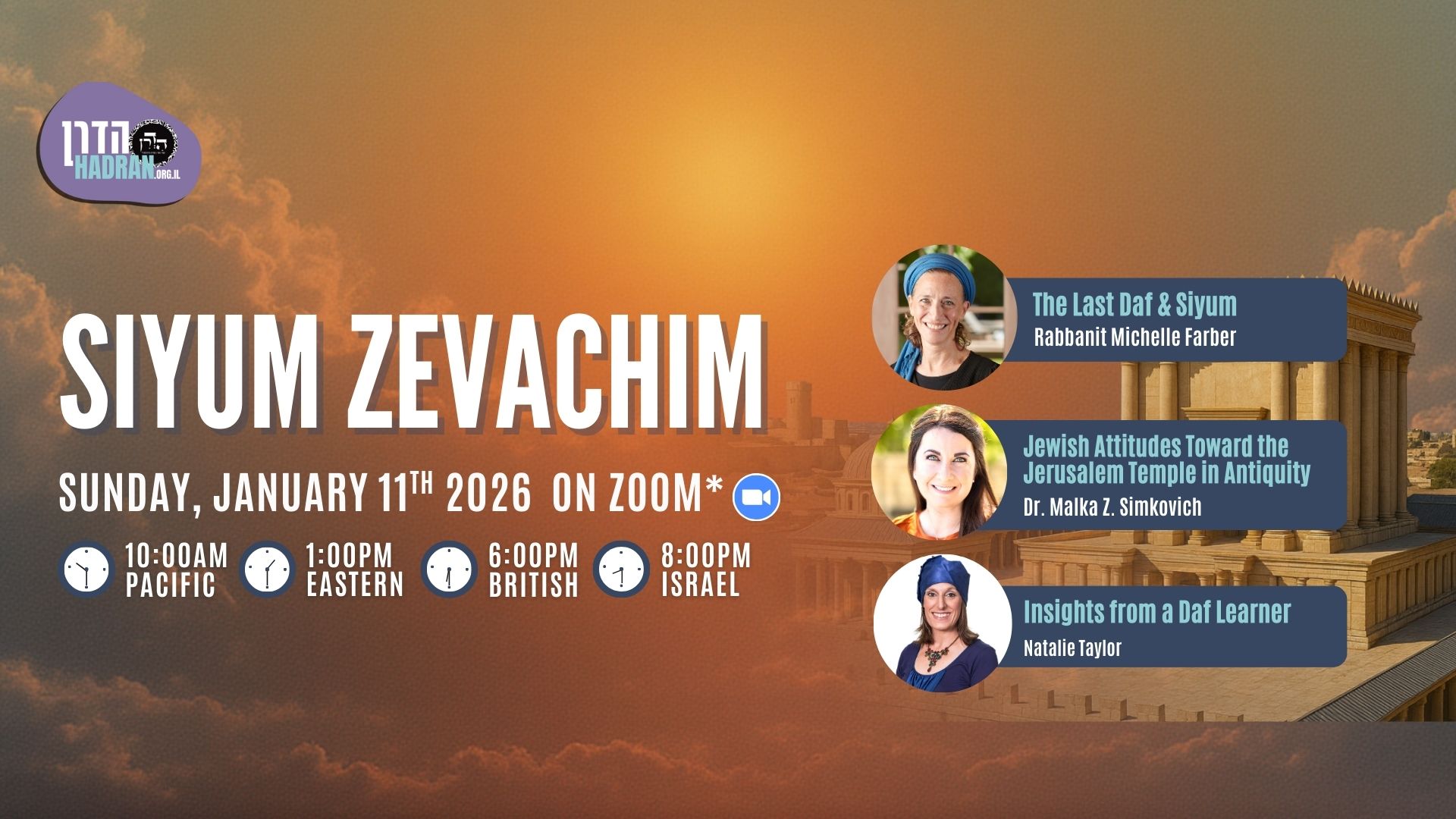
Jewish Attitudes Toward the Jerusalem Temple in Antiquity – Dr. Malka Z. Simkovich
Zevachim 120- Last Daf and Siyum By Rabbanit Michelle Farber
Zevachim Daf 115-120+ Siyum– Daf Yomi: One Week at a Time


Din & Daf: A Breakaway Mikdash in Egypt? Chazal’s take the Temple of Onias
New to Talmud?
Check out our resources designed to help you navigate a page of Talmud – and study at the pace, level and style that fits you.
The Hadran Women’s Tapestry
Meet the diverse women learning Gemara at Hadran and hear their stories.
Ive been learning Gmara since 5th grade and always loved it. Have always wanted to do Daf Yomi and now with Michelle Farber’s online classes it made it much easier to do! Really enjoying the experience thank you!!

Neve Daniel, Israel
When I was working and taking care of my children, learning was never on the list. Now that I have more time I have two different Gemora classes and the nach yomi as well as the mishna yomi daily.
Jerusalem, Israel
What a great experience to learn with Rabbanit Michelle Farber. I began with this cycle in January 2020 and have been comforted by the consistency and energy of this process throughout the isolation period of Covid. Week by week, I feel like I am exploring a treasure chest with sparkling gems and puzzling antiquities. The hunt is exhilarating.
Pennsylvania, United States
I began my Daf Yomi journey on January 5, 2020. I had never learned Talmud before. Initially it struck me as a bunch of inane and arcane details with mind bending logic. I am now smitten. Rabbanit Farber brings the page to life and I am eager to learn with her every day!

Highland Park, United States
I started learning the daf during Covid. I’d always wanted to learn Talmud but that wasn’t an option for girls in the small town I grew up in and I struggled to help my younger kids with Hebrew homework let alone read a Hebrew text. I decided to start small by listening to the daf podcast on the way to work each morning. Then I joined the Long Island WhatsApp group. Now I go to the siyyums.

Long Island, United States
I began my journey two years ago at the beginning of this cycle of the daf yomi. It has been an incredible, challenging experience and has given me a new perspective of Torah Sh’baal Peh and the role it plays in our lives
Efrat, Israel
When the new cycle began, I thought, If not now, when? I’d just turned 72. I feel like a tourist on a tour bus passing astonishing scenery each day. Rabbanit Michelle is my beloved tour guide. When the cycle ends, I’ll be 80. I pray that I’ll have strength and mind to continue the journey to glimpse a little more. My grandchildren think having a daf-learning savta is cool!

Jerusalem, Israel
I started learning at the beginning of this Daf Yomi cycle because I heard a lot about the previous cycle coming to an end and thought it would be a good thing to start doing. My husband had already bought several of the Koren Talmud Bavli books and they were just sitting on the shelf, not being used, so here was an opportunity to start using them and find out exactly what was in them. Loving it!

Borehamwood, United Kingdom
I am a Reform rabbi and took Talmud courses in rabbinical school, but I knew there was so much more to learn. It felt inauthentic to serve as a rabbi without having read the entire Talmud, so when the opportunity arose to start Daf Yomi in 2020, I dove in! Thanks to Hadran, Daf Yomi has enriched my understanding of rabbinic Judaism and deepened my love of Jewish text & tradition. Todah rabbah!

California, United States
After being so inspired by the siyum shas two years ago, I began tentatively learning daf yomi, like Rabbanut Michelle kept saying – taking one daf at a time. I’m still taking it one daf at a time, one masechet at a time, but I’m loving it and am still so inspired by Rabbanit Michelle and the Hadran community, and yes – I am proud to be finishing Seder Mo’ed.

Bet Shemesh, Israel

Philadelphia, United States
I decided to learn one masechet, Brachot, but quickly fell in love and never stopped! It has been great, everyone is always asking how it’s going and chering me on, and my students are always making sure I did the day’s daf.
Memphis, Tennessee, United States
I started Daf during the pandemic. I listened to a number of podcasts by various Rebbeim until one day, I discovered Rabbanit Farbers podcast. Subsequently I joined the Hadran family in Eruvin. Not the easiest place to begin, Rabbanit Farber made it all understandable and fun. The online live group has bonded together and have really become a supportive, encouraging family.

Edmonton, Alberta, Canada

Phoenix, Arizona, United States
Studying has changed my life view on הלכה and יהדות and time. It has taught me bonudaries of the human nature and honesty of our sages in their discourse to try and build a nation of caring people .
Kfar Saba, Israel
In January 2020, my chevruta suggested that we “up our game. Let’s do Daf Yomi” – and she sent me the Hadran link. I lost my job (and went freelance), there was a pandemic, and I am still opening the podcast with my breakfast coffee, or after Shabbat with popcorn. My Aramaic is improving. I will need a new bookcase, though.
Atlanta, Georgia, United States
I started to listen to Michelle’s podcasts four years ago. The minute I started I was hooked. I’m so excited to learn the entire Talmud, and think I will continue always. I chose the quote “while a woman is engaged in conversation she also holds the spindle”. (Megillah 14b). It reminds me of all of the amazing women I learn with every day who multi-task, think ahead and accomplish so much.

Zichron Yakov, Israel
I started last year after completing the Pesach Sugiyot class. Masechet Yoma might seem like a difficult set of topics, but for me made Yom Kippur and the Beit HaMikdash come alive. Liturgy I’d always had trouble connecting with took on new meaning as I gained a sense of real people moving through specific spaces in particular ways. It was the perfect introduction; I am so grateful for Hadran!

Minnesota, United States
I started learning at the beginning of the cycle after a friend persuaded me that it would be right up my alley. I was lucky enough to learn at Rabbanit Michelle’s house before it started on zoom and it was quickly part of my daily routine. I find it so important to see for myself where halachot were derived, where stories were told and to get more insight into how the Rabbis interacted.

Ra’anana, Israel
I was inspired to start learning after attending the 2020 siyum in Binyanei Hauma. It has been a great experience for me. It’s amazing to see the origins of stories I’ve heard and rituals I’ve participated in my whole life. Even when I don’t understand the daf itself, I believe that the commitment to learning every day is valuable and has multiple benefits. And there will be another daf tomorrow!

Jerusalem, Israel
Zevachim 120
שֶׁהִכְנִיסָהּ לִפְנִים וְהוֹצִיאָהּ לַחוּץ – מַהוּ? מִי אָמְרִינַן: כֵּיוָן דַּעֲיַילָא – קָלְטָה לַהּ מְחִיצְתָּא; אוֹ דִלְמָא, כֵּיוָן דַּהֲדַר – הֲדַר?
that one brought inside and subsequently took outside, what is the halakha? Does it have the status of a sacrificial item of a public altar? The Gemara clarifies the question: Do we say that once it was brought in the partition has already absorbed it, and all halakhot of sacrificial items of a public altar apply; or perhaps once it returns, i.e., was taken outside again, it returns to its prior status as an offering of a private altar?
לָאו הַיְינוּ פְּלוּגְתָּא דְּרַבָּה וְרַב יוֹסֵף? דִּתְנַן: קׇדְשֵׁי קָדָשִׁים שֶׁשְּׁחָטָן בַּדָּרוֹם – מוֹעֲלִין בָּהֶן, וְאִם עָלוּ לֹא יֵרְדוּ.
The Gemara asks: Isn’t this issue a disagreement between Rabba and Rav Yosef? As we learned in a mishna (Me’ila 2a): With regard to offerings of the most sacred order, e.g., a sin offering or a guilt offering, that were slaughtered in the south of the Temple courtyard, and not in the north as dictated by halakha, and are therefore disqualified, one who derives benefit from them is liable for misuse of consecrated property, and despite the fact that they should not ascend the altar, if they ascended they shall not descend.
וְאִיבַּעְיָא לְהוּ: יָרְדוּ, מַהוּ שֶׁיַּעֲלוּ? רַבָּה אָמַר: לֹא יַעֲלוּ, וְרַב יוֹסֵף אָמַר: יַעֲלוּ.
And a dilemma was raised before the Sages: If they did descend the altar, what is the halakha with regard to ascending again? Rabba says: They shall not ascend, and Rav Yosef says: They shall ascend. Consequently, they disagree with regard to the issue of whether an item that is not fit to be sacrificed in a consecrated area acquires the sanctity of that area even if it is removed from there.
תִּיבְּעֵי לְרַבָּה, תִּיבְּעֵי לְרַב יוֹסֵף. תִּיבְּעֵי לְרַבָּה: עַד כָּאן לָא קָאָמַר רַבָּה – אֶלָּא בְּמִזְבֵּחַ; דַּחֲזֵי לֵיהּ מְקַדֵּשׁ, דְּלָא חֲזֵי לָא מְקַדֵּשׁ; אֲבָל מְחִיצָה, אַף עַל גַּב דְּלָא חֲזֵי לַיהּ – קָלְטָה.
The Gemara responds: The disagreements are not identical, as the dilemma can be raised according to the opinion of Rabba, and the dilemma can be raised according to the opinion of Rav Yosef. The Gemara elaborates: It is possible to raise the dilemma according to the opinion of Rabba, as Rabba says his statement: Offerings of the most sacred order that were slaughtered in the south shall not descend if they ascended, only with regard to the altar, as the altar consecrates that which is fit for it, while it does not consecrate that which is not fit for it. But with regard to the partition of the public altar, even though an offering that was consecrated for a private altar is not fit for that altar, the partition nevertheless absorbs the offering and it is sacrificed there. Consequently, all the halakhot of the public altar apply to that offering, even if it is taken outside.
אוֹ דִלְמָא, אֲפִילּוּ לְרַב יוֹסֵף – עַד כָּאן לָא קָאָמַר רַב יוֹסֵף הָתָם, אֶלָּא דְּחַד מָקוֹם הוּא; אֲבָל הָכָא, דִּתְרֵי מְקוֹמוֹת נִינְהוּ – לָא. אוֹ דִלְמָא לָא שְׁנָא? תֵּיקוּ.
Or perhaps the dilemma of the burnt offering of a private altar can be raised even according to the opinion of Rav Yosef. Rav Yosef states his opinion there, that offerings of the most sacred order that were slaughtered in the south of the Temple courtyard and descended the altar shall ascend again, only because the altar and the offering are both located in one place, i.e., the Temple courtyard. But here in Rabbi Zeira’s case, where the private altar and public altar are two separate places, the halakhot of the public altar do not apply if the offering was taken outside the designated location. Or perhaps there is no difference, and the opinions of Rabba and Rav Yosef in one case are identical to their opinions in the other. The Gemara concludes: The dilemma shall stand unresolved.
מִילְּתָא דִּפְשִׁיטָא לֵיהּ לְרַבָּה בְּחַד גִּיסָא, וּלְרַב יוֹסֵף בְּחַד גִּיסָא – מִיבְּעֵי לֵיהּ לְרַבִּי יַנַּאי. דְּבָעֵי רַבִּי יַנַּאי: אֵבְרֵי עוֹלַת בָּמַת יָחִיד, שֶׁעָלוּ לַמִּזְבֵּחַ וְיָרְדוּ – מַהוּ? הֵיכָא דְּלֹא מָשְׁלָה בָּהֶן הָאוּר – לָא תִּיבְּעֵי לָךְ; כִּי תִּיבְּעֵי לָךְ – הֵיכָא דְּמָשְׁלָה בָּהֶן הָאוּר. מַאי? תֵּיקוּ.
The Gemara notes that a matter that is obvious to Rabba on one side, i.e., that these offerings shall not ascend the altar again, and to Rav Yosef on the other side, i.e., that they shall ascend again, was raised as a dilemma by Rabbi Yannai. As Rabbi Yannai raises a dilemma: What is the halakha with regard to the limbs of a burnt offering of a private altar that ascended the altar and descended? The Gemara notes: In a case where the fire has not yet taken hold of them, do not raise the dilemma, as they certainly shall not ascend again. When should you raise the dilemma? Raise it in a case where the fire has taken hold of them: What is the halakha? The Gemara concludes: The dilemma shall stand unresolved.
אִיתְּמַר: שְׁחִיטַת לַיְלָה בְּבָמַת יָחִיד – רַב וּשְׁמוּאֵל; חַד אָמַר: כְּשֵׁרָה, וְחַד אָמַר: פְּסוּלָה. וְקָא מִיפַּלְגִי בִּדְרַבִּי אֶלְעָזָר;
§ Additionally, with regard to a private altar it was stated: With regard to the slaughter of offerings at night on a private altar, Rav and Shmuel disagree: One says that it is valid, and one says that it is not valid. The Gemara explains: And they disagree with regard to the resolution to a contradiction that was raised by Rabbi Elazar.
דְּרַבִּי אֶלְעָזָר רָמֵי קְרָאֵי אַהֲדָדֵי – כְּתִיב: ״וַיֹּאמֶר בְּגַדְתֶּם גֹּלּוּ אֵלַי הַיּוֹם אֶבֶן גְּדוֹלָה״,
As Rabbi Elazar raised a contradiction between two verses: It is written in the context of Saul’s war with the Philistines: “And the people flew upon the spoil and took sheep and cattle and calves and slew them on the ground; and the people ate them with the blood. Then they told Saul, saying: ‘Behold, the people sin against the Lord in that they eat with the blood. And he said: You have dealt treacherously; roll a great stone to me this day” (I Samuel 14:32–33). That stone was made into a private altar upon which offerings could be slaughtered and sacrificed. Evidently, Saul was particular about slaughtering offerings during the day and not at night, despite the fact that it was a private altar and not a public altar.
וּכְתִיב: ״וַיֹּאמֶר שָׁאוּל פֻּצוּ בָעָם וַאֲמַרְתֶּם לָהֶם הַגִּישׁוּ אֵלַי אִישׁ שׁוֹרוֹ וְאִישׁ שְׂיֵהוּ, וּשְׁחַטְתֶּם בָּזֶה וַאֲכַלְתֶּם, וְלֹא תֶחֶטְאוּ לַה׳ לֶאֱכוֹל עַל הַדָּם. וַיַּגִּשׁוּ כׇל הָעָם אִישׁ שׁוֹרוֹ בְיָדוֹ הַלַּיְלָה, וַיִּשְׁחֲטוּ שָׁם״.
And immediately thereafter it is written: “And Saul said: Disperse yourselves among the people and say to them: Bring me here every man his ox and every man his sheep, and slay them here and eat and sin not against the Lord in eating with the blood. And all the people brought every man his ox with him that night, and slew them there” (I Samuel 14:34). This verse states explicitly that the slaughter took place at night and not during the day.
מָר מְשַׁנֵּי: כָּאן בְּחוּלִּין, כָּאן בְּקָדָשִׁים. וּמַר מְשַׁנֵּי: כָּאן בְּקׇדְשֵׁי בָּמָה גְּדוֹלָה, כָּאן בְּקׇדְשֵׁי בָּמָה קְטַנָּה.
Rav and Shmuel disagree with regard to the resolution of this contradiction: One Sage answers that here, i.e., when the slaughter took place at night, it was of non-sacred animals, while there, i.e., when Saul was particular about slaughtering during the day, it was the slaughter of sacrificial animals. According to this opinion, the sacrificial service was performed only during the day, even on a private altar. And the other Sage answers that both verses are referring to the slaughter of offerings: Here, in the verse that states that Saul was particular about slaughtering during the day, it is referring to the sacrificial animals of a great public altar, while there, in the verse that states that the slaughter took place at night, it is referring to sacrificial animals of a small private altar.
אִיתְּמַר: עוֹלַת בָּמַת יָחִיד – רַב אָמַר: אֵין טְעוּנָה הֶפְשֵׁט וְנִיתּוּחַ, וְרַבִּי יוֹחָנָן אָמַר: טְעוּנָה הֶפְשֵׁט וְנִיתּוּחַ. וְקָא מִיפַּלְגִי בִּדְרַבִּי יוֹסֵי הַגְּלִילִי – דְּתַנְיָא, רַבִּי יוֹסֵי הַגְּלִילִי אוֹמֵר: עוֹלָה שֶׁהִקְרִיבוּ יִשְׂרָאֵל בַּמִּדְבָּר – אֵין טְעוּנָה הֶפְשֵׁט וְנִיתּוּחַ; שֶׁאֵין הֶפְשֵׁט וְנִיתּוּחַ אֶלָּא מֵאֹהֶל מוֹעֵד וְאֵילָךְ.
§ It was stated that with regard to the burnt offering of a private altar, Rav says: It does not require flaying and cutting into pieces, which the Torah requires of a burnt offering (see Leviticus 1:6), and Rabbi Yoḥanan says: It does require flaying and cutting into pieces. The Gemara explains: And they disagree with regard to the meaning of a statement of Rabbi Yosei HaGelili. As it is taught in a baraita that Rabbi Yosei HaGelili says: The burnt offering that the Jewish people sacrificed in the wilderness, i.e., at Mount Sinai before the establishment of the Tabernacle, did not require flaying and cutting into pieces, because the requirement of flaying and cutting into pieces applied only from the Tent of Meeting and onward, as this halakha was first taught in the Tent of Meeting.
מָר סָבַר: מֵאֹהֶל מוֹעֵד וְאֵילָךְ – לָא שְׁנָא בָּמָה גְּדוֹלָה, וְלָא שְׁנָא בָּמָה קְטַנָּה. וּמָר סָבַר: בְּבָמָה גְּדוֹלָה אִין, בְּבָמָה קְטַנָּה לָא.
One Sage, Rabbi Yoḥanan, holds that from the Tent of Meeting and onward there is a requirement of flaying and cutting into pieces, and there is no difference whether the offering is brought upon a great public altar, and there is no difference whether it is brought upon a small private altar. And one Sage, Rav, holds that with regard to a great public altar, yes, flaying and cutting are required, but with regard to a small private altar they are not.
תַּנְיָא כְּוָתֵיהּ דְּרַבִּי יוֹחָנָן: דְּבָרִים שֶׁבֵּין בָּמָה גְּדוֹלָה לְבָמָה קְטַנָּה – קֶרֶן וְכֶבֶשׁ וִיסוֹד וְרִיבּוּעַ בְּבָמָה גְּדוֹלָה, וְאֵין קֶרֶן וִיסוֹד וְכֶבֶשׁ וְרִיבּוּעַ בְּבָמָה קְטַנָּה. כִּיּוֹר וְכַנּוֹ בְּבָמָה גְּדוֹלָה, וְאֵין כִּיּוֹר וְכַנּוֹ בְּבָמָה קְטַנָּה. חָזֶה וָשׁוֹק בְּבָמָה גְּדוֹלָה, וְאֵין חָזֶה וָשׁוֹק בְּבָמָה קְטַנָּה.
It is taught in a baraita in accordance with the opinion of Rabbi Yoḥanan: What are the matters that are different between a great public altar and a small private altar? The corner of the altar, the ramp, the base of the altar, and the square shape are required in a great public altar, but the corner, the base, the ramp, and the square shape are not required in a small private altar. The Basin and its base are required in a great public altar, but the Basin and its base are not required in a small private altar. The breast and thigh of a peace offering, which are given to a priest, are waved at a great public altar, but the breast and thigh are not waved at a small private altar.
דְּבָרִים שֶׁשָּׁוְותָה בָּמָה גְּדוֹלָה לְבָמָה קְטַנָּה: שְׁחִיטָה בְּבָמָה גְּדוֹלָה וּקְטַנָּה, הֶפְשֵׁט וְנִיתּוּחַ בִּגְדוֹלָה וּקְטַנָּה, דָּם מַתִּיר וּמְפַגֵּל בִּגְדוֹלָה וּקְטַנָּה, מוּמִין וּזְמַן בִּגְדוֹלָה וּקְטַנָּה.
And there are other matters in which a great public altar is identical to a small private altar: Slaughter is required at both a great public altar and a small private altar. Flaying a burnt offering and cutting it into pieces is required at both a great public altar and a small private altar. Sprinkling the blood permits the meat to be eaten, and if at that time the priest thought of eating or sacrificing this offering outside its appropriate time, this renders the offering piggul both at a great public altar and at a small private altar. Likewise, the halakha that blemishes disqualify an offering and the halakha that there is a limited time for eating offerings are in effect at both a great public altar and a small private altar.
אֲבָל נוֹתָר וְהַזְּמַן וְהַטָּמֵא – שָׁוִין בָּזֶה וּבָזֶה.
§ Following the detailing of the differences between a communal altar and a private altar, the mishna teaches: But the halakha that portions of the offering left over [notar] beyond the time it is permitted must be burned and that one who eats them incurs karet, and the halakha that intent to sacrifice or partake of the offering beyond its designated time renders the offering piggul, and the prohibition against performing the sacrificial service or eating consecrated meat while ritually impure are equal in this, i.e., a private altar, and that, i.e., a public altar.
תָּנוּ רַבָּנַן: מִנַּיִן לַעֲשׂוֹת זְמַן בְּבָמָה קְטַנָּה כְּבָמָה גְּדוֹלָה? אָמְרָה תּוֹרָה: לָן יִשָּׂרֵף, וּפִיגּוּל יִשָּׂרֵף; מָה פִּיגּוּל – פָּסוּל בְּבָמָה, אַף לָן – פָּסוּל בְּבָמָה.
With regard to this the Sages taught in a baraita: From where is it derived that time, i.e., the halakha that an offering left over beyond its designated time is disqualified, in the case of a small private altar should be made equivalent to the halakha in the case of a great public altar? The Torah stated: An offering that was left overnight must be burned, and likewise the Torah stated that an offering that was sacrificed with the intent to consume it after its designated time [piggul] must be burned. Therefore, another parallel may be drawn between them: Just as piggul is disqualified in the case of a private altar, so too, an offering that was left overnight is disqualified in the case of a private altar.
אוֹ כְּלָךְ לְדֶרֶךְ זוֹ – דְּהָא אָמְרָה תּוֹרָה: לָן יִשָּׂרֵף, וְיוֹצֵא יִשָּׂרֵף; מָה יוֹצֵא – כָּשֵׁר בְּבָמָה, אַף לָן – כָּשֵׁר בְּבָמָה. וְלָאו קַל וָחוֹמֶר הוּא מֵעוֹפוֹת:
Or go this way, and say that because the Torah stated: An offering that was left overnight must be burned, and likewise, the Torah stated that an offering that leaves the Temple courtyard must be burned, the following conclusion may be drawn: Just as an offering that leaves the Temple courtyard is valid in the case of a private altar because it has no set perimeter, so too, an offering that was left overnight is valid in the case of a private altar, and it may therefore be concluded that the halakha of time does not apply to offerings on a private altar. The Gemara asks: And is it not an a fortiori inference from the halakha of bird offerings that in the case of a private altar, time should render an offering disqualified?
מָה עוֹפוֹת, שֶׁאֵין הַמּוּם פּוֹסֵל בָּהֶן – זְמַן פּוֹסֵל בָּהֶן; קׇדְשֵׁי בָּמָה קְטַנָּה, שֶׁהַמּוּם פּוֹסֵל בָּהֶן – אֵינוֹ דִּין שֶׁזְּמַן פּוֹסֵל בָּהֶן?!
If bird offerings, whose halakhot are more lenient in that a blemish does not disqualify them, are nevertheless disqualified by time, then with regard to sacrificial animals of a small private altar, which are disqualified by a blemish, is it not logical that they should be disqualified by time?
מָה לְעוֹפוֹת – שֶׁכֵּן אֵין הַזָּר כָּשֵׁר בָּהֶן; תֹּאמַר בְּבָמָה קְטַנָּה, שֶׁהַזָּר כָּשֵׁר בָּהּ – לֹא יְהֵא זְמַן פָּסוּל בָּהּ?! תַּלְמוּד לוֹמַר: ״וְזֹאת תּוֹרַת זֶבַח הַשְּׁלָמִים״ – לַעֲשׂוֹת זְמַן בָּמָה קְטַנָּה כִּזְמַן בָּמָה גְּדוֹלָה.
The Gemara questions the inference: What is notable about bird offerings? They are notable in that a non-priest is not fit to sacrifice them. Shall you say the same with regard to offerings sacrificed on a small private altar, where a non-priest is fit? No, and consequently they should not be disqualified by time. Therefore, the verse states: “And this is the law of the sacrifice of peace offerings” (Leviticus 7:11), which equates all peace offerings, to render the halakha of time with regard to a small private altar identical to the halakha of time with regard to a great public altar.
הֲדַרַן עֲלָךְ פָּרַת חַטָּאת, וּסְלִיקָא לַהּ מַסֶּכֶת זְבָחִים

