No one’s closet in ancient Judea was more splendid than that of the Kohen Gadol, the High Priest. His clothes were prescribed by the Torah (Shemot 39) and imbued with religious significance (see here). Their beauty was enhanced by gold and gems but the main impression was of the colors, and the main color was a lovely blue called techelet:
“The Sages taught: The robe of the High Priest was sewn entirely of sky-blue wool (techelet), as it is stated: “And he made the robe of the ephod of woven work, all of sky-blue wool” (Shmot 39:22).” (Zevachim 88b)
Other parts of the priestly garments were also attached with techelet dyed string (Shmot 39:21, 31). The vessels of the Tabernacle were covered with techelet colored cloths when they were moved from place to place:
“Then they shall take a techelet cloth and cover the menorah for lighting, with its lamps, its tongs, and its fire pans, as well as all the oil vessels that are used in its service.” (Bamidbar 4:9)
Of all the colors in ancient times, purple and blue were the most associated with royalty. We hear this in the expressions “royal blue” and “born to the purple,” as well as in Tanakh. The beloved in the Song of Songs, who is a king (or God, depending on your interpretation) is described as driving in a chariot of argaman, purple. Not only purple dye, but the purple stone, porphyry, was used by kings and queens. How were blue and purple dyes made and what is their significance in Judaism?
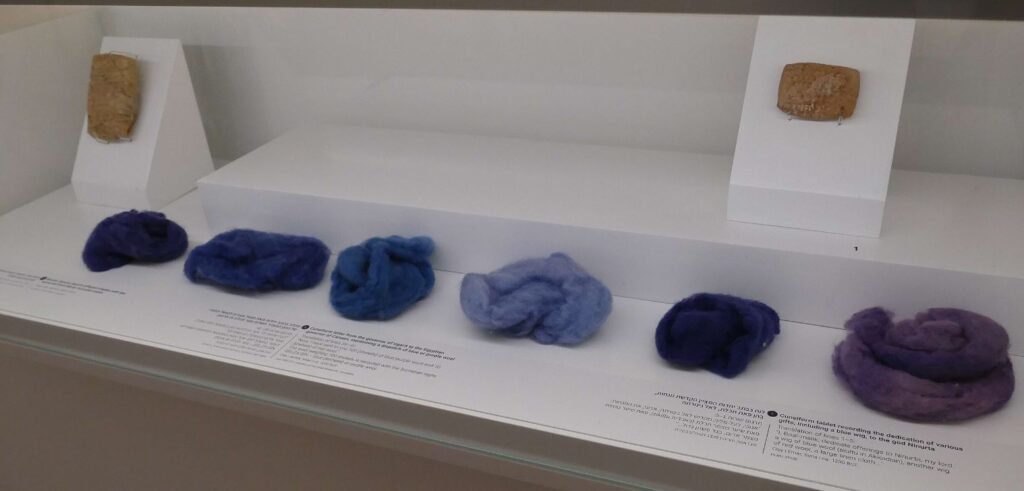
Bukvoed, CC BY 4.0 <https://creativecommons.org/licenses/by/4.0>, via Wikimedia Commons
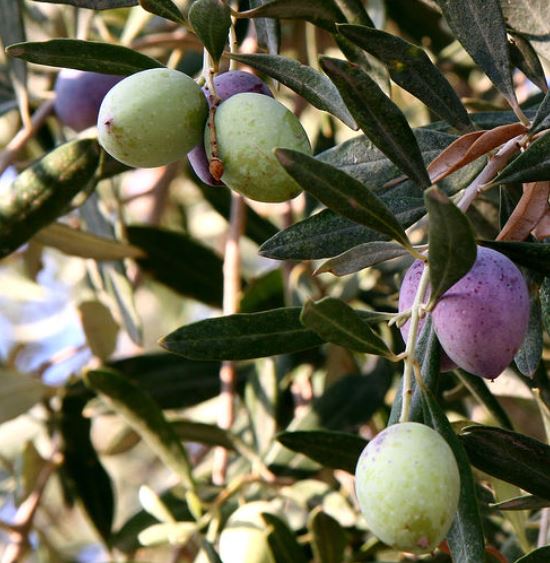
Purple was often called Tyrian purple because the masters of this dyeing technique in our area were the Phonecians, from Tyre. The Greek name Phonecia means land of the purple. The Tyrians harvested snails that lived in the Mediterranean, called Murex snails, or hilazon in Hebrew, and extracted the color from mucus in their glands. Because you needed many snails to make even a small amount of dye Tyrian purple was very expensive. Expensive equals status symbol equals royalty and wealthy people and purple became the royal color.
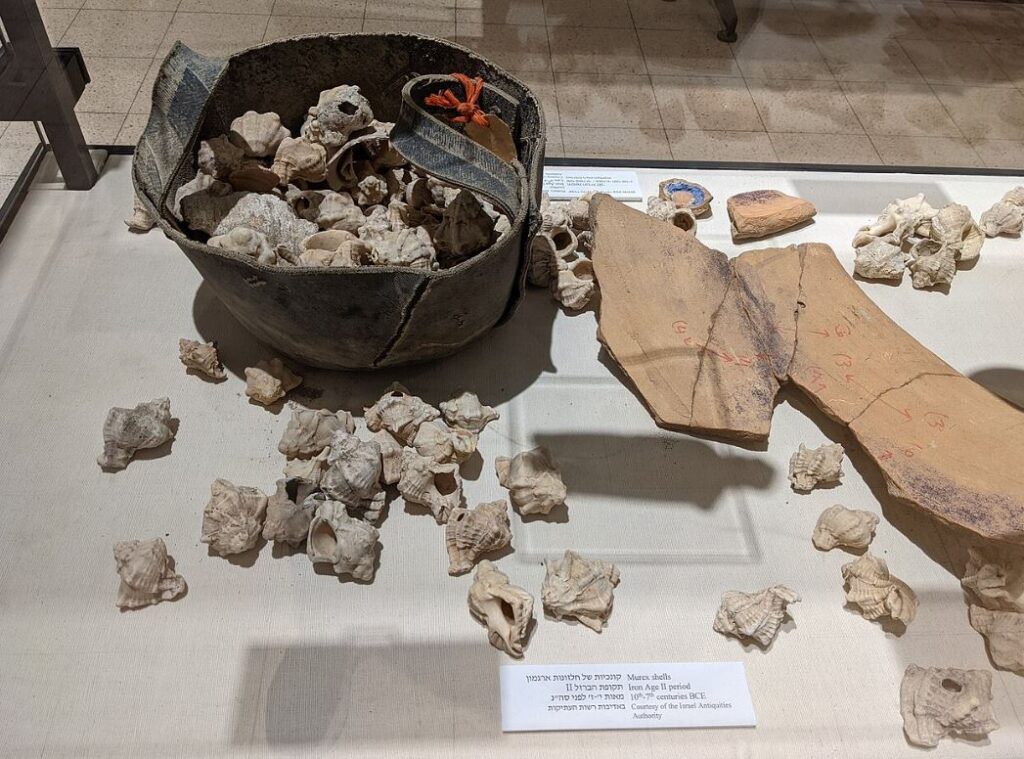
Murex snail shells from Biblical times, with traces of purple dye on the pottery
Aaadir, CC0, via Wikimedia Commons
Jews were aware of this royal pigment as well. We have items colored argaman, purple, in the Tabernacle and later in the Temple, as well as in the robes of the high priest. But the elusive color was not the argaman but the techelet. Besides being used for the priestly garments and vessels, techelet is needed for the tzitzit, the ritual fringes that are meant to be worn on any four cornered garment. The Torah commands that there be a ptil techelet, one blue string, among the white ones.
“Speak to the Israelite people and instruct them to make for themselves fringes on the corners of their garments throughout the ages; let them attach a cord of blue to the fringe at each corner.” (Bamidbar 15:38)
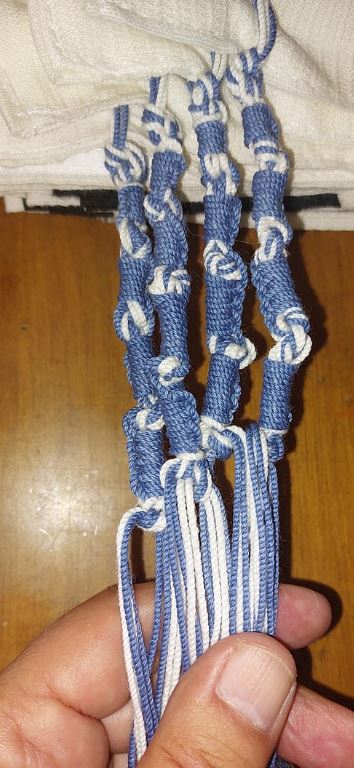
Rhecht, CC BY-SA 4.0 <https://creativecommons.org/licenses/by-sa/4.0>, via Wikimedia Commons
Rashi explains that this is the blue green that comes from the hilazon. While the Torah only relates the commandment, the Gemara provides us with an explanation of the special quality of the techelet color:
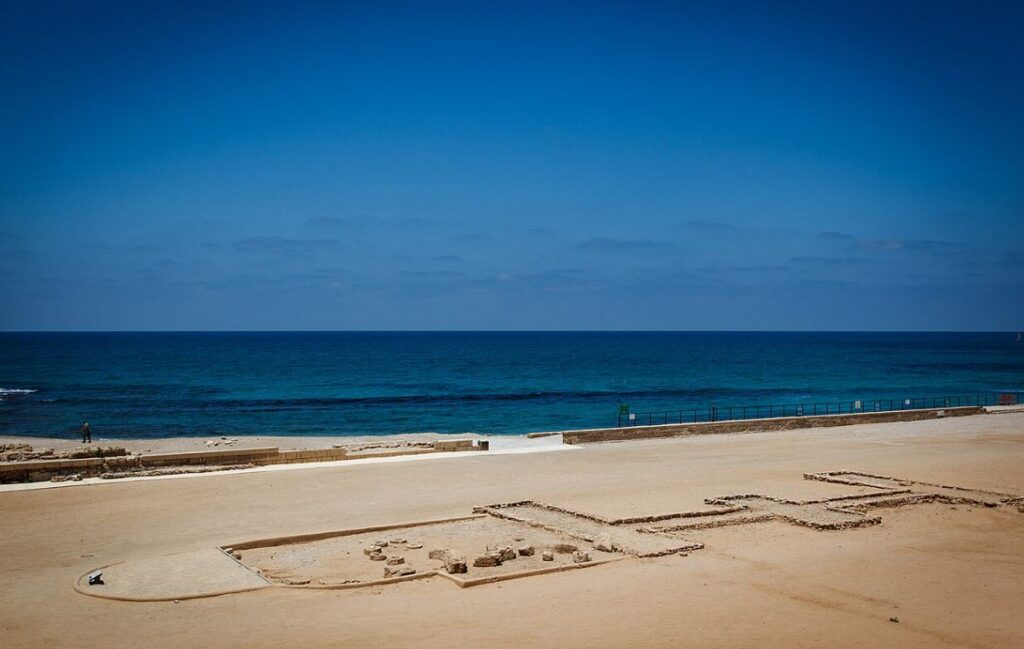
“Rabbi Meir would say: What is different about sky-blue from all other colors? It is because sky-blue dye is similar in its color to the sea, and the sea is similar to the sky, and the sky is similar to the Throne of Glory, as it is stated: ‘And they saw the God of Israel; and there was under His feet the like of a paved work of sapphire stone, and the like of the very heaven for clearness’ (Exodus 24:10).” (Sotah 17b)
Rabbi Meir’s message seems to imply that the techelet helps to remind us of God’s presence in our daily lives. A variation of his statement in the Yerushalmi makes an even stronger point – wearing tzitzit is akin to receiving God’s presence:
“We have stated in the name of Rebbi Meïr: It does not say “you shall see it” but “you shall see Him”. This tells you that anyone who keeps the obligation of tzitzit is as if he were admitted to the presence of God’s glory.” (Yerushalmi Berachot 1:2)
Ruby1619, CC BY-SA 3.0 https://creativecommons.org/licenses/by-sa/3.0, via Wikimedia Commons
Making and procuring techelet was complicated. The Talmud discusses a different dye, called kala ilan, which is a “fake” techelet. It is not legitimate for use in the tzizit. (Although Karaites only require a dyed blue thread, regardless of the origin of the dye.) The two colors are very similar and there is a discussion in Menachot 43 about how to test “true” techelet. But ultimately, the only one who could really know if the tzitzit had kosher techelet was God:
“Rava says: Why do I need the mention of the exodus from Egypt with regard to ritual fringes (see Numbers 15:39–41) . . . And [I am also He Who is destined to exact punishment] from one who hangs ritual fringes dyed with indigo [kala ilan] dye on his garment and says it is dyed with the sky-blue dye (techelet)” (Bava Metzia 61b)
When the Jews went into exile, the technique of making techelet was forgotten. In modern times there were attempts to rediscover it. The Radzhiner Rebbe and Rabbi Yitzchak Halevi Herzog suggested various candidates for the hilazon. Only in the last few decades has there been general agreement that the techelet is produced from the Murex snail and that the dye must have certain chemicals added to it and be exposed to sunlight to change from purple to the deep blue of techelet. An organization called Ptil Techelet is involved in making the strings as well as teaching about the rediscovery of techelet.
The beautiful blue makes an appearance not only in ritual objects. The Israeli flag was modeled on the tallit, with techelet stripes and a techelet Star of David. If you have ever been to the old city of Tzfat, everywhere you look is blue. The idea is the same as the tzizit, to raise your eyes and your thoughts towards heaven.
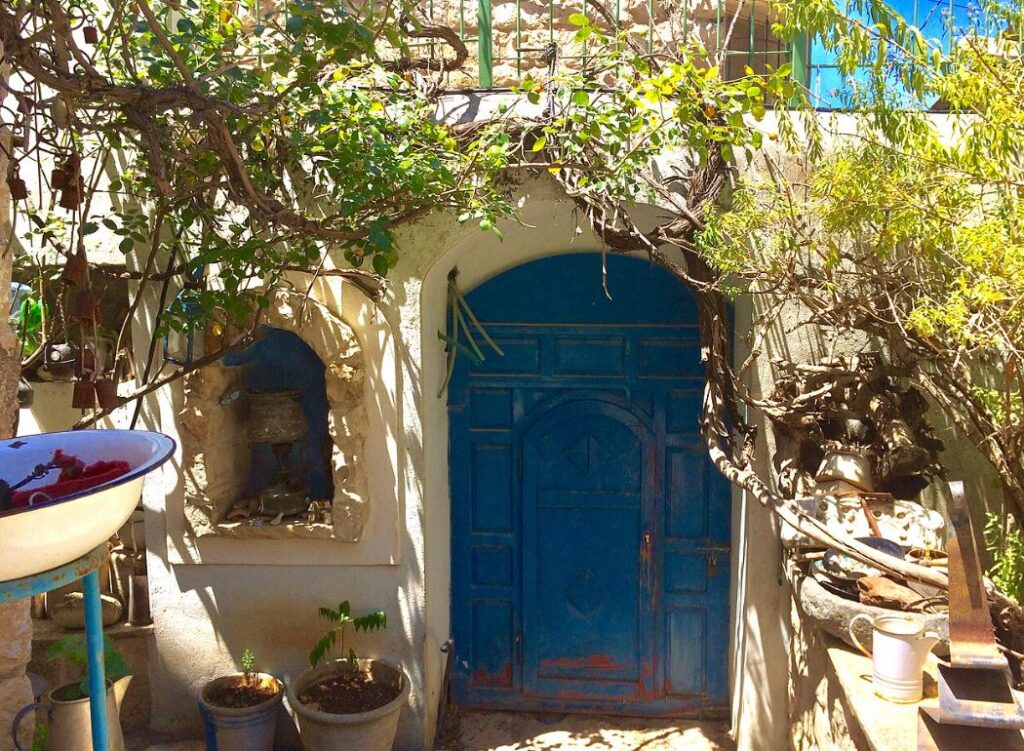
A doorway in Tzfat
Homerethegreat, CC BY-SA 4.0 <https://creativecommons.org/licenses/by-sa/4.0>, via Wikimedia Commons
Color can be a tool not only for art but also for spirituality.