
This week’s daf yomi discusses the traditional understanding of the term ממחרת השבת for beginning sefirat ha-omer not as Sunday, but as the second day of Pesach. In this shiur, we will examine logical justifications for this understanding, each of which shed light on the various themes of both Pesach and Shavuot.
Menachot 65
Questions? Comments? Email dinanddaf@gmail.com
- ויקרא כג:ט״ו
וּסְפַרְתֶּם לָכֶם מִמׇּחֳרַת הַשַּׁבָּת מִיּוֹם הֲבִיאֲכֶם אֶת עֹמֶר הַתְּנוּפָה שֶׁבַע שַׁבָּתוֹת תְּמִימֹת תִּהְיֶינָה.
And you shall count for yourselves on the day after “the rest day,” from the day on which you bring the omer offering – it shall be 7 full weeks (of counting).
- מנחות סה:
רַבִּי אֱלִיעֶזֶר אוֹמֵר: אֵינוֹ צָרִיךְ, הֲרֵי הוּא אוֹמֵר: ״תִּסְפׇּר לָךְ״, סְפִירָה תְּלוּיָה בְּבֵית דִּין, שֶׁהֵם יוֹדְעִים לְחַדֵּשׁ. ״מִמָּחֳרַת הַשַּׁבָּת״ – מָחֳרַת יוֹם טוֹב, יָצָאת שַׁבַּת בְּרֵאשִׁית שֶׁסְּפִירָתָהּ בְּכׇל אָדָם…
Rabbi Eliezer says: The previous proof is not necessary, as the verse states: “Seven weeks you shall count for you; from the time the sickle is first put to the standing grain you shall begin to number seven weeks” (Deuteronomy 16:9). The term “for you (in singular rather than plural)” indicates that the counting of the weeks is dependent upon the decision of the court, as they know how to calculate the new months, upon which the date of the Festival depends. Therefore, when the verse states: “The morrow after the day of rest [hashabbat]” (Leviticus 23:16), it means: The morrow after the Festival (i.e., the second day of Pesach), as the determination of Festivals is by the court. This serves to exclude the interpretation that the counting starts after the Shabbat of Creation, i.e., a regular weekly Shabbat, whose counting can be performed by every person, not exclusively by the court…
- פירושי רב דוד צבי הופמן על ויקרא כג:יא
ראב”ע סבור, שהנאמן למסורת יכול להשיב למתנגדים, שהפסח הראשון אחרי נתינת החוק חל אז דווקא בשבת…באופן דומה ניסה הרב מקלנבורג (הכתב והקבלה, כאן) להסביר את הביטוי “ממחרת השבת” מתוך הלוח של השנה הראשונה ליציאת מצרים, והוא חושב עוד, שיום ראשון של חג הפסח יכול להיקרא בשם “שבת”, משום שבני ישראל, שיצאו ממצרים, היו מחויבים להוציא את החמץ מבתיהם, מה שנקרא (בשמות יב טו): “השבתת שאור”. הירש משער קשר אל “שבת הארץ” (ויקרא כה ב), כיון שאסור היה לקצור לפני יום שני של פסח, היה עד אותו יום “שבת הארץ”, (ברם, היכן נקבע, מתי נגמרת שבת הארץ, אם השבת אין פירושה חג הפסח אלא שביתת הארץ?).
Ibn Ezra though that those loyal to tradition can respond to challengers: that the first Pesach after the law was given happened on Shabbat…Rav Mecklenburg similarly tried to explain mimacharat hashabbat based on the calendar of the first year of the exodus, and he further thinks that the first day of Pesach can be called shabbat because the Jews who left Egypt were obligated to remove the leaven from their homes, which is called: “destruction (hashbatat) of leaven.” [Rabbi Samson Raphael] Hirsch connects it to the rest of the land (Vayikra 25:2) – because it was prohibited to harvest (grain) before the second day of Pesach, that first day of Pesach is a resting of the land. (But where is it established when the resting of the land ends, if the term shabbat does not refer to Pesach but rather to the resting of the land?)
…
הרמב”ן אומר שאת “השבת” בפסוק יא אפשר לפרש גם במובן “שבוע” כלומר: הכתוב מצוה לראות את יום הנפת העומר כיום ראשון של שבוע ומאז לספור שבעה שבועות. לפי זה נקרא יום העומר “ממחרת השבת”, היינו “יום ראשון לשבוע אחד”, (אבל באופן כזה, לא היה ידוע, מתי צריך להניף את העומר. הרמב”ן חש, כנראה, בקושי זה, אך אינו מיישב אותו באופן משביע רצון)…
Ramban says that the word shabbat in verse 11 can also be understood as week, as if to say: Scripture commands us to see the day of the waving of the omer as the first day of the week[s that we will count] and from there to count 7 weeks. Therefore, the day of the omer is called the day after shabbat, i.e., the first day of the first week [of counting]. (But in this way, it would be unknown when it is necessary to wave the omer. Ramban seemed to notice this problem, but doesn’t resolve it satisfactorily)…
מנדלסון, שאף אחד מבין כל הביאורים אינם מניחים את דעתו, מתאמץ להוכיח, שפירושם של הקראים נתקל גם הוא בקשיים חזקים כאלה, ורואה עצמו נאלץ להתנחם בנחמה הקלושה: “שבקיה לקרא דדחיק ומוקי אנפשיה”.…
[Moses] Mendelssohn who is dissatisfied with all the explanations strains to explain that the Karaite interpretation also has major challenges, and he comforts himself with the weak comfort that it’s better to interpret the verse in a slightly challenging way than in a deeply challenging way.
יש לנו להניח בעקבות חכמינו, שהצווי “שבתון” במועדים, שבא בפעם הראשונה בראש השנה, בונה בנין אב לכל החגים בלא יוצא מן הכלל, (לפי משנת עדויות ב י, נקראים במיוחד פסח ושבועות בשם “שבת”). כך דרכה של תורה גם בסגנון הרבה מצוות אחרות.
We may presume – in the footsteps of our sages – that the command “shabbaton” on the festivals, which is first used regarding Rosh HaShanah, sets a precedent for all holidays without exception (per Eduyyot 2:10, Pesach and Shavuot are specifically called shabbat). This is the way of the Torah in many other mitzvot.
…
אין שום ספק, שכל המועדים שבהם חלה שביתה ממלאכה, הם בחינת שבת ברוח החוק, לפיכך נקראת שבת השבוע בפי חכמינו “שבת בראשית”, ובזה היא נבדלת משאר החגים, השוה נדרים עח: ורא”ש שם.
עם זה אין הימים הטובים נקראים על פי רוב “שבת”, אלא “חג” או “מועד”, ביטויים שמגדירים את הימים האלה לא לפי הציון האופייני של שביתת מלאכה, אלא לפי הציון האופייני של התקהלות עם במקום אחד והתעצמות השמחה לפני ה’ (השוה היטציג, פסח ושבועות (גרמנית) ב, עמ’ 9)…
There is no doubt that all of the holidays where which there is resting from labor, are a type of shabbat in the spirit of the law, and therefore the Shabbat of the week is called by our sages Shabbat Bereshit, and in this way it is distinguished from other holidays (compare Nedarim 78b and the comments of the Rosh there). At the same time, most holidays are not referred to as shabbat but rather as hag or moed, phrases that define these days not by the characterizing mark of resting from labor, but by the characterizing mark of communing of the nation in one place and the strengthening of joy before God (compare Hitzig, Pesach and Shavuot (German) 2, p9)…
…
ולכן לא היה בנמצא שם מתאים יותר לציון היום הששה עשר בניסן מאשר “ממחרת השבת”, הרי החג עוד לא נסתיים, אך ה”שבת” של החג כבר עבר ומתחיל חולו של החג או של המועד. ואין מקום לטעות, כאילו “השבת” לא היה מתכוון ליום הראשון של החג אלא ליום האחרון, שהרי היום האחרון מסיים את החג והיום המחרת שלו נקרא בוודאי כרגיל “מחרת החג”. ורק את יום טז בניסן קראו, כפי שאפשר לשער, “מחרת השבת”.
Therefore, there is no more fitting label for the 16th of Nissan than the day after “shabbat,” for the holiday has not yet ended, but the shabbat, i.e., resting part of the holiday has passed, and the mundane part of the hag or the moed has begun. And there is no room to mistake that “the shabbat” refers not to the first day of the holiday but to the last day, for the last day that ends the holiday, the day after would certainly be called “the day after the hag.” And only the 16th Nissan would be called the day after “shabbat.”
ומתקבל על הדעת, כי הכינוי “מחרת השבת” נבחר גם מטעמים מסויימים אחרים לסמן את יום הששה עשר בניסן. ביום זה היה צריך להתחיל ספירת שבעת השבועות, שהם מקבילים אל שבע שבתות השנים לפני היובל, כפי שהסברנו לעיל. שנים אלו מוקפות שתי שנות יובל, אחת מזה ואחת מזה, וכך יהיו מוקפים גם ימי שבעת השבועות – שני ימים מצויינים.
And it makes sense, as the label “after the shabbat” was chosen for other reasons as well to reference the 16th of Nissan. On this day, it is necessary to begin counting 7 weeks, which parallel the 7 X 7 years before the jubilee year, as we explained above. These years are surrounded by two jubilee years, one before the 49 years begin and one after the 49 years begin. And likewise, the 49 days (of counting the omer) are surrounded by two demarcated days (=Pesach and Shavuot)…
היום אחרי גמר שבעת השבועות הוא חל לעצמו, שכך הוא נראה בעיניו וכך הוא נקרא כבר בספר הברית (שמות כג טז).אולם היום שלפני “שבעת השבועות” הוא כשלעצמו איננו חג שלם, אלא ששת הימים הבאים אחריו משלימים אותו, אבל בתורת יום שבת הוא עצמאי…
The day after the 7 weeks stands alone, for so it looks in a person’s eyes, and so it is called in Shemot. But the day before the 7 weeks is not a full holiday on its own, but the six days that come afterwards fill it in, but as a shabbat (=a day of rest) it is independent…
…
שבת זו ויום החמשים המקודש מאצילים על שבעת השבועות של הקציר רוח של תקופה קדושה, (רב האי גאון דורש שיכבדו תקופה זו במיוחד גם בזה, שלא יעשו מלאכה משקיעת החמה עד אור הבוקר, השוה בית יוסף אורח חיים סימן תצג, השוה גם פירושו של רמב”ן לויקרא כג לו). ויום הראשון צויין בצדק כיום “שבת”, בזה הוא מובדל במהותו מיום הקרבת העומר, שהוא “מחרת השבת”. שניהם הינם באמת ימי חג, אך כיום מנוחה, כיום “שבת”, לא היה היום הראשון של החג מתאים להתחלת הקציר, ואם כן גם לא להקרבת העומר, ברם, לאחר שעבר יום המנוחה ובא היום הראשון של עבודה, היינו “מחרת השבת”, והקציר התחיל, יש להזדרז להביא עוד באותו יום את קרבן ה’ (השוה באכמן, שם, 118)…
This shabbat (=day of rest) and the 50th day which is consecrated ennoble the 7 weeks of harvest as a holy time (Rav Hai Gaon expounds that people should honor this time period in this way as well, that people now perform labor from sundown until daybreak; compare to Beit Yosef Orah Hayyim sima 493; compare also Ramban’s commentary to Vayikra 23:36). And the first day (of Pesach) is appropriately labeled as a day of rest, which distinguishes it from the day of offering the omer, which is the day after the rest day. They are both actually days of hag, but as a day of rest, a day of shabbat, the first day of the holiday would not have been appropriate for the beginning of the harvest, and therefore not for the offering of the omer either. But once the day of rest has past, and the first day of labor has started, i.e., the day after rest, and the harvest began, it is proper to rush to being an offering to God already on that day…
- ד”ר דוד הנשקה, “ממחרת השבת” – מבט חדש, מגדים יד, סיוון תשנ”א
pp. 16-17
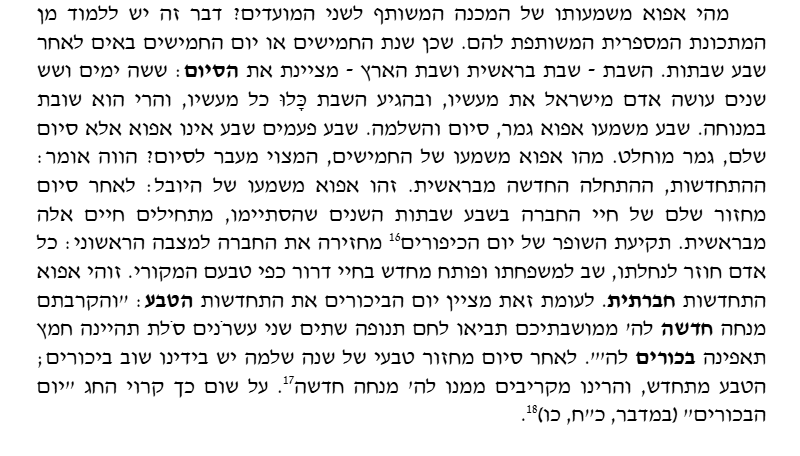
What is the meaning of the shared characteristic of the two holidays (i.e., Shavuot and Jubilee 50th year)? This can be learned from their shared numerological format. For both the 50th year (=Jubilee) and the 50th day (=Shavuot) come after 7 shabbatot. The shabbat – shabbat bereshit and the rest of the land – represents the completion: for 6 days and 6 years a Jewish person does their work, and when the Shabbat comes, their work ends, and they rest. 7 represents completion. 7 times 7 is a complete ending, absolute completion. What is the meaning of 50, however, that comes after the ending? Renewal, a new beginning from Bereshit. This is the meaning of the jubilee: after a full cycle of the life of society over the past 49 years, this life begins again from the beginning. The blowing of the shofar on Yom Kippur returns society to its original situation: everyone returns to their land, to their family, and begins again a life of liberty per their natural state. This is societal renewal. On the the other hand, the day of bikkurim (=Shavuot) represents the renewal of nature: “And you shall give a new offering to God; from your settlements you shall bring two breads of waving – 2 tenths of fine flour they shall be, they shall be baked as leaven, first produce to God.” After the end of the natural cycle of a full year, we have again first produce: nature renews, and we offer from it a new offering to God. Therefore the holiday is called the day of the bikkurim, first produce (Bamidbar 28:26).
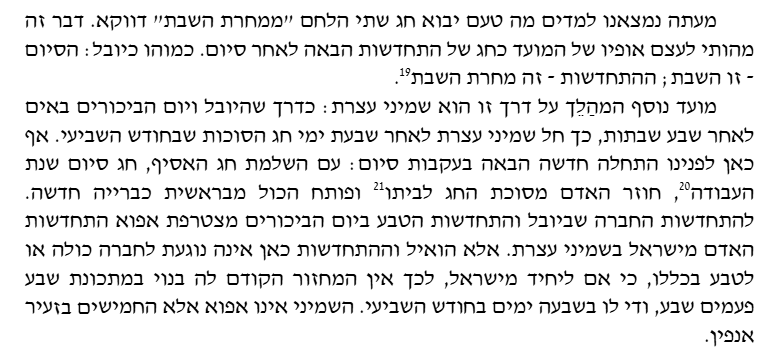
From here we learn why the holiday of the 2 loaves (=what we call Shavuot) specifically comes the day after the “shabbat.” This is essential to the character of the holiday as one of renewal that comes after completion. Likewise, the jubilee: the completion, which is shabbat, and then the renewal, which is “after the shabbat,”
Another holiday that follows this pattern is Shemini Atzeret: just as the jubilee and the day of bikkurim come after 7 shabbatot, likewise Shemini Atzeret comes after 7 days of Sukkot which is in the seventh month. Here too, is a renewal that follows completion: with the completion of the gathering festival, the festival of the completion of the year of work, a person returns from the sukkah of the holiday to their home, and begins everything from Bereshit as a new creature. To the renewal of society of the jubilee and the renewal of nature on Shavuot, is added the renewal of the Jewish person on Shemini Atzeret. But because the renewal is not of the whole society or all of nature, but for the Jewish individual, therefore, the cycle before it is not built using the format of 7 by 7, but rather it is enough for a person to have seven days in the seventh month. The eighth is a miniature version of 50.
Pps. 21-22

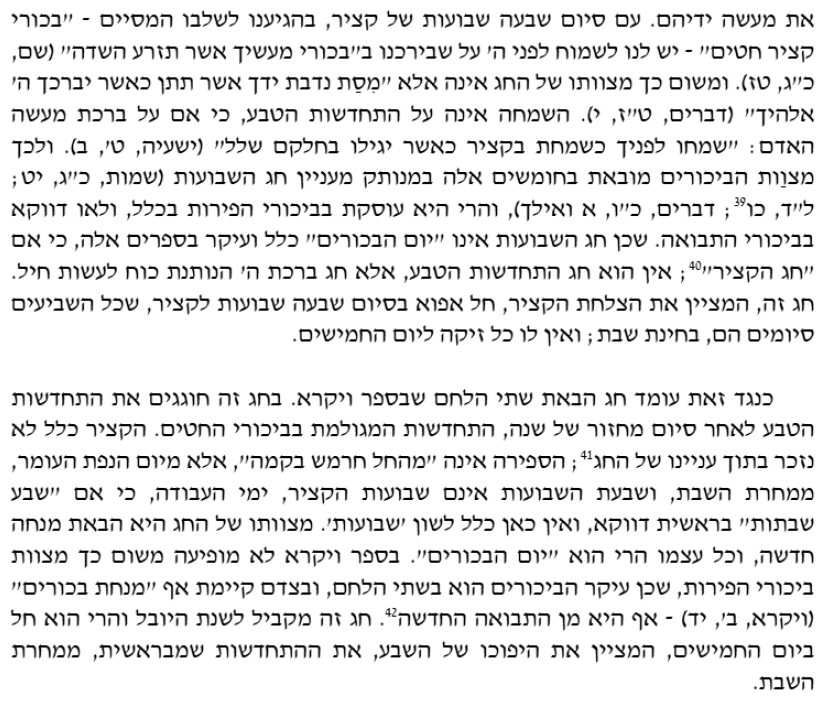
We will summarize: two different holidays are described in the Torah at the time of the beginning of the wheat harvest: in the Books of Shemot and Devarim, there is the Holiday of Harvest, where Israel celebrates before God for blessing their handiwork. With the end of the 7 weeks of harvest, when we reach the time that ends “the beginning of the wheat harvest’ – we should celebrate before God for blessing “the beginnings of your work that you sow in the field (Shemot 23:16).” And therefore the mitzvah of the holiday is only “offering your freewill contribution according as the ETERNAL your God has blessed you. (Devarim 16:10).” The joy is not about the renewal of nature, but the blessing of human handiwork: “They have rejoiced before You as they rejoice at reaping time, as they exult when dividing spoil (Yeshayahu 9:2).” And therefore the commandment of first produce brought in these Books is separate from the holiday of Shavuot. And it refers to the first fruits generally, not necessarily just the first grains. For the holiday of shavuot is not a day of first grains at all, but a holiday of harvest. It is not a holiday of the renewal of nature, but a holiday of God’s blessing which gives strength to accomplish. This holiday, which marks the success of the harvest, happens at the end of 7 weeks to the harvest, for all sevens are completion, like Shabbat. And it has no connection to the fiftieth day.
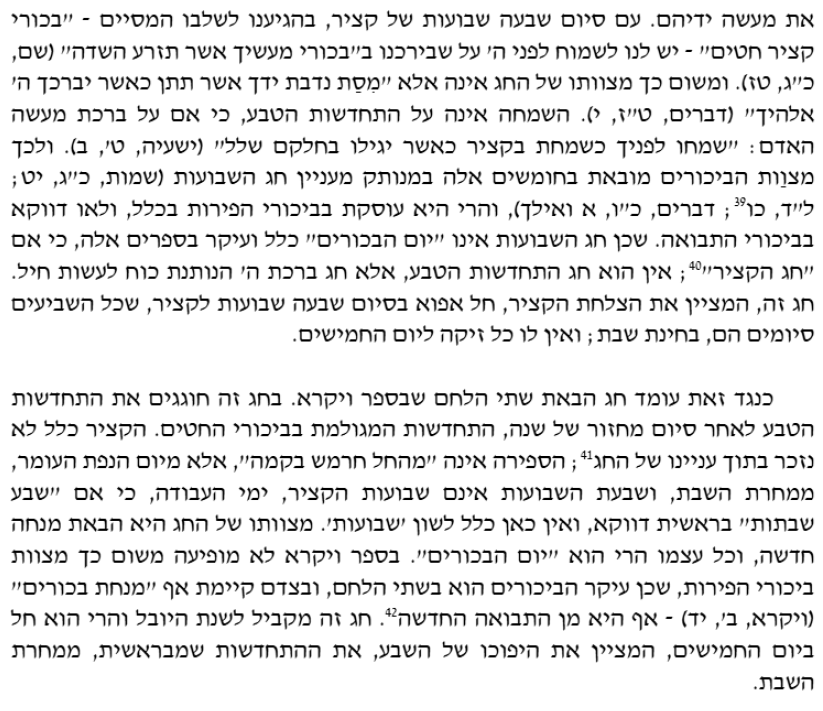
On the other hand, stands the day of the bringing of two loaves in the Book of Vayikra. On this holiday we celebrate the renewal of nature of after the completion of the annual cycle – a renewal that is embodied in the first wheat. The harvest is not mentions within the description of the holiday: the counting is not from when the sickle first hits the standing grain, but from the day of the waving of the omer, on the day after “shabbat.” And the 7 weeks are not weeks of harvest, days of labor, but rather specifically 7 shabbatot of Bereshit, and this is not the language of weeks. The commandment of the holiday is beginning a new offering, and the whole essence is a day of first produce. In the Book of Vayikra, therefore, no mitzvah of bringing first fruits is mentioned, for the first is the two loaves, and alongside there is also an offering of first – which is also from the new grain. This holiday is parallel to the Jubilee year, and therefore it happens on the fiftieth day, which references the opposite of 7, namely the renewal from Bereshit, the day after Shabbat.
- Michael Fishbane, PhD, Biblical Interpretation in Ancient Israel, pp. 149-150
The obvious question must now be posed:…why would a term indicating a heptad, or the Sabbath day, be applied to a mid-month festival?…All these problems are resolved once it is realized that the term Shabbat used in Lev. 23:16 actually preserves an ancient and precise terminology…The issue takes an entirely new turn in the light of evidence…that the (Akkadian term) Shappatu was used as a technical term for the full moon at mid-month…Comparatively viewed, this sequence strikingly clarifies the biblical parallelism Chodesh-Shabbat found in 2 Kgs. 4:23, Isa. 1:13, Amos 8:5, and Hos. 2:13. This latter must not, therefore, be assumed to mention the new moon and the Sabbath day, but rather to indicate two distinct lunar phases. The corollary juxtaposition of Chodesh-Kesseh means the same thing in Ps. 81:4 and Phoenician texts.