Much of the Oral Law is derived from deep reading and comparison of Torah verses. One of the most significant teachers of this method is the third generation Tanna, Rabbi Yishmael ben Elisha, who almost always appears just as Rabbi Yishmael. One of his methods of learning is displayed here in Menachot, where he uses the rule of klal uprat, general and specific, to understand which garments are required to have tzitzit:
“As a tanna of the school of Rabbi Yishmael taught: Since the word ‘garments’ is stated in the Torah without specification, and one verse specified garments made from wool or linen, so too, all [garments mentioned in the Torah are those made from] wool or linen.” (Menachot 39b)
In the rule of klal uprat according to Rabbi Yishmael, the general (klal) only includes what is specified in the prat (detail). Therefore, because one section of the Torah talks about garments made of wool or linen, all (generic) garments are also considered to be made of wool or linen.
Rabbi Yishmael’s rules, called the thirteen midot, or principles,,are well known not only to those who study Gemara. They are used by Rashi in his commentary on the Torah; the most well-known one is kal vachomer – a fortiori. These rules became even more well known when the Baraita of Rabbi Yishmael was added to the beginning of morning prayers,:
“R. Yishmael says: The Torah is expounded by thirteen hermeneutical principles. . .” (introduction to Sifra)
Rabbi Yishmael’s contemporary, Rabbi Akiva was his friend and also his sparring partner. Each developed a school of Midrash Halacha, ways of teasing out the law from the verses. But while Rabbi Akiva is one of the most well-known Sages, Rabbi Yishmael’s life and personality are more hidden, despite his influence being felt throughout Rabbinic literature. Who was Rabbi Yishmael?
The tragic events of late first century Judea affected the young Yishmael in a dramatic way. He seems to have come from a wealthy family in the Galilee ((Bava Kamma 80a) but in the revolt against Rome he was taken prisoner and brought to Rome to be sold as a slave. There he is redeemed by none other than Rabbi Yehoshua, who became his teacher:
“Rabbi Yehoshua ben Ḥananya went to the great city of Rome, where they said to him: There is a child in prison with beautiful eyes and an attractive appearance, and his curly hair is arranged in locks. Rabbi Yehoshua went and stood by the entrance to the prison. He said: “Who gave Jacob for a spoil, and Israel to the robbers?” (Isaiah 42:24). That child answered by reciting [the continuation of the verse]: “Did not the Lord, He against Whom we have sinned, and in Whose ways they would not walk, neither were they obedient to His law?” Rabbi Yehoshua said: I am certain that this child will issue halakhic rulings in Israel, He said: I take an oath by the Temple service that I will not move from here until I ransom him for whatever sum of money they set for him. . . And who was this child? This was Rabbi Yishmael ben Elisha.” (Gittin 58a)
Rabbi Yishmael was taught by Rabbi Yehoshua and Rabbi Eliezer ben Hyrkanos, the same rabbis who taught Rabbi Akiva. But whereas Rabbi Akiva was also a disciple of Nahum Ish Gamzo, Rabbi Yishmael followed another early sage, Nehunya ben HaKana (see here)
Unlike almost all the other Sages of his time, who lived in the center or the north of the country, Rabbi Yishmael settled in Kfar Aziz in the southern Hebron hills, a more barren area where barley, a crop that does not need much water, was the main grain. Hence his ruling about food that must be provided by a husband for his wife:
“Rabbi Yosei said: Only Rabbi Yishmael, who was near Edom, allotted her barley.” (Mishnah Ketubot 5:8)
He also seems to have been involved with the Jewish communities to the east as we see from a ruling of his that was cited in Madaba, in Transjordan:
“But the men of Madaba testified in his [Rabbi Yishmael’s] name that he had once told them: go and bring snow and with it prepare a mikveh from the outset.” (Mishnah Mikvaot 7:1)
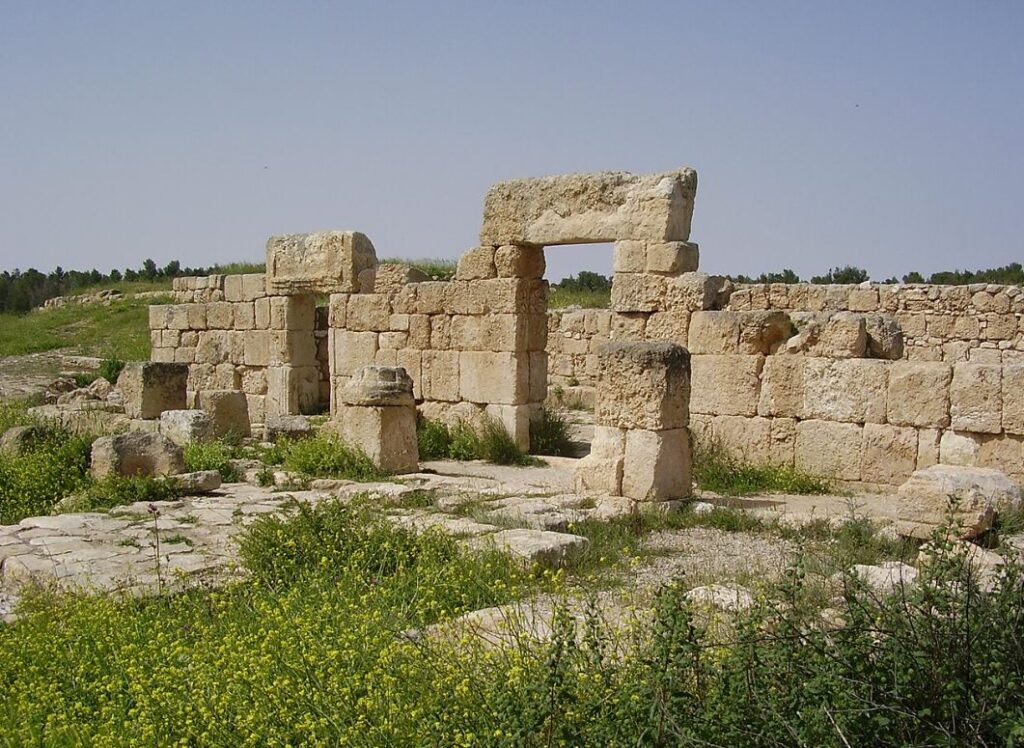
Hirbet Anim, another community in the southern Hebron hills
צילום:ד”ר אבישי טייכר, CC BY 2.5 <https://creativecommons.org/licenses/by/2.5>, via Wikimedia Commons
Rabbi Yishmael and Rabbi Akiva each excelled in Midrash Halacha, but they took very different approaches to it. Rabbi Benjamin Lau, quoting from Rabbi Abraham Joshua Heschel’s book about Oral Law (Torah min HaShamayim BeAspaklariya shel HaDorot) explains that Rabbi Yishmael’s principles were based on a simple and honest look at the Biblical text and its language. His principles were modeled on the idea that while each word of Torah is significant, ultimately Torah speaks in the language of man (Sifrei Bamidbar 112). Rabbi Akiva on the other hand took a deeper look at the words and would expostulate from even the smallest nuances. This is what the Gemara means in the story we had a few pages ago – Rabbi Akiva will come and expound on the crowns of the letters in the Torah and not even Moses will understand him:
“God said to him: There is a man who is destined to be born after several generations, and Akiva ben Yosef is his name; he is destined to derive from each and every thorn of these crowns mounds upon mounds of halakhot.” (Menachot 29b)!
Rabbi Yishmael’s human-centered approach appears in a different debate, this time with one of Rabbi Akiva’s students, Rabbi Shimon bar Yohai. While Rabbi Shimon insists that Torah must be studied all the time, and God will take care of one’s material needs, Rabbi Yishmael cannot see that happening in a real world situation:
“The Sages taught: What is the meaning of that which the verse states: “And you shall gather your grain”? Because it is stated: “This Torah shall not depart from your mouths, and you shall contemplate in it day and night” (Joshua 1:8), I might have thought that these matters are as they are written; one is to literally spend his days immersed exclusively in Torah study. Therefore, the verse states: “And you shall gather your grain, your wine and your oil,” follow the way of the world; set aside time not only for Torah, but also for work. This is the statement of Rabbi Yishmael.” (Berachot 35b)
Both Rabbi Yishmael and Rabbi Akiva had a deep love for the Jewish people and were concerned for their welfare in difficult times. One lovely example of Rabbi Yishmael’s connection to his fellow Jews is a story about a bride who was rejected because her intended thought she was ugly. Rabbi Yishmael brought her to his house and beautified her. He bemoaned the fact that the terrible circumstances of his time prevented women from making themselves attractive:
“At that time Rabbi Yishmael wept and said: The daughters of Israel are beautiful, but poverty makes them ugly. And when Rabbi Yishmael died, the daughters of Israel raised a lamentation, saying: Daughters of Israel, weep for Rabbi Yishmael.” (Mishnah Nedarim 9:10)
Rabbi Yishmael’s legacy to us is to take the Torah and bring it into our daily lives, to see the world as it is but also to try and make it better.

R Yishmael’s grave in Farod
Hoshvilim, CC BY-SA 4.0 <https://creativecommons.org/licenses/by-sa/4.0>, via Wikimedia Commons//