Everyone has heard of the menorah in the Temple. Another important but less well-known piece of Temple “furniture” is the table (shulhan). While the menorah brings light into the world and symbolizes the human need for knowledge, the table is arguably more prosaic. It holds twelve loaves of bread that are ultimately eaten by the kohanim. Bread and table together symbolize the desire to make a living, a goal we can all identify with.
The loaves of bread that are placed on the table have an unusual name – lechem hapanim. This is often translated as showbread, or in more old-fashioned texts, shewbread. This translation does not really help us understand the meaning of the Hebrew word “panim.” The term comes from the Torah:
“And you shall set upon the Table shewbread [leḥem panim] before Me always” (Exodus 25:30).
Pseudo Jonathan, an Aramaic translation, writes that it is “inner” bread, from the Hebrew word פנימי, inside. This fits nicely with the location of this bread, in the inner part of the Temple, the Holy (kodesh). It also is echoed in the name of the table as we see here:
וְעַ֣ל ׀ שֻׁלְחַ֣ן הַפָּנִ֗ים יִפְרְשׂוּ֮ בֶּ֣גֶד תְּכֵ֒לֶת֒ וְנָתְנ֣וּ עָ֠לָ֠יו אֶת־הַקְּעָרֹ֤ת וְאֶת־הַכַּפֹּת֙ וְאֶת־הַמְּנַקִּיֹּ֔ת וְאֵ֖ת קְשׂ֣וֹת הַנָּ֑סֶךְ וְלֶ֥חֶם הַתָּמִ֖יד עָלָ֥יו יִהְיֶֽה׃
“Over the inner table they shall spread a blue cloth; they shall place upon it the bowls, the ladles, the jars, and the libation jugs; and the regular bread shall rest upon it.” (Bamidbar 4:7)
Another approach connects the panim to the phrase “lifnei Hashem” – the bread that is placed before God, i.e., in the closest place to the Holy of Holies. The Biblical commentator Abraham ibn Ezra chose another meaning. He translates panim as important or significant, as we see in Metzudat David’s explanation of the portion that Elkanah gave to his beloved wife Chana:
וּלְחַנָּ֕ה יִתֵּ֛ן מָנָ֥ה אַחַ֖ת אַפָּ֑יִם
But to Chana he would give one choice portion” (Samuel I 1:5)”
“One portion: Meaning to say, unique in its fineness. And to explain further, it said, “apayim (face)” – one fitting to be received with a joyful face.” (Metzudat David)
The Gemara quotes a different explanation offered by Ben Zoma who relates the name not to its meaning but rather to the bread’s shape:
“Ben Zoma says .. leḥem panim indicates that it should have sides [panim]” (Menachot 96a)
A final answer connects the word to its most well-known definition – panim is a face. The thickness of the bread needs to be equal to the thickness of a person’s face, which as Rashi explains (Pesachim 37a) is never less than a tefach. A more whimsical approach might be that if the bread’s shape is curved on the bottom, it looks like a smile (Eliezer Saidel).
How did this enigmatic bread look? The Gemara offers two suggestions:
“Rabbi Ḥanina says: It was like a box that is open. Rabbi Yoḥanan says that it was like a dancing boat” (Menachot 94b)
Was the bread shaped like a box or a boat? And how is a dancing boat shaped anyway? Rashi illustrates for us a basic box and a “V” shaped “boat.” The boat is a much more problematic shape and the Gemara tries to solve all sorts of practical questions about it. In any case, the length of it, ten tefachim (about a meter) was too long for the table, because it was placed widthwise. In order to make it fit, the bread had to be folded over when it was shaped:
“The priest places the length across the width of the table, [which leaves five handbreadths of each loaf protruding from the table]. And he folds the protruding two and a half handbreadths upward on this side of the table, and the protruding two and a half handbreadths upward on that side of the table.” (Menachot 96a)
Do we have any images of this unusual bread that could perhaps illuminate for us what shape it was? While we have many images of the more popular menorah, we have only a few of the table and its bread. The most interesting one is on coins of Mattityahu Antigonus, the last of the Hasmonean kings (40 – 37 BCE). One side shows the menorah and it has been reproduced in Israel’s ten agorot coin. The obverse has two variations, both of which show the table. One has the loaves represented in a very schematic fashion as circles:
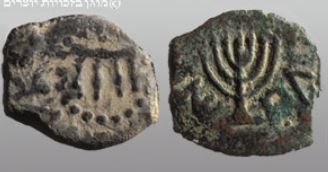
Rachelbarkay, CC BY-SA 4.0 <https://creativecommons.org/licenses/by-sa/4.0>, via Wikimedia Commons
The other, much more rare, actually shows the surface of a table with two piles of three curved loaves on it. These are not the “box” of Rabbi Hanina, but they aren’t exactly the ships of Rabbi Yohanan either, at least the way Rashi explains them. However, a curved bottom would make much more sense. It would be harder for the loaf to break and it also fits with the Tosefta which says we don’t want a dancing ship, we want a ship that stays still:
“It would hold the bread in place so that it would be like a ship that does not dance” (Tosefta 11:3)
The coin, while intriguing, is not a conclusive proof. Perhaps it was just easier for the coin maker to make this shape. We have another depiction of a table and bread, from the synagogue mosaic in Zippori:
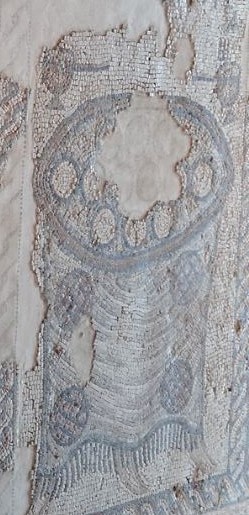
Hanay, CC BY-SA 3.0 <https://creativecommons.org/licenses/by-sa/3.0>, via Wikimedia Commons
While this one has great details, it clearly is not a depiction of reality. It has nothing in common with either the Biblical or the Rabbinic description of the bread and the table and it was made centuries after the Temple was destroyed.
To make this unique bread required special skills. The Mishnah tells us that there was a specific family who knew how to do this, the Garmu family. Both the Yerushalmi and the Bavli tell stories about them:
“The family Garmu were experts in preparing the shew-bread and its removal from the oven, but they did not want to teach [others how to do it]. They [the Rabbis] sent and brought craftsmen from Alexandria who were experts in preparing the shew-bread but were not experts in its removal from the oven. . . They [the Rabbis] asked them [the Garmu family], why do you not want to teach? They answered them, there is a tradition among us from our forefathers that this Temple will be destroyed in the future. Others should not learn and prepare the same before their foreign worship” (Yerushalmi Yoma 3:9)
When the Rabbis decide they did not want to pay the Garmu family’s high prices, they turned to the bakers of Alexandria. Alexandria was a technological powerhouse and had skilled artisans and craftsmen. It was there that the Rabbis tried to replicate the incense in a similar story (Yoma 38a). But the Alexandrians could not replicate technique of taking the bread out of the oven without breaking it and so the commission was returned to the Garmus. Professor Zohar Amar gives a fascinating suggestion for the meaning of the name Garmu. He thinks it may be derived from the Latin gremium which means bosom or womb, something deep within the body. This would fit beautifully with the meaning of lehem penimi, inner bread.
Inside or outside, these twelve loaves were an important element of Temple worship. Today an institute in the Shomron run by master baker Eliezer Saidel has studied the sources extensively and makes the bread in workshops to teach people about its shape and composition. Then you can taste it, something that only kohanim could do in Temple times.
Much of what I wrote is based on an extensive article by Professor Zohar Amar about the lehem hapanim in Maalin BaKodesh 17.