Some foods are basic and important but they have no cachet. This seems to be the case with the lowly lentil. Our Gemara says that no one would ever assume you can bring a mincha offering from lentils – barley perhaps, since we do have offerings of barley, but not lentils:
“With regard to barley, one may err,. But with regard to lentils, one would not err” (Menachot 103a)
Lentils may not have been acceptable in the Temple but they were in wide use everywhere else. One of the earliest domesticated crops, they provided a cheap, filling and healthy meal. An employer had to guarantee his workers a basic meal that included bread and legumes, often lentils:
“on the condition that you have the right to claim from me only a meal of bread and legumes” (Mishnah Bava Metzia 7:1)
When Barzilai of Gilead wishes to bring supplies to his friend King David who is fleeing from Avshalom, lentils are part of the gift:
“When David reached Mahanaim, Shobi son of Nahash from Rabbath-ammon, Machir son of Ammiel from Lo-debar, and Barzillai the Gileadite from Rogelim presented couches, basins, and earthenware; also wheat, barley, flour, parched grain, beans, lentils, parched grain, honey, curds, a flock, and cheese from the herd for David and the troops with him to eat.” (Samuel II 17:27-29)

Rainer Zenz, Public domain, via Wikimedia Commons
While lentils may have been nourishing and tasty, they were not considered food for the upper class. While we occasionally hear about a wealthy household like that of Rabban Gamliel preparing lentils (Betzah 14b), they were usually thought of as poor people’s food. Some even thought that they might cause harm to someone not used to eating them:
“A certain person came before Rabbi Neḥemya to request charity. He said to him: On what do you normally dine? He said to him: on fatty meat and aged wine. Rabbi Neḥemya asked him: Is it your wish to partake together with me in a meal of lentils רְצוֹנְךָ שֶׁתְּגַלְגֵּל עִמִּי בַּעֲדָשִׁים ? He partook with him of lentils, and he died, [since he was not accustomed to this food].” (Ketubot 67b)
(note here the play on words in Hebrew תגלגל עמי literally will you roll with me and eat the lentils, but lentils are round so it is an apt verb).
A husband who cannot provide even lentils for his wife was a poor provider indeed. And yet, the rabbis thought that the pride of having ANY husband would offset this hardship:
“Rav Ashi says: One whose husband sells cabbage heads does not require lentils for her pot.” (Yevamot 118b)
Lentils were considered to be a healthy food and eating them in moderation was thought to be a cure for askarah, often translated as diphtheria:
“Rav Mari said that Rabbi Yoḥanan said: One who is accustomed to eat lentils once in thirty days prevents diphtheria from afflicting his house” (Berachot 40a).
Dr. Moshe Raanan explains that doctors in the ancient world used lentils in different types of remedies, including for sore throats. Today research has shown that lentils can stop diarrhea and also ease breathing, something that may be connected to diphtheria, a disease where air passages are blocked.
Lentils were a ubiquitous food so it makes sense that they would be used as a measurement for various halachic needs, like how big an impure creature is (Keilim 17:8) or to understand the relative sizes of a nega tzaraat:
“The minimum size of a bright spot must be that of a Cilician split bean squared. The space covered by a split bean equals that of nine lentils.” (Negaim 6:1)
Lentils also have a distinctive shape. They are round,and slightly thicker in the middle. This shape meant that they gave their name to the round grinding stones of an olive press:
“yam is the lentil (טְלָפְחָא Aramaic for lentil) [the round stationary container into which the olives are placed before being crushed].” (Bava Batra 67b)
The thickness in the middle also gave the lentils or lens in Latin its other meaning, which it also has in Hebrew עדשה: an optical lens, which is round but shaped concave or convex in the middle.

The most famous lentils of all are the ones made into a soup by Jacob and sold to his brother Esav in exchange for his birthright:
“Jacob then gave Esau bread and lentil stew; he ate and drank, and he rose and went away. Thus did Esau spurn the birthright.” (Bereshit 25:34)
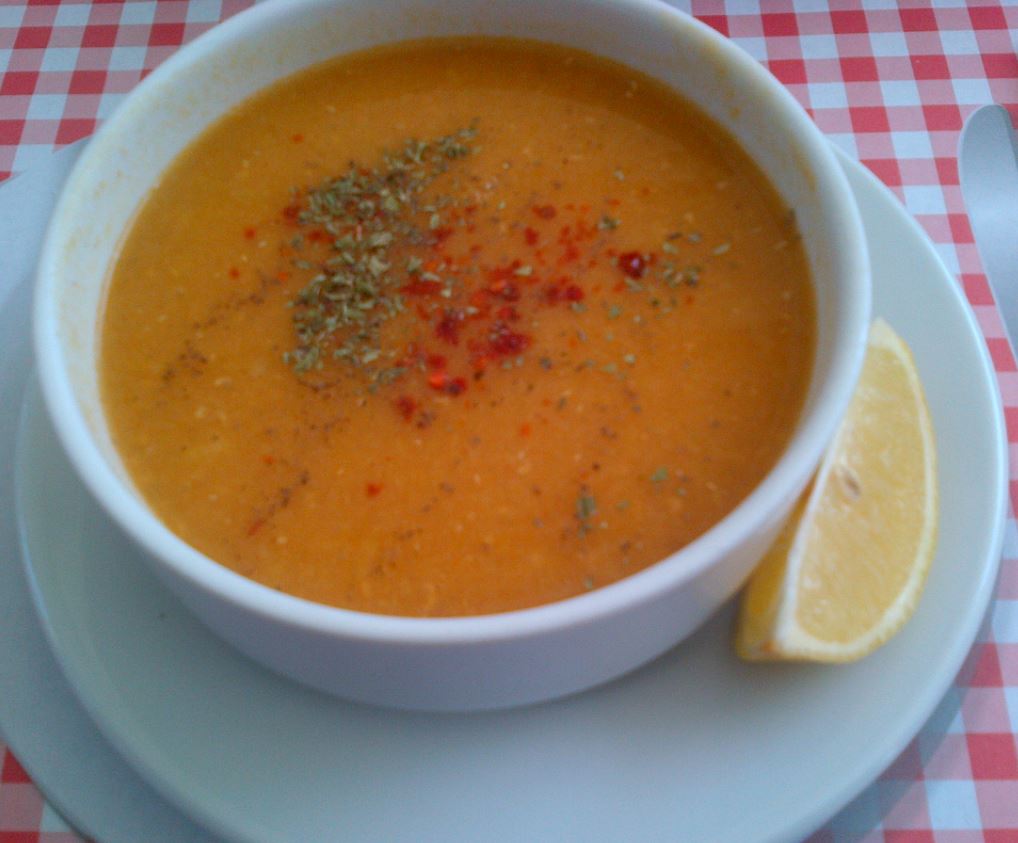
Did Jacob’s soup look like this?
E4024, CC BY-SA 4.0 <https://creativecommons.org/licenses/by-sa/4.0>, via Wikimedia Commons
Naturally, the Rabbis ask why Jacob happened to be making lentil soup that day (or perhaps why the Torah feels the need to tell us what the soup was made of). They explain that it was because lentils are a food for mourning and that day was the day of Abraham’s death. But why should the lentil be appropriate for mourning? The answer lies in its shape:
“On that day Abraham our forefather passed away, and Jacob our forefather prepared a lentil stew to comfort Isaac, his father, And what is different about lentils [that they in particular are the fare customarily offered to mourners]? They say in the West, in the name of Rabba bar Mari: Just as this lentil has no mouth, so too a mourner has no mouth, Alternatively, just as this lentil is round, so too mourning comes around to the inhabitants of the world.” (Bava Batra 16b)
Unlike other beans or legumes that have a crack where a sprout can emerge, lentils are smooth, with no openings, or “mouth.”.

Chickpeas with a crack for the sprout
Huhulenik, CC BY 3.0 <https://creativecommons.org/licenses/by/3.0>, via Wikimedia Commons
In this way they are meant to resemble the mourner who cannot speak because he or she is in shock. The round shape reminds us that there is a wheel turning in the world, גלגל סובב בעולם; eventually death will come to everyone.
For the Rabbis, lentils, like so much else, became a lens through which they viewed the world.

Monica Borys, UnSplash