









Are you a Tel Avivian? Or perhaps a Michiganer? Sometimes people are called after their place of origin, and sometimes that moniker may sound like another word. Here is Hullin the Gemara discusses whether the “orevim” who bring Elijah food in the desert (Kings I 17) are crows, the literal translation of orev, or people named Orev or perhaps people from a town called Orev. To back up that last assertion, a proof is brought from a different Bible story about a young girl, a naara ketana:
“And perhaps they are called orevim after the name of their place of origin. Isn’t it written: “And the Arameans had gone out in bands, and had brought away captive out of the land of Israel a minor young woman [na’ara ketana]” (II Kings 5:2)? [And it is difficult for us to understand why the verse calls her a young woman and also calls her a minor]. And Rabbi Pedat said: She was a minor girl who was from a place called Naaran.” (Hullin 5a)
A naara, young woman, is not the same biologically or halachically as a ketana, a minor. It would also be redundant to describe her this way even if both words meant the same thing. So Rabbi Pedat explains that naara means she comes from Naaran. A similar repetition is found in the story about Elisha and the boys who taunt him (Kings II chapter 2):
“What is the meaning of: “Young lads [ne’arim ketannim]”? Rabbi Elazar says: The word “lads [ne’arim]” means that they were shaken empty [meno’arim] of the mitzvot; the word “young [ketannim]” means that they were of little faith [ketannei amana]. . .Rav Yosef objects to this interpretation: And perhaps they were called ne’arim after their place of origin? . . .These two cases are not comparable. There the verse does not specify her place of origin, [so “na’ara” could mean from the town of Ne’oran;] but here the verse specifies their place of origin, [namely Jericho].” (Sotah 46b)
While in the case of the boys, the Gemara rejects the comparison and prefers a more homiletic explanation, the girl seems to have been from Naaran. Where is this place? Naaran appears in the description of the tribal inheritance of Ephraim in the book of Joshua. Here we see its proximity to Jericho, on the east of the land of Israel:
“from Janoah it descended to Ataroth and Naarath, touched on Jericho, and ran on to the Jordan.” (Joshua 16:7)
In the book of Chronicles, Naaran is mentioned again as the eastern edge of Ephraim, parallel to Gezer in the west:
“Their possessions and settlements were Bethel and its dependencies, and on the east Naaran, and on the west Gezer and its dependencies,” (Divrei HaYamim I 7:28)
Naaran sits on the southern and eastern edge of Ephraim, with the territory of Benjamin to the south and the Jordan River to the east. Like its more famous neighbor Jericho, Naaran is close to a spring and the water and warm climate year round meant that it was perfect for agriculture. The whole area was favored by the Hasmonean and Herodian kings for their winter palaces. Josephus tells us (Antiquities 17:13) that Archelaus, Herod’s son, diverted water from Naaran to use in his Jericho palace.
By the third century, the area of Jericho was a mixture of Jewish and Christian towns. Eusebius in his geographichal work the Onomasticon mentions Naaran as a Jewish town. The residents seem to have been persecuted by their Christian neighbors as this passage from VaYikra Rabbah tells us:
“ ‘the Lord has commanded for Jacob that his besiegers surround him’ (Lamentations 1:17), e.g., Ḥalamish for Naveh, Jericho for Naaran, Susita for Tiberias, Gastera for Haifa, Lod for Ono” (VaYikra Rabbah 23:5)
Each Jewish town (Naveh, Naaran, Tiberias etc) has a non-Jewish “partner that persecuted it; in the case of Naaran that partner is Jericho.
Naaran was known from Jewish sources but it was not located until an accident happened in the twentieth century. When the Turks were shelling the area during World War I one shell hit close to a site with a mosaic. The mosaic was exposed by Dominican priests who brought some parts back to their Biblical Institute in Jerusalem. They were clearly from a Jewish synagogue since the pictures included menorahs and Hebrew writing. The proximity to Jericho seemed to indicate that this was Naaran and the synagogue has been dated to the sixth century CE.
Despite this exciting discovery, much was happening in the Land of Israel and the mosaic was eventually covered over and forgotten. During the Six-Day War an Israeli unit stationed nearby were sent to dig latrines. They rediscovered the ancient synagogue. Today it has been studied and even though Naaran is on the edge of Palestinian territory, dedicated Jews come to pray and study in the ancient synagogue, with IDF support.
synagogue
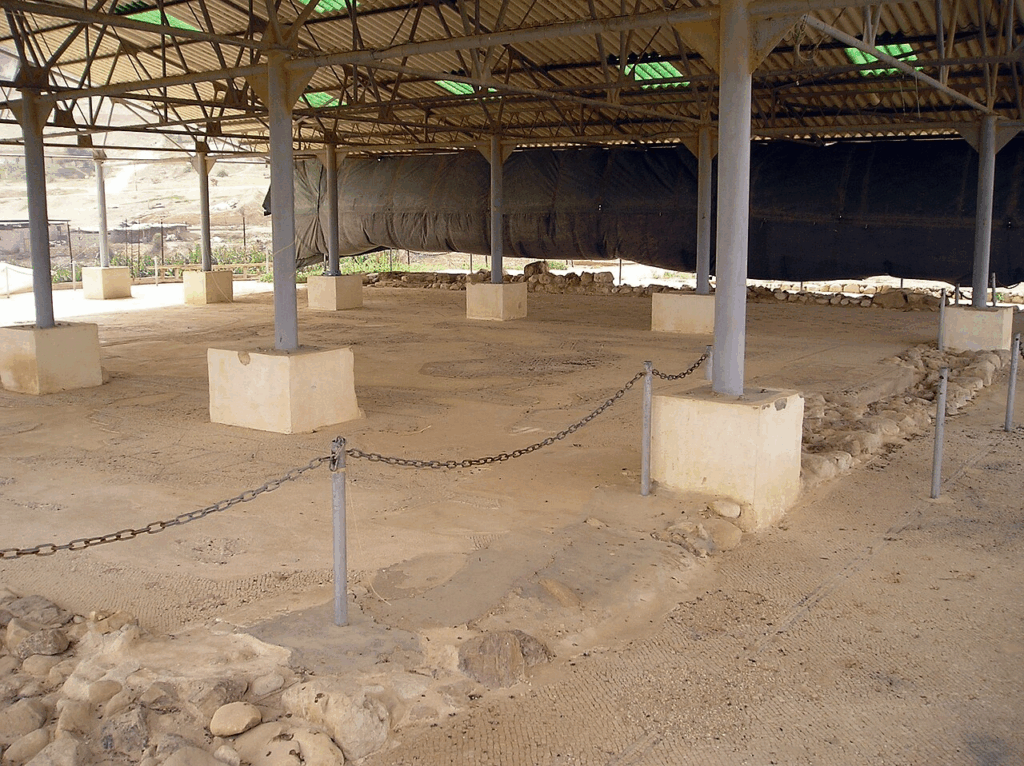
https://upload.wikimedia.org/wikipedia/commons/c/c9/Jerycho_Synagoga.jpg?utm_source=commons.wikimedia.org&utm_campaign=index&utm_content=original
The mosaics, while faded and partially destroyed, are fascinating. They include menorahs and a depiction of a Torah ark as well as many animals: birds, a rabbit and a fox, lions and more. Some of the faces of the living creatures were destoyed, perhaps by iconclasts, those who were opposed to images. Were these activists Jewish or Christian?
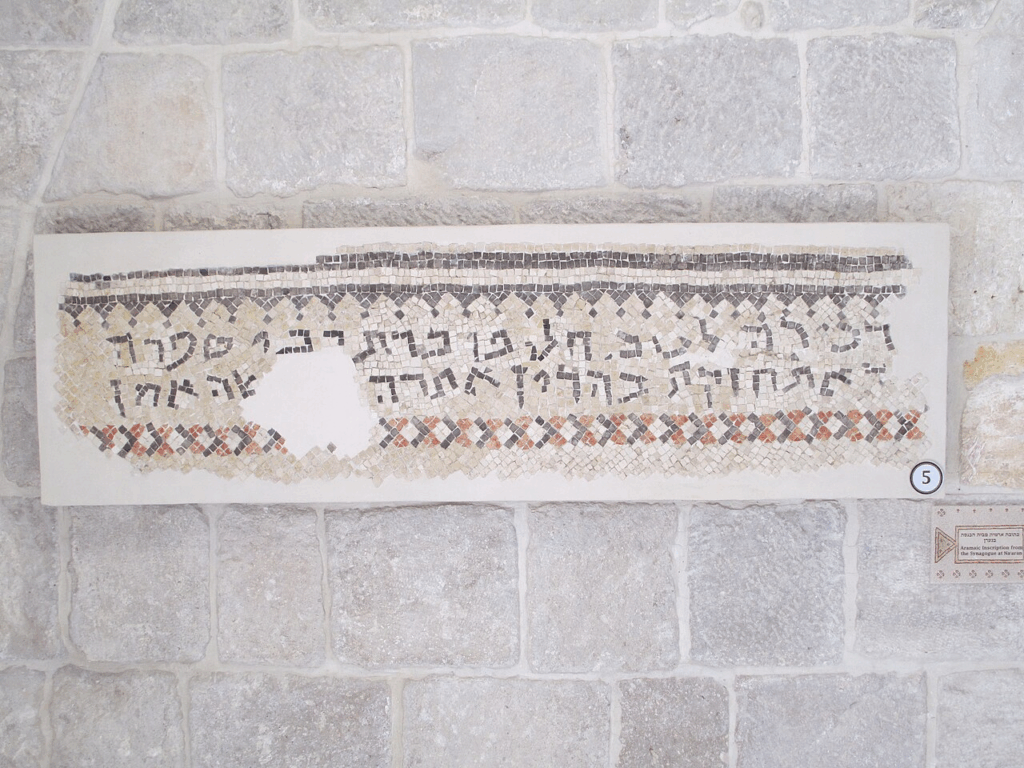
As in other contemporary synagogues in the Galilee, the Naaran mosaic includes a zodiac, depictions of the seasons and an image in the center representing the sun on a chariot. While the inscriptions with donors’ names are in Aramaic, the zodiac has Hebrew words describing each of the symbols. The donors include men and women, including a married couple, Pinchas and his wife Rivka. There is also a general “remembered for good” of all those who contributed to the synagogue upkeep.
The most unusual element in the mosaic is a figure that has barely survived but fortunately for us is labeled: Daniel in the lions’ den. The inscription above it read “Daniel Shalom,” Daniel peace. Why was Daniel, of all Biblical figure, represented here? Perhaps his dangerous life among non Jews and his miraculous salvation was something that the Naaran community could relate to, surrounded as they were by hostile elements.
Pinchas, Rivka, Halifa and all the other good people of Naaran are long gone. Whether they called themselves “Naarim” or not, they definitely felt strongly about their Jewish heritage and worked hard to create a beautiful sanctuary on the edge of the desert.
inscription







#/media/%D7%A7%D7%95%D7%91%D7%A5:Jerycho_Synagoga.jpg)