If the name Rabbi Tarfon sounds familiar, it is probably because of the famous story in the Passover Haggadah about the Sages who spoke of the Exodus until dawn:
“Once Rabbi Eliezer and Rabbi Yehoshua and Rabbi Elazar ben Azaria and Rabbi Akiva and Rabbi Tarfon reclined [for the seder] in Bnei Brak.
And they told of the Exodus from Egypt all that night until their students came in and said ,’Teachers – the time for saying the Shema of the morning has come.’ ” (Passover Haggadah)
But while the other rabbis in the story are well known to us, Rabbi Tarfon is somewhat less familiar. He appears here in Bechorot with an answer to a question about which one of twin animals should belong to the Cohen:
“Rabbi Tarfon says: The priest chooses the better one. What is the reasoning of Rabbi Tarfon? He holds that the healthier and better of the two emerged first,” (Bechorot 18a)

Which would you choose?
Jacquie Wingate from Recovery, usa, CC BY-SA 1.0 <https://creativecommons.org/licenses/by-sa/1.0>, via Wikimedia Commons
The laws of bechor and everything else connected to priestly gifts were well known to Rabbi Tarfon. He was a Cohen on both sides of the family – both his mother and his father descended from priestly families. He tells us of his memories of going up to recite the Birkat Kohanim in the Temple with his maternal uncle:
“It is taught: Rabbi Tarfon said: On one occasion I ascended after my mother’s brother to the platform ]to give the Priestly Benediction[, and I inclined my ear near the High Priest, and I heard him conceal the name during the sweet melody of his priestly brothers.” (Kiddushin 71a)
Rabbi Tarfon was a Tanna of the second generation, a student of Rabban Gamliel and Rabban Yohanan ben Zakkai. As we saw above, the Temple was still standing when he was a child, but his adult life was spent in a post Temple world, in the Yavneh generation. He lived in Lod, not far from Yavneh, and was the halakhic leader of the community there. While much of the activity of the Sages took place in Yavneh, important meetings were also held in Lod, as we see here:
“Rabbi Tarfon and the Elders were reclining in the loft of the house of Nitza in Lod, when this question was asked of them: Is study greater or is action greater? Rabbi Tarfon answered and said: Action is greater. Rabbi Akiva answered and said: Study is greater. Everyone answered and said: Study is greater as study leads to action.” (Kiddushin 40b)
His priestly lineage meant that he received the gifts of teruma, bechor and more. But he understood that the idea of these gifts was to keep the spirit of the Temple alive. He saw eating teruma as a way to fulfill the obligation of avoda, service in the Temple, even after the Temple had been destroyed:
“an incident involving Rabbi Tarfon, who did not come in the evening to the study hall. In the morning, Rabban Gamliel found him and said to him: For what reason did you not come in the evening to the study hall? He said to him: I was performing sacred service. He said to him: All your words are astonishing; from where do we have service in this time? He said to him: It says in Scripture: ‘I have given you the priesthood as a service of gift; and the stranger that comes near shall be put to death’ (Numbers 18:7). They made the eating of teruma in the outlying areas, i.e., outside the Temple, like the service of the Temple.” (Pesachim 72b)
Rabbi Tarfon was a wealthy landowner and could live well even without the priestly gifts. When he could he would return the money to the givers, as he does here with the money given for pidyon haben:
“And this was the practice of Rabbi Tarfon, as he would take the redemption money and return it.” (Bechorot 51b)
In addition, he used his Cohen status to provide for poor women in a time of famine:
“Rabbi Tarfon who betrothed 300 wives for them to eat terumah, for they were years of famine.” (Tosefta Ketubot 5:1)
The Yavneh generation was a time of transition: from Temple to Bet Midrash, from sectarianism to unity. Rabbi Tarfon seems to have been a follower of the school of Shammai. However, as Rabbi Binyamn Lau points out, he was not set in his ways and when he saw that Bet Shammai’s opinion was incorrect, he changed his mind. Here is an example of how he followed Bet Shammai:
“Rabbi Tarfon said:, I was coming on the road and reclined to recite Shema in accordance with the statement of Beit Shammai. I endangered myself due to the highwaymen. The Sages said to him: You deserved to be liable to pay with your life, as you transgressed the statement of Beit Hillel.” (Mishnah Berachot 1:3)
Another significant issue in the Yavneh generation was the rise of Christianity Jewish believers in Jesus lived among normative Jews and Rabbi Tarfon, along with other Sages, saw them as a grave threat, worse than idol worshippers. Their sacred texts, the Gospels, needed to be destroyed:
“Rabbi Tarfon said: I will bury my sons, that if these books come into my possession I will burn them and the names therein. As even if a person is pursuing him with the intent to kill him, and a snake is hurrying to bite him, one enters a house of idolatry and does not enter the houses of these heretics.” (Shabbat 116a)
Rabbi Tarfon was a natural teacher and he also had a way with words. I particularly liked his way of praising, and disparaging, comments by others:
“When a person would say a worthy statement before Rabbi Tarfon, he would say: ‘A knob and a flower [kaftor vaferaḥ].’ But when he would say nonsense, he would say: ‘My son will not go down with you.’ [a reference to Jacob’s response to Reuven’s untenable suggestion to kill his sons if he does not bring Benjamin back]” (Bereshit Rabba 91:9)
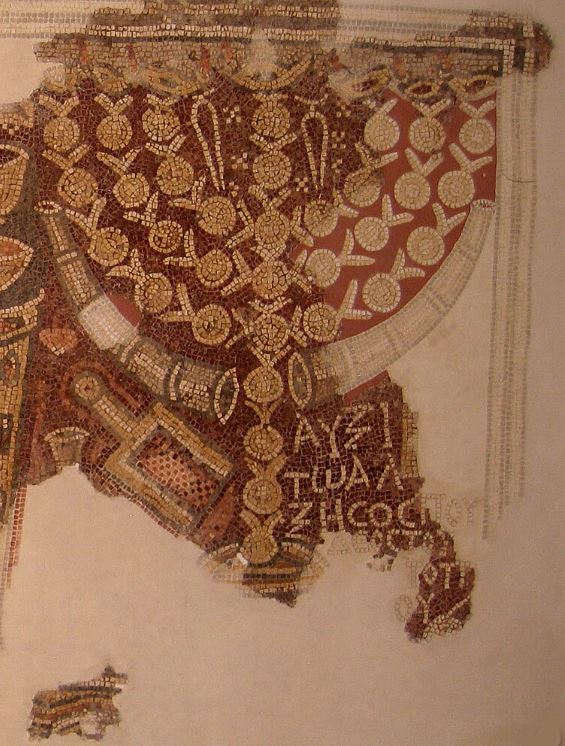
Kaftor vaperach on a menorah
Talmoryair, CC BY 3.0 <https://creativecommons.org/licenses/by/3.0>, via Wikimedia Commons
The Yavneh generation’s task of restoring Judaism after the destruction of the Temple was a formidable one. Perhaps the enormity of this work is what Rabbi Tarfon is referring to in his most famous statement recorded in the Ethics of the Fathers:
“Rabbi Tarfon said: the day is short, and the work is plentiful, and the laborers are indolent, and the reward is great, and the master of the house is insistent. He used to say: It is not your duty to finish the work, but neither are you at liberty to neglect it;” (Pirkei Avot 2:15-16)

The day is short
Jessie Eastland Attribution Commons: Jessie Eastland, CC BY-SA 3.0 <https://creativecommons.org/licenses/by-sa/3.0>, via Wikimedia Commons
His strong values, coupled with an ability to be flexible, earned Rabbi Tarfon the title “father of all of Israel.” (Yerushalmi Yoma 1:1)