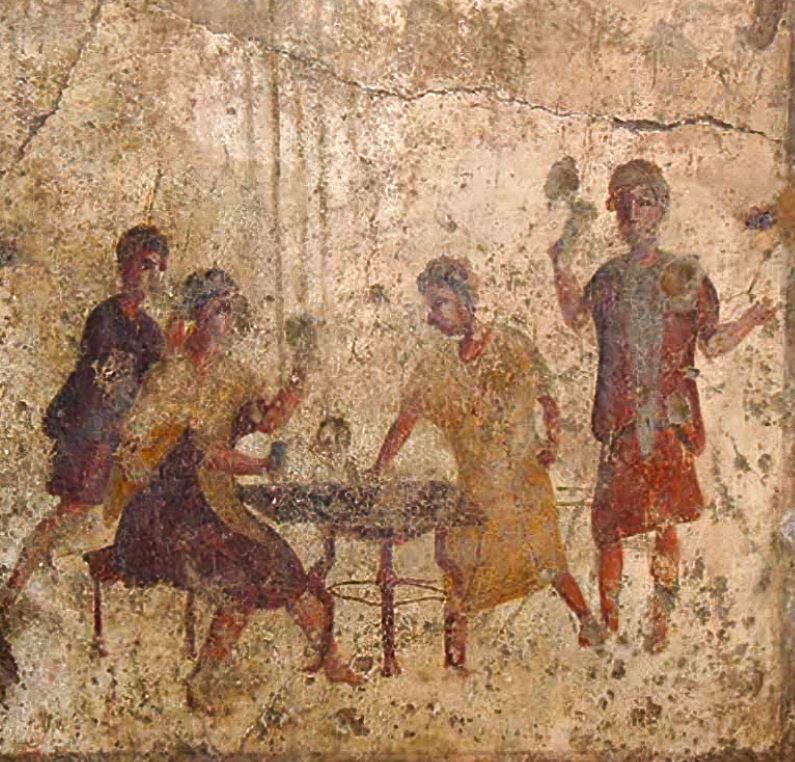






When is a window not a window? The question arises when we look at our Mishnah:
MISHNA: “The hair of a blemished firstborn animal that shed from the animal, and which one placed in a chalon חלון for safekeeping, and thereafter he slaughtered the animal;” (Bechorot 25a)
The Hebrew word chalon is often translated as window and that is the way it appears in older translations of the Gemara, like the Soncino. Readers of the Bible are familiar with windows. They are one of humanity’s great inventions, allowing light and air into the house while keeping it protected from the elements. The Bible tells of people using windows to peek in on their neighbors:
“When some time had passed, Abimelech king of the Philistines, looking out of the window, saw Isaac fondling his wife Rebekah.” (Bereshit 26:8)
We also see women at the window, trying to look out at the world and see what is going on, or why someone is not arriving:
“Through the window peered Sisera’s mother,
Behind the lattice she whined:
‘Why is his chariot so long in coming?
Why so late the clatter of his wheels?’ ” (Shoftim 5:28)
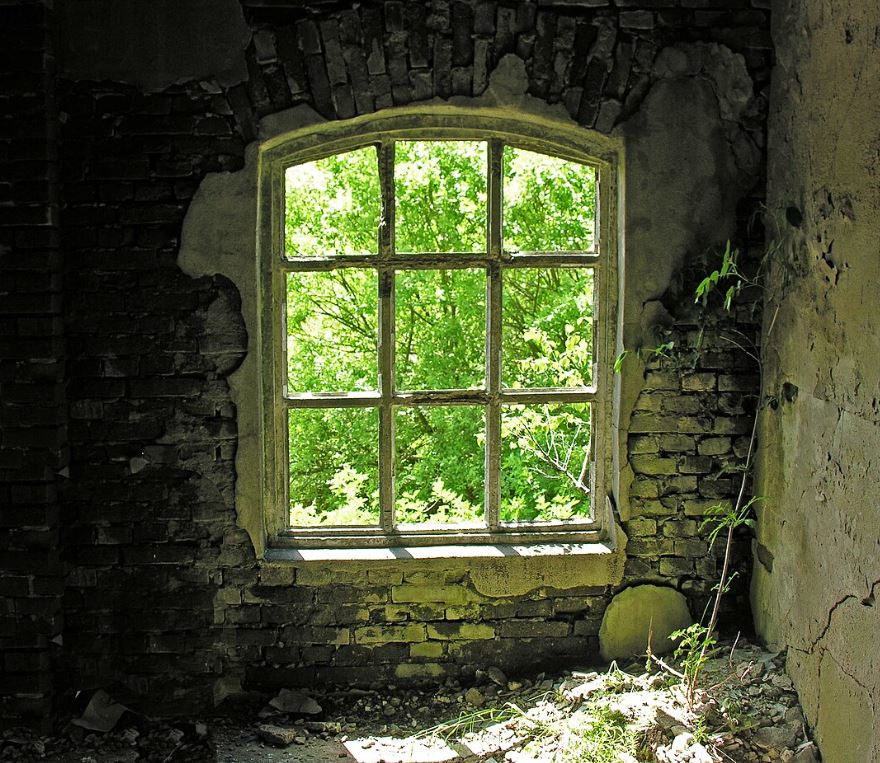
Thomas Geersing, CC BY 2.0 <https://creativecommons.org/licenses/by/2.0>, via Wikimedia Commons
A different woman used her window proactively, to save the two Israelite spies who had snuck into Jericho:
“She [Rahab] let them down by a rope through the window—for her dwelling was at the outer side of the city wall and she lived in the actual wall.” (Joshua 2:15)
The Sages are also familiar with these windows to the outside and they warn people not to build their houses with windows facing each other, which would take away from the owners’ privacy:
“A person may not open his windows, into a courtyard belonging to partners,” (Mishnah Bava Batra 3:7)
However, the word chalon does not always mean a window. It can also mean a compartment, as the Tosfot Yom Tov explains in the parallel Mishnah to ours in Masechet Eduyot:
“Regarding the word chalon here: it is not used in the same sense as other instances of the word—such as in the phrase “a person shall not open his windows” or the reference to “window facing window” which refer to openings used for looking out from the house into a courtyard, another private domain, or the public domain, or openings designed to admit light or air into the room. . . . However, the chalon mentioned here does not open all the way through to the other side; rather, it opens only into the interior of the room—not to the outside—and is designed as a recess where a person can place their belongings.” (Tosfot Yom Tov Mishnah Eduyot 5:6)
These openings were in the walls between rooms or in recesses in the walls of the room, and they were very useful as storage. We would call them cubbies. People kept objects there as in this Mishnah in Meilah:
“If the homeowner said to the agent: Bring me this item or this money from the chalon or from the chest” (Mishnah Meilah 6:1)
They were so useful that we even find them in the Temple, as a place to store the clothes of the priests when they are not performing their duties:
“And there were chalonot there, and on each of them was written the use of the garment” (Mishnah Tamid 5:3)
Can we see these cubbies in actual ancient homes? The earliest ones were found in the Jewish town of Chorazim, north of the Kinneret, and they became known as Chorazim windows. As you can see in the picture, they are both a storage space and a separation between rooms. These “window walls” were usually a little less than a meter off the ground. They allowed light and air to flow between the spaces of the house.
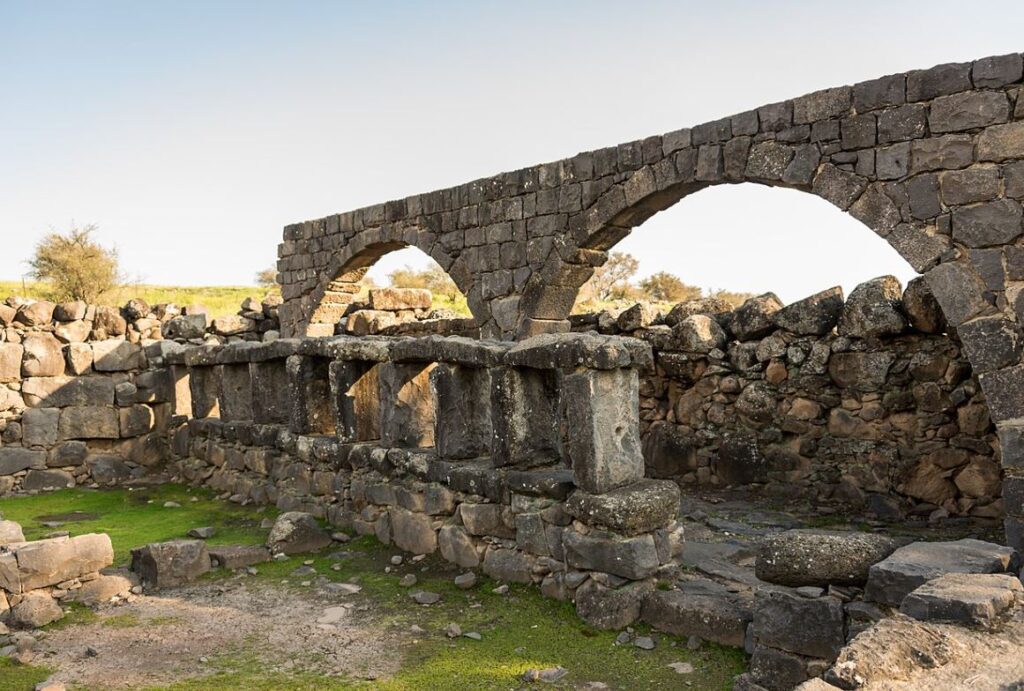
Chorazim windows
Lev.Tsimbler, CC BY-SA 4.0 <https://creativecommons.org/licenses/by-sa/4.0>, via Wikimedia Commons
After the Chorazim discovery, these windows were also found in other ancient buildings in Israel. In Hirbet Farag in the Golan the spaces are deep and seem to have been used as animal troughs. This was such useful architecture that Arab houses in the 1970s still had windows in their walls, as documented by Professor Izhar Hirshfeld in his study of traditional homes in the South Hebron Hills. They also used them as troughs as well as for food storage and closets. The shelf of the window was sometimes wide enough to sleep on, a useful solution for temporary guests.
We also find a window like this in Qumran, the place of the Dead Sea Scrolls, It is in a room adjacent to the room called the scriptorium where archaeologists think some of the scrolls were written. The suggestion is that it was used to pass items, like scrolls, back and forth between rooms, but it could also have been used to store these precious documents.
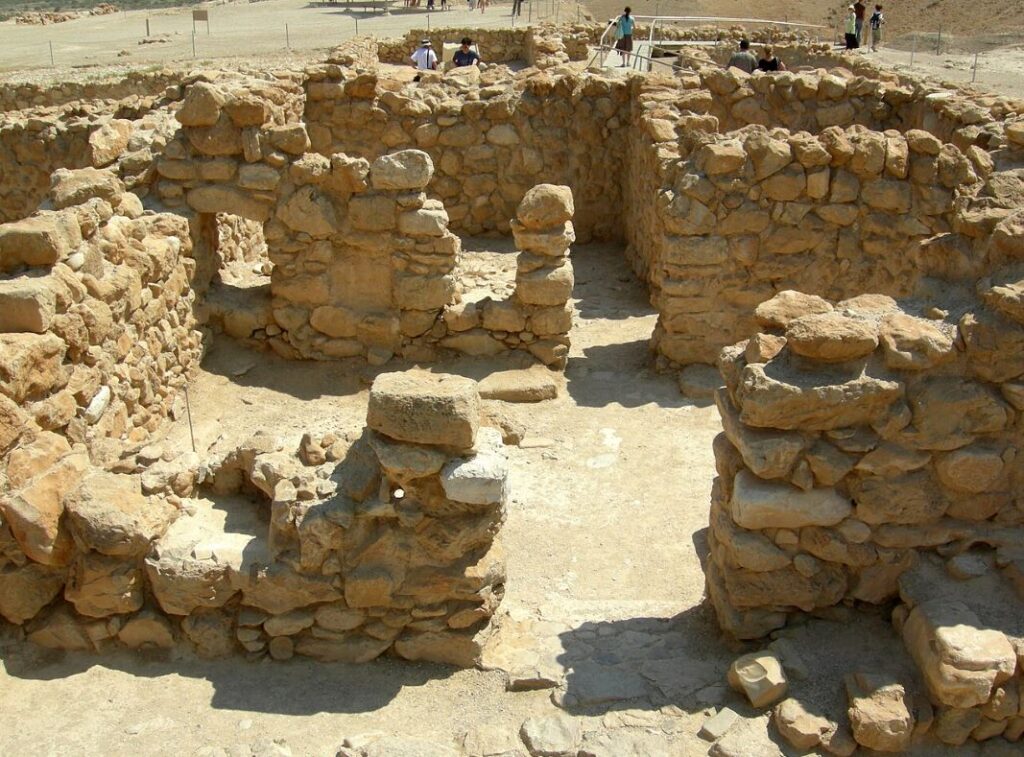
Qumran window (on left)
Wilson44691, Public domain, via Wikimedia Commons
Today most of us have way too much stuff and are always looking for a way to store it all. Perhaps the chalon was the ancient answer to the Container Store.
Interested in the realia of the daf? Join me on a series of tours to explore the world of the Sages, first tour is this Thursday to the Israel Museum. All the information here.