





The Shabbat meal is ending, it is time to say the Birkat haMazon, the blessing after meals. Is everyone obligated to say it? Do they have to say it together?
Although the Rabbis exempted women from quite a lot of positive mitzvot (מצות עשה), they obligated them to recite the blessing after meals. The Mishnah tells is so explicitly:
“Women, slaves and minors are exempt from the recitation of Shema and from phylacteries, but are obligated in prayer, mezuza and Grace after Meals.” (Mishnah Berachot 3:3)
When people eat together as a group, there is an additional obligation called zimmun, literally inviting everyone to join in the blessing together. The meal creates a community out of a group of individuals; the zimmun makes that connection official. But are women obligated in this collaboration? Our Gemara tells us that they are:
“Everyone is obligated to form a zimmun: ‘everyone’ to add women and slaves. As it is taught in a baraita: Women form a zimmun for themselves and slaves form a zimmun for themselves.” (Arachin 3a)
Three women have a halachic obligation to join together and make a zimmun. But is it an obligation? Or an option? Tosafot comments that while there may have been exceptions, most women in their communities did not recite the zimmun:
“It is different there, because there are differing opinions”—from this, it is implied that women may recite the zimmun among themselves. Indeed, the daughters of our teacher Avraham—the father-in-law of our teacher Yehudah—did so, acting upon the instruction of their father. However, the general custom is not to do so. This raises a difficulty: why is it not the custom? Since the text states “they recite the zimmun,” it implies that they are obligated to do so. One could answer that the statement “women recite the zimmun among themselves” means that if they wish to recite the zimmun, they may do so.” (Berachot 45b, Tosfot “shani”)
An impediment to a women’s zimmun was that most women were not proficient in the blessings. This is something we see centuries later in the Mishnah Berura:
“One could explain that the reason the Sages did not wish to impose upon them the obligation of Birkat HaZimmun (the Grace after Meals recited with a quorum) when they are dining independently is that it is not particularly common for them to be proficient in the Birkat HaZimmun formula.” (Mishnah Berura Orach Chaim 199:7)
Even if women have an obligation to recite zimmun, this is only in situations where they are eating with other women. They cannot join with slaves or with men, as Rashi explains:
“Three women may form a zimmun (a quorum for reciting the Grace After Meals) among themselves, and likewise three slaves; however, two women or two slaves cannot join with [two] men to form a quorum.” (Rashi Arachin 3a)
Why would women not be able to join with other groups to recite the zimmun? Rashi gives an answer which may seem strange to us today: women and slaves do not say the same blessings as the men:
“This is because men possess a quality that women and slaves lack: women do not recite the phrase “the covenant,” and slaves do not recite the phrase “concerning our inheritance.” (Rashi Arachin 3a)
Women do not say the blessing on the covenant, i.e., brit milah, because they are not circumcised. Slaves do not own property so they cannot bless the inheritance of the Land of Israel. Today we have a uniform Birkat haMazon for all, but perhaps Rashi’s explanation can still be valid, if we say that women and slaves are obligated differently from men and therefore cannot really join in a community with them.
A different objection is that by joining together in this community of a meal, women and/or slaves and/or men will behave licentiously when they are together:
“it is different there due to promiscuity” (Berachot 45b)
A fascinating suggestion as to why women and men cannot join together in zimmun is that it is unseemly for women to bless on behalf of men. How ignorant must a man be if a slave or a woman has to say a blessing for him! Such a man will be cursed:
“It is stated: In truth, they said a woman may say Grace for her husband, a slave for his master, and a minor for his father. . .He for whom a slave, a woman, or a minor were reading it, repeats after them what they are saying, and may it be a curse for him.” (Yerushalmi Berachot 3:3)
So women should not join with men in zimmun because they have different obligations, or it is unseemly, or it looks bad for the man. Or perhaps it is all a reflection of social reality?
In the Greek world, women did not come to the formal meals, the symposia. These were male-only occasions, with the only women being servants, entertainers or prostitutes. The Roman world in contrast did have noble and prominent women dining with their husbands, even at public feasts. However, Roman literature seems to reflect an element of licentiousness at these feasts, where men were looking for sexual conquests, even with noble women. We also know that women dined on their own, as we see in this painting:
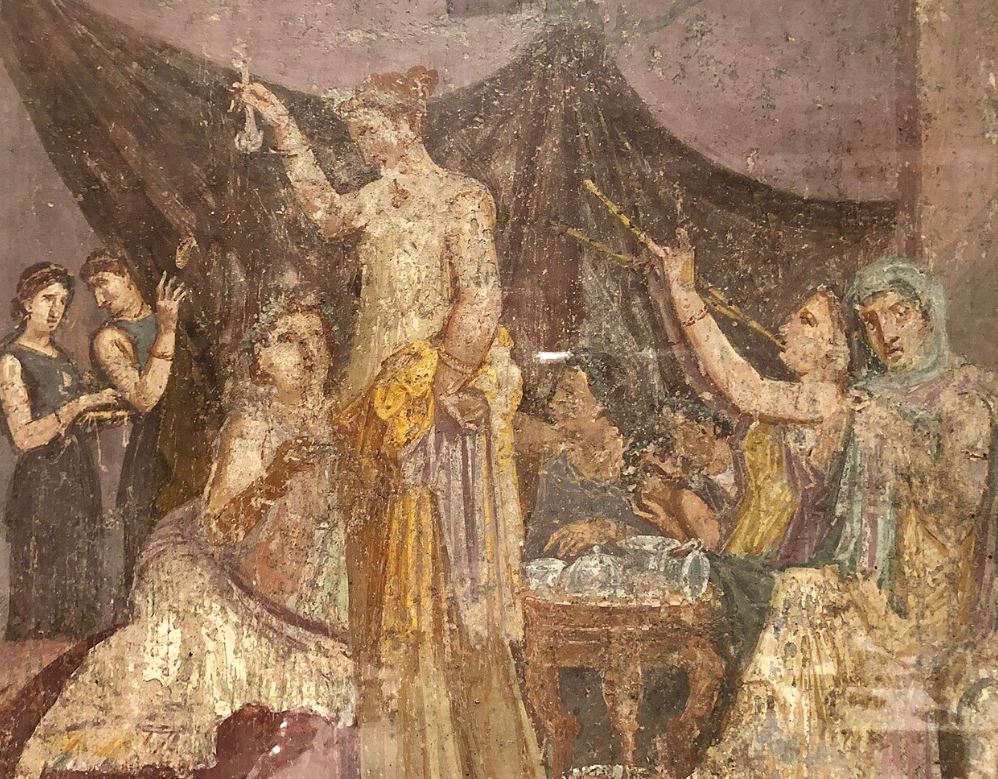
Women’s dinner party in Pompeii
unknown artist, 40-79 A.D., Pompeii, Public domain, via Wikimedia Commons
In the world of Babylonian Jews, the Zoroastrians did often dine in mixed company. Which model were the Rabbis following? We have examples of women dining separately, like here in the famous story of Ulla and Yalta, where Rav Nahman asks to “send” the cup of blessing to her:
“Ulla happened to come to the house of Rav Naḥman. He ate bread, recited Grace after Meals, and gave the cup of blessing to Rav Naḥman. Rav Naḥman said to him: Master, please send the cup of blessing to Yalta,” (Berachot 51b)
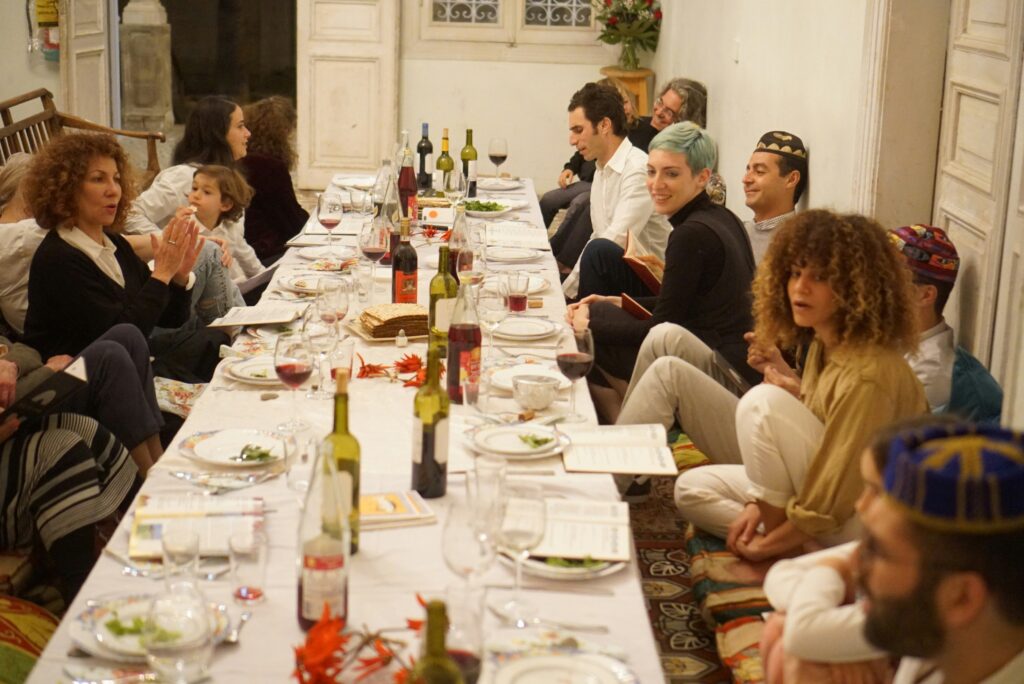
Women’s zimmun, for many centuries an obscure practice, has come back into vogue in modern times. Many women are Jewishly literate and want to bring this beautiful communal practice into their own meals, whether in a single sex or mixed gathering. Chaverotai, my friends and colleagues, let us bless God!
Green prophet, UnSplash
For a more detailed explanation of the laws of women’s zimmun and whether women and men can join together, see here.