In the midst of all the complex and tragic cases about births gone wrong and miscarriages, the Mishnah deals not with a fetus but a placenta:
“But in the case of sacrificial animals the placenta must be buried. But one may neither bury it at an intersection, nor may one hang it on a tree, due to the prohibition against following the ways of the Amorite” (Chullin 77a)
The law here is that the placenta of a sanctified animal must also be treated as hekdesh, holy to the Temple, because it may have the remains of a fetus in it. It must be buried as a holy thing that cannot be used. The fear that this financial loss might recur in the animal’s next pregnancy caused some people to bury the placenta in what they felt was an auspicious place, as Rashi explains:
“At a crossroads—a place where the roads fork in two—it is the custom of soothsayers to bury an object there, so that she will not miscarry again.”

David Brown / Country crossroads via Wikimedia Commons
The Mishnah forbids this practice on the basis of the prohibition of following in the ways of the Amorite, Darkei haEmori. This is a general term in Rabbinic literature for all kinds of superstitions and folkways that are not exactly idolatry but are done by Gentiles. The word Emori אמורי has a few different meanings in Tanakh. It can be a specific nation, or a general term for all Canaanites and it can even mean part of the land of Israel, the mountains of the Emori (Devarim 1:7). In our case it is meant as a catch-all term for non-Jews and their foolish, albeit not idolatrous ways.
What is the source for this prohibition? There are both negative and positive reasons not to follow Darkei haEmori. When the Israelites enter the land of Israel, they are forbidden to behave like the inhabitants of the land:
“You shall not copy the practices of the land of Egypt where you dwelt, or of the land of Canaan to which I am taking you; nor shall you follow their laws” (VaYikra 18:3)
In addition, many of these practices are attempts to divine or shape the future: if I act a certain way, then the world will respond accordingly. The Gemara in Shabbat (67b) offers many such practices, for example, if I leave wine in my cup I will always have enough wine. This is not how a Jew should be in the world, rather we are commanded to accept what God gives us and believe it will be good. This idea is expressed in a different verse:
“You must be wholehearted תמים with the Eternal your God” (Devarim 18:13)
But what if the practice is not only not idolatrous, it isn’t even foolish? What if it works? The question here is are you doing it for medical reasons. The Rabbis disagreed over whether some folk remedies constituted Darkei haEmori or not:
“MISHNA: One may go out on Shabbat with a locust egg, and with a fox tooth, and with a nail from the crucified, for the purpose of healing; this is the statement of Rabbi Meir. The Rabbis prohibit using these remedies even during the week, due to the prohibition of following the ways of the Amorite.” (Shabbat 67a)
Abaye and Rava explain that anything used as medicine is not Darkei haEmori:
“Abaye and Rava, who both said: Anything that has a medicinal purpose is not subject to the prohibition against following the ways of the Amorite. But if it does not have a medicinal purpose it is subject to the prohibition against following the ways of the Amorite.” (Chullin 77b)
Maimonides, who was no fan of foolishness, but also understood medicine and psychology, expands this category even further. He includes something that may psychologically help someone in their distress:
“When a person has been bitten by a scorpion or a snake, it is permitted to recite incantations over the bite. [This is permitted] – even on the Sabbath – in order to settle his mind and strengthen his feelings. Even though [the incantations] are of no avail, since the victim’s life is in danger, permission was granted lest he become overly disturbed” (Mishneh Torah Avodah Zara 11:11)
So what is true Darkei haEmori? This question requires a book, not an article and several have been written on it (See Rav Shlomo Aviner’s excellent נר באישון לילה). Many of these customs have their roots in ancient pagan practices, others, like the hamsa come from Islam or Christianity. Sometimes the examples given seem to us the height of ridiculousness, like the woman who dances to make sure her food turns out well (Shabbat 67b).

Hanging items on a sacred tree – a custom practiced across many religions
Psantala3, CC BY-SA 4.0 <https://creativecommons.org/licenses/by-sa/4.0>, via Wikimedia Commons
However other practices are still very much with us today. One controversial custom is kapparot on Erev Yom Kippur – the Sephardi Rabbi Yosef Caro forbids it, the Ashkenazi Rabbi Moshe Isserles permits it:
“The custom regarding the “kapparah” (atonement ceremony) on the Eve of Yom Kippur by slaughtering a rooster for each male and to say biblical verses over it should be stopped.
Hagah (the RMA): There are some geonim who listed this custom (as a proper custom) and likewise many of the aḥronim listed it thusly. And likewise it is the custom in all these lands. and it is not to be changed because it is a custom of the pious.” (Shulhan Aruch Orach Haim 605)
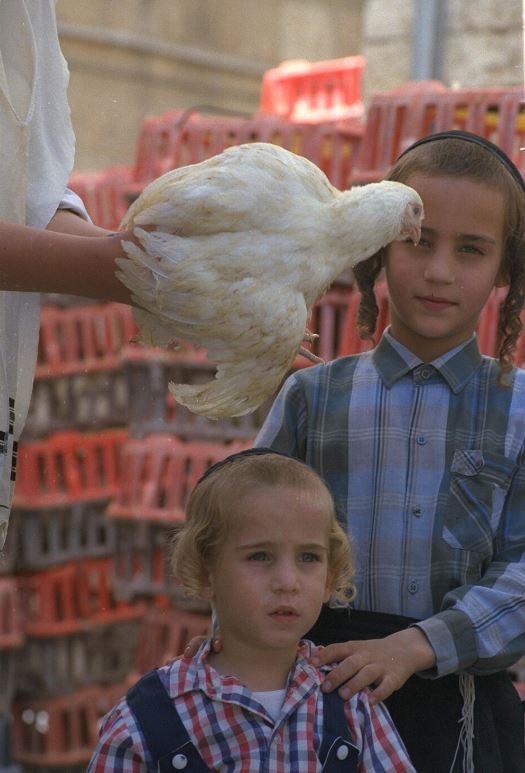
Government Press Office (Israel), CC BY-SA 3.0 <https://creativecommons.org/licenses/by-sa/3.0>, via Wikimedia Commons
The strongest opponent of Darkei haEmori as well as any other practices he deems foolish or pagan is of course Maimonides.:
“All the above matters are falsehood and lies with which the original idolaters deceived the gentile nations in order to lead them after them. It is not fitting for the Jews who are wise sages to be drawn into such emptiness, nor to consider that they have any value . Whoever believes in [occult arts] of this nature and, in his heart, thinks that they are true and words of wisdom, but are forbidden by the Torah, is foolish and feebleminded. . .For these reasons, when the Torah warned against all these empty matters, it advised [Deuteronomy 18:13]: “Be of perfect faith with God, your Lord.” (Mishneh Torah Avodah Zara 11:16)
And yet, people still continue to do these things. Why? For one thing, as we have seen in this chapter of Chullin, pregnancy and birth are frightening things. In a world before proper medicine and hygiene, superstitious practices were seen as protection for the mother and baby.
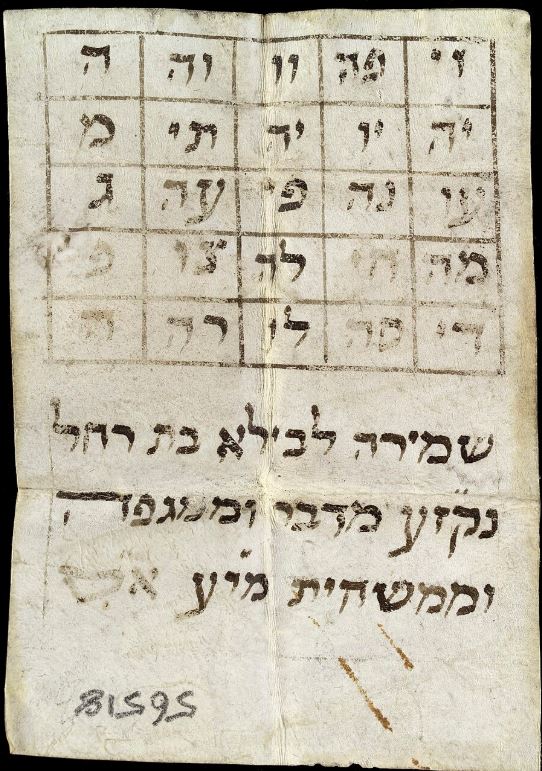
An amulet to protect a woman in labor
CC BY 4.0 <https://creativecommons.org/licenses/by/4.0>, via Wikimedia Commons
But this is only one piece of the puzzle. As Rabbi Aviner writes, everyone likes a quick and easy fix. Perhaps these tricks will make our lives easier. But acting in this way not only contravenes Torah law, it takes away our own intelligence and agency. We need to be tamim, whole, not only with God but with ourselves as human beings.