The Gemara is full of disagreements, sometimes they are even accompanied by insults. But on our daf two students of Rabbi Yohanan are shocked that a Babylonian amora could disrespect the statement of their teacher:
“When Rav Oshaya ascended he found Rabbi Ami, and he said this halakha before him: This is what Ulla said and this is what Rav Naḥman responded to him. Rav Oshaya said to Rabbi Ami: And just because Rav Naḥman is the son-in-law of the family of the Nasi, can he demean the halakhic statement of Rabbi Yoḥanan?” (Chullin 124a)
Gemara learners encounter Rabbi Yohanan on nearly every page of the Bavli as well as throughout the Yerushalmi. He is considered the “father” of the Yerushalmi even though it was only redacted about a century after his time. Rabbi Yohanan was a second generation amora, active in the Land of Israel but with influence far beyond. He lived in the third century CE, during a time of political and economic upheaval in the Roman Empire and consequently also in Israel.
Rabbi Yohanan’s life was filled with tragedy. He was orphaned from both his parents already at birth:
“Rabbi Yoḥanan when his mother was pregnant with him, his father died; and when she gave birth to him, his mother died.” (Kiddushin 31b)
He suffered from illness and lost ten of his children (Berachot 5b). Despite his deep belief in God and the Torah, he did not welcome suffering as an expiation of sin:
“Rabbi Yoḥanan fell ill. Rabbi Ḥanina entered to visit him, and said to him: Is your suffering dear to you? Rabbi Yoḥanan said to him: neither this suffering nor its reward.” (Berachot 5b)
Although Rabbi Yohanan was a promising scholar who studied under Rabbi Yehudah haNasi in his youth (Chullin 137b), he was very poor and at one point he and his colleague Ilfa decided to leave the bet midrash and seek their fortune:
“Ilfa and Rabbi Yoḥanan studied Torah and they became very hard-pressed for money. They said: Let us get up and go and engage in commerce. They went and sat under a dilapidated wall and were eating bread, when two ministering angels arrived.” (Taanit 21a)
In the continuation of the story, Rabbi Yohanan overhears the angel say that one of the two men will succeed in learning. He understands that since Ilfa did not hear the angel, it must be he who will be the success. He returns to the Bet Midrash, where he thrives. However, to survive he must live a life of poverty and sell off any inheritance he might have had. He does not regret this choice:
“Rabbi Yoḥanan was strolling and ascending from Tiberias to Tzippori, and Rabbi Ḥiyya bar Abba was next to him. They arrived at a certain agricultural estate. Rabbi Yoḥanan said: ‘This agricultural estate was mine, and I sold it in order to engage in Torah study.’ They arrived at a certain vineyard. Rabbi Yoḥanan said: ‘This vineyard was mine and I sold it in order to engage in Torah study.’ They arrived at a certain olive grove. Rabbi Yoḥanan said: ‘The same is true regarding this.’ Rabbi Ḥiyya bar Abba began crying. [Rabbi Yoḥanan] said to him: ‘Why are you crying?’ He said to him: ‘I am crying because you did not leave anything for your old age.’ He said to him: ‘Ḥiyya my son, is it inconsequential in your eyes what I did, that I sold something that was given in six days, But the Torah was given in forty days?” (Shir haShirim Rabba 8:7)
Although not wealthy, Rabbi Yohanan was handsome. The Gemara relates that women would look at him when they exited the mikveh so that they would have children as beautiful as he was. Here is how the Gemara describes his good looks:
“One who wishes to see the beauty of Rabbi Yoḥanan should bring a silver goblet from the smithy and fill it with red pomegranate seeds and place a diadem of red roses upon the lip of the goblet, and position it between the sunlight and shade. That luster is a semblance of Rabbi Yoḥanan’s beauty.” (Bava Metzia 84a)
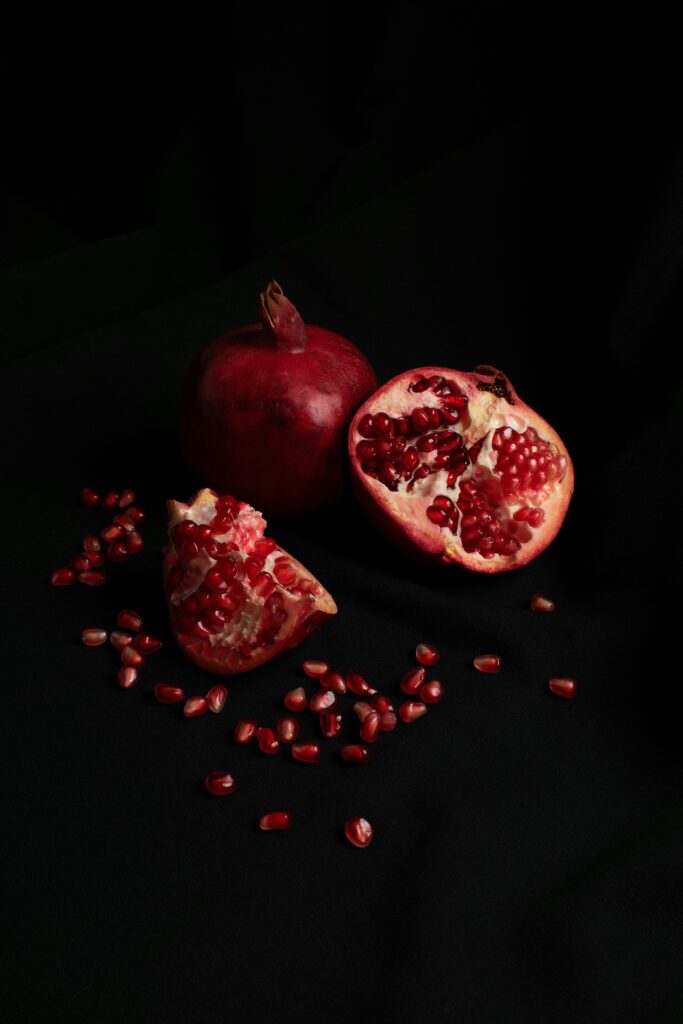
Margarita Zueva, Unsplash
Rabbi Yohanan studied under Rabbi Oshaya, one of the great collectors of beraitot (see here ). He also was a student of Rabbi Hanina bar Hama and Rabbi Yannai. He left Zippori and established himself in Tiberias, where he raised the next generation of scholars: Rabbi Ami, Rabbi Asi, Rabbi Abahu, Rabba bar bar Hanna and others. His famous study and sparring partner was Resh Lakish.
As an Eretz Yisrael teacher, Hebrew and the Land of Israel were very important to him. According to Rabbi Yohanan, angels do not know Aramaic so one must pray in Hebrew (Shabbat 12b).
While he also taught beautiful Aggadah, Rabbi Yohanan’s greatness was in establishing Rebbe’s Mishnah as the standard text of Jewish law. While he knew many beraitot and quoted them, he understood that the Mishnah needed to be the bottom line:
“They asked before Rabbi Yoḥanan: What do you say? He said, I have only the Mishnah” (Yerushalmi Terumot 2:1)
However, even the Mishnah includes multiple opinions. How can we determine halachah? Rabbi Yohanan established rules, as we see here:
“Rabbi Ya’akov bar Idi said that Rabbi Yoḥanan said: In the case of a dispute between Rabbi Meir and Rabbi Yehuda, the halakha is in accordance with the opinion of Rabbi Yehuda; between Rabbi Yehuda and Rabbi Yosei, the halakha is in accordance with the opinion of Rabbi Yosei; and, needless to say, between Rabbi Meir and Rabbi Yosei, the halakha is in accordance with the opinion of Rabbi Yosei.” (Eruvin 46b)
These rules were used to develop the great books of halacha that followed the Mishnah, like Maimonides’ Mishneh Torah and the Shulhan Aruch.
Rabbi Yohanan modestly declared that he did not know what his place would be in the next world. Therefore he asked his students to bury him in neutral clothes, not black like a sinner nor white like a saint:
“Rabbi Yoḥanan, when he was departing from the world, said to those who needed to tend to him: ‘Bury me in garments dyed green, not white and not black, so if I stand among the righteous we will not be shamed, and if I stand among the wicked we will not be disgraced.’” (Bereshit Rabba 96:5)
Despite his doubts, it seems that Rabbi Yohanan not only got to heaven but was able to bring one of the great Rabbinic sinners, Elisha ben Abuya in with him (See Hagigah 15b). His renown was so great thar he was even able to overcome the heavenly guards:
“A certain eulogizer began his eulogy of Rabbi Yoḥanan with the following: Even the guard at the entrance could not stand before you, our rabbi.” (Hagigah 15b)
Great in life, Rabbi Yohanan’s legacy continued after his death, even until today.