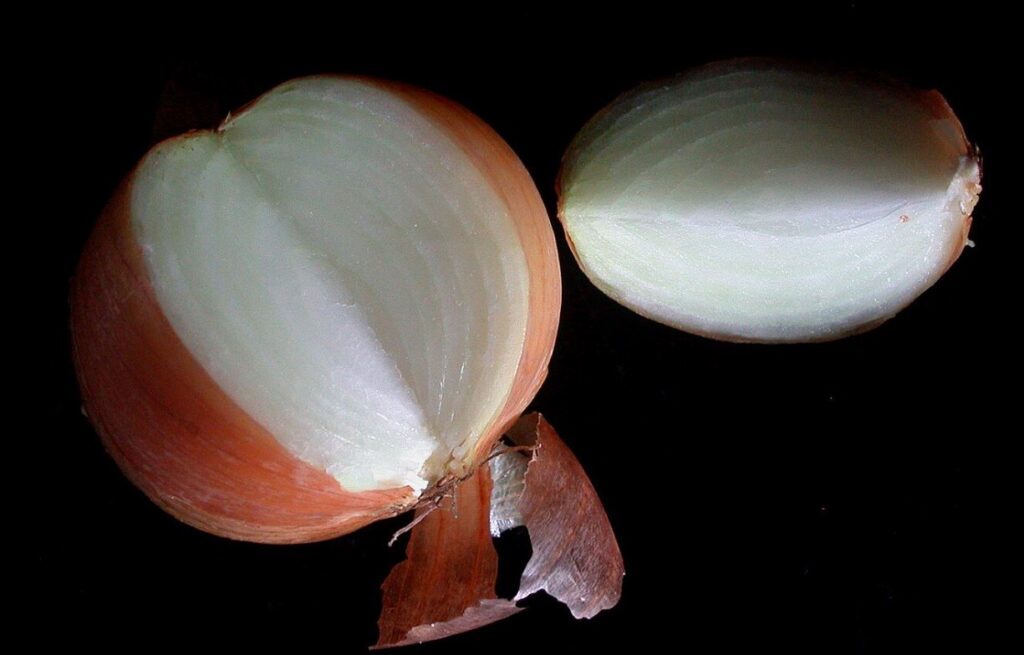
Are you as complex as an onion? Our Gemara talks about the layers of the onion and how they might protect against impurity:
“But didn’t we learn that Rabbi Yehuda says: There are three peels surrounding an onion.” (Chullin 119b)
Onions are ubiquitous in the literature of Chazal. They are a very ancient food, cultivated for at least seven millennia. Onions are depicted on Egyptian pyramids and appear in four-thousand year old recipes from Mesopotamia. We have found remains of Bronze Age onions in Jericho and onions placed on the eyes of Pharaoh Ramses IV. Onions are mentioned by Herodotus as constituting part of slave wages, something that reminds us of the only place onions appear in the Torah, when the Israelites complain about missing them:
“We remember the fish that we used to eat free in Egypt, the cucumbers, the melons, the leeks, the onions, and the garlic” (Bamidbar 11:5)
The Midrash, emphasizing the superiority of the heavenly manna, explains that it could taste like anything except these foods, because these are unhealthy and God wanted to protect the Israelites from them:
“R. Shimon says: The manna would change for them to any flavor they desired, except for (that of) these five things” (Sifrei Bamidbar 87:1)
Onions grow from seeds and they have leaves and flowers but the part we eat is the bulb that grows underground. Sometimes bulbs were left in the soil so that the flowers would mature and provide seeds for the next season. These are called אמהות של בצלים , the mothers of the onions (Mishnah Peah 3:4).
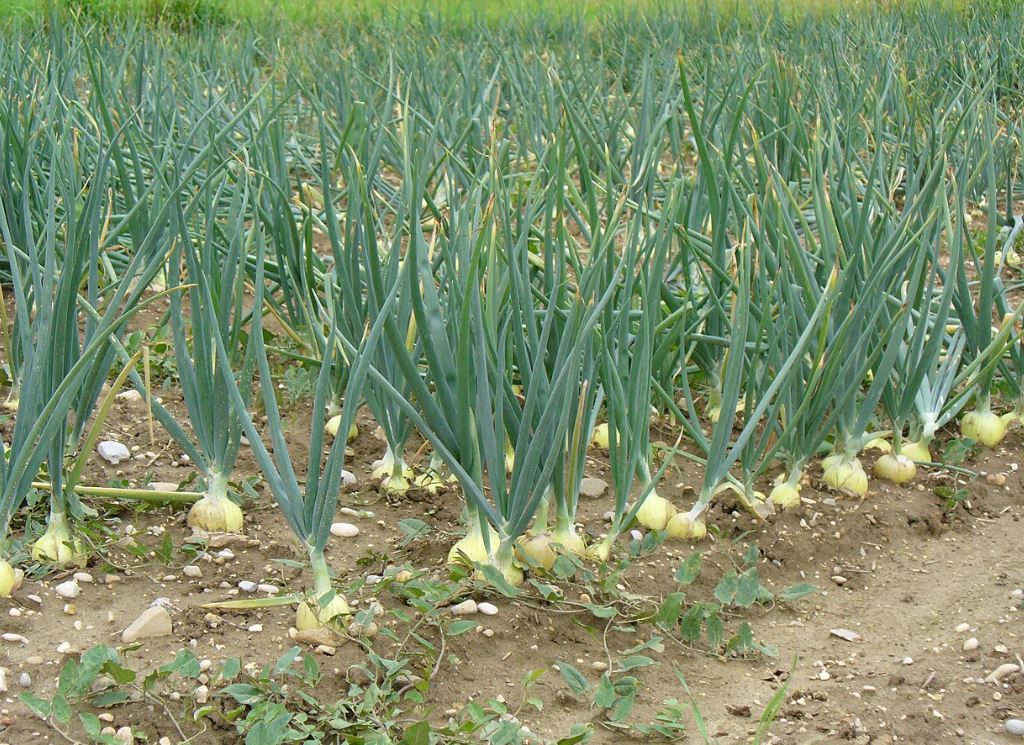
Rainer Haessner, CC BY-SA 3.0 <http://creativecommons.org/licenses/by-sa/3.0/>, via Wikimedia Commons
The Rabbis discuss two species of onions, one small and hard that was eaten by the country people and called כופרי, literally village. The others were called בני מדינה, “town onions” and these were bigger and better and eaten by the people of the town, the citizens of the polis known as politicians!
“Rabbi Judah says: they give terumah from town onions for those from the village, but not from village onions for those from the town, since these are the food of its principal citizens (politikin)” (Mishnah Terumah 2:5)
There is even a variety of onion named for its place of origin in Israel, the scallion from Ashkelon.
The main characteristic of the onion is its strong taste. It is this quality that makes it complicated in terms of kashrut: it can retain and impart flavor, thereby making meaty things milky and vice versa. The Gemara compares forbidden food to onions and leeks – would an onion in a similar proportion to the forbidden food give flavor to the whole dish? In that case the food is considered non- kosher:
“Rabbi Abbahu says that Rabbi Yoḥanan says: With regard to all forbidden foods that are in the Torah, we assess the mixture as though the forbidden food were onion or leek.” (Chullin 97b)
Were onions considered a healthy food? Depends on who you ask. For some, an onion in your diet was considered a symbol of a simple, ascetic lifestyle, as we see in this catchy statement of Rabbi Yehuda bar Ilai:
“Rabba bar bar Ḥana said that Rabbi Yoḥanan said, citing Rabbi Yehuda, son of Rabbi Ilai: Eat an onion [batzal] and sit in the shade [batzel], but do not eat geese and chickens, as your heart will pursue you, [i.e., you will develop a taste for luxuries].” (Pesachim 114a)
However other sources see the sharpness of the onion as a detriment to health:
“ ‘You shall be devoured by the sword’ (Isaiah 1:20): Rava says: you shall eat food that harms the body like a sword, e.g., coarse grains of salt, hard barley bread, and onions. As the Master said: Dried bakery bread eaten with salt and onions harms the body like swords.” (Kiddushin 62a)
Maimonides, drawing on his medical knowledge, chooses a middle path: onions should be eaten but sparingly:
“There are [other] foods which are harmful, but their harmful effects do not compare to those first [mentioned]. Therefore, a person ought to eat them only sparingly and after intervals of many days. He should not eat them regularly as his main fare or constantly as a side dish with his food. They are . . . leeks, onions, garlic, mustard and radishes.” (Mishneh Torah Hilchot Deot 4:9)
There is one situation where onions are definitely dangerous to your health: when they are left peeled overnight. In that case, at least according to Rabbi Shimon bar Yohai, they are absolutely deadly because an evil spirit (רוח רעה) will enter them:
“Rabbi Shimon ben Yoḥai says: There are five actions which one who performs them is held liable for his own life, and his blood is upon his own head, One who eats peeled garlic or a peeled onion or a peeled egg, and one who drinks diluted drinks; when they were left overnight.” (Niddah 17a)
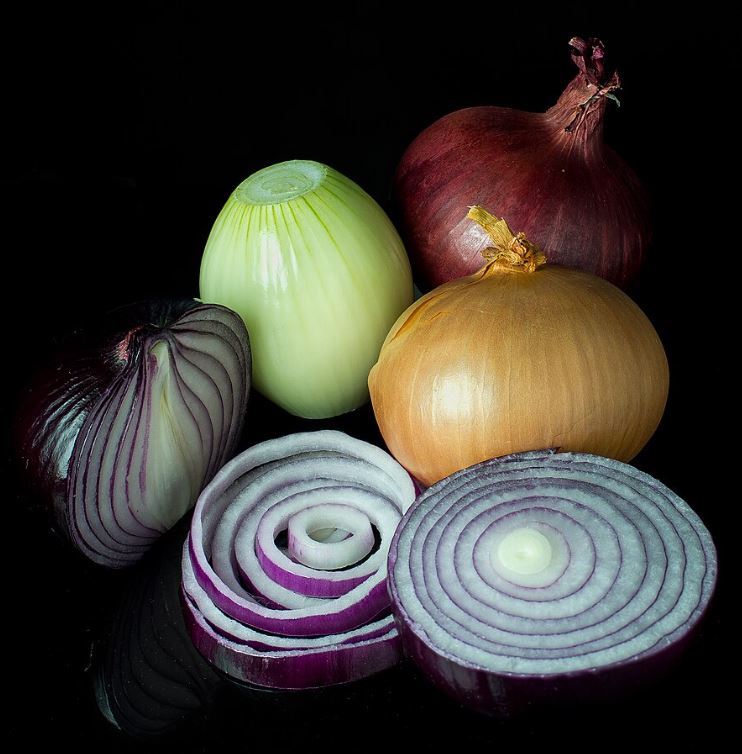
User:Colin / Wikimedia Commons
The onion lent itself to various proverbs. In Arabic, the expression “yom asal yom basal” means one day is honey, the next is onion ; life has ups and downs. In Yiddish you can curse someone that he may grow like an onion, with his head in the ground and his feet in the air. It also was given as a nickname. A neighborhood in Jerusalem is called Abu Basal, father of the onion, after the vegetable seller who helped found it.
The strangest onion name appears as part of a long legend about the afterlife. A man given a vision of Heaven and Hell, sees two people from his town, Ashkelon, and then he sees a woman named Miriam the Onion Leaf’s daughter, who is suffering a terrible fate in Hell:
“He also saw Miriam, Onion-leaf’s daughter. . . . Rebbi Yose ben Ḥanina said, the hinge of Hell’s door was fixed in her ear. He asked them, why? They told him, because she fasted and made herself famous. Some say, she fasted one day and was dissolute two.” (Yerushalmi Hagigah 2:2)
Why did Miriam deserve this fate and how is her name significant? Rabbi Yehuda Amital offers a fascinating explanation. The onion is all layers and covers. It literally has nothing inside once the layers are removed. Miriam’s outer layer was all about her piety and her fasts. But what about on the inside? Here she was less holy and perhaps not holy at all. Rabbi Amital says an onion is a symbol of hypocrisy. We must be careful not to be like the onion, presenting a carefully curated self to the world while not really having much on the inside.
Who knew there were so many layers to the onion!
Laval University, CC BY-SA 4.0 <https://creativecommons.org/licenses/by-sa/4.0>, via Wikimedia Commons