What is the law regarding the love child of a tzvi and a goat? For that you will need to learn the passage in Chullin 132a, here we are going to be looking at the definition of a tzvi, often (mis)translated as a deer, but in reality a gazelle.
Gazelles used to be ubiquitous in the Land of Israel. While they were not domesticated, they were definitely eaten, as the Torah often mentioned eating the meat of both the tzvi (gazelle) and the ayal (deer):
“Eat it, however, as the gazelle and the deer are eaten” (Devarim 12:22)
Because the gazelle was wild it needed to be trapped in order to be eaten, as we see in the laws of Shabbat:
“Rabbi Yehuda says: One who traps a bird into a closet or cage, and one who traps a deer into a house is liable.” (Mishnah Shabbat 13:5)
This wildness is used in a beautiful parable about why God loves converts, who chose the “enclosure” of halacha over their wild and free life:
“God loves the strangers very much. This is similar to a king who had a flock . . . Once, a gazelle entered with the flock, and went to the goats and the ewes and grazed with them. When the king went out to the field, he loved the gazelle the most. He would command the shepherd to be careful with the gazelle, so that no one would harm it. . . The shepherd said to the king, ‘My lord the king, how many sheep, goats, ewes, and goats do you have, yet you only warn me about the gazelle every day?’ The sheep are used to grazing . . . but the gazelle came and lived with us, leaving the wide open space of the wilderness where the gazelles and deer roam. We must treat it well. Similarly, God said, ‘I must treat the stranger well, for he left his family and father’s house and came to Me.” (Midrash Tehillim 146)
Gazelles are members of the antelope family. Besides being beautiful, they are amazingly fast and can run about eighty kilometers an hour. When the book of Samuel wants to describe the speed of Asael, Yoav ben Zeruyah’s brother, it says that he was as swift as a gazelle (Samuel II 2:18). Later Rabbi Yehuda ben Tema in Ethics of the Fathers (5:20) says a person should run like a gazelle to do the will of God. Gazelles also have sharp eyes and are intelligent enough to distinguish people they are familiar with from others whom they perceive as threatening.
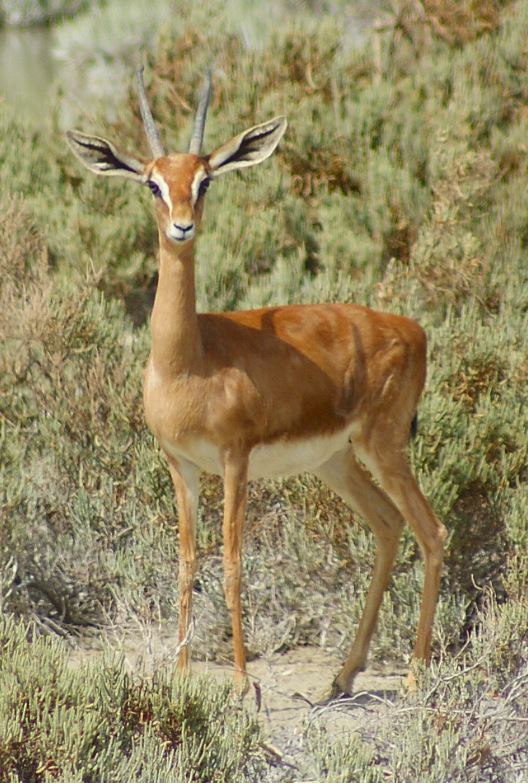
An Eretz Yisrael gazelle
Nepenthes, CC BY-SA 4.0 <https://creativecommons.org/licenses/by-sa/4.0>, via Wikimedia Commons
Gazelles are social animals and live in female dominated packs. They are herbivores and as such are considered a nuisance by farmers who set out traps and poison for them. That and the fact that they are kosher and halal meant that they were hunted, almost to extinction. Today there are laws in the State of Israel to protect gazelles and there are natural habitats designed to help them survive. Still, the modern world is not good for them. New roads and highways carve up their living space and limit their access to grazing areas. A prime example is the Begin Highway in Jerusalem. Before the highway was built in the 1990s there was a herd of about thirty gazelles that roamed the area. One survived from the original herd. The city built the lovely Gazelle Valley עמק הצבאים and brought in new animals but they have limited mobility. Today there are about four thousand gazelles in Israel.
The gazelle is such a beautiful animal that love poems like the Song of Songs often use them to describe the beloved:
“Hurry, my beloved, Swift as a gazelle or a young stag, To the hills of spices!” (Song of Songs 8:14)
The commentary of Rabbi Moshe Alsheich says that the gazelle here is an allegory for God. The Jewish people say God, You should return to the land of Israel, Your home, but be like a gazelle that always turns its head and looks back when it runs. So too, You should always be checking on us in exile. A different midrash says that the gazelle is actually the Jews. Just as the gazelle remembers its home no matter how far it travels, so do we.
The Arabs also noted the beauty of the gazelle and used it in their own love poetry. Some say that the Arabic word for love poem, ghazal, comes from the word gazelle. Gazelles decorated the stunning mosaics in the eighth century Hisham’s Palace in Jericho and can still be seen in Middle Eastern art.
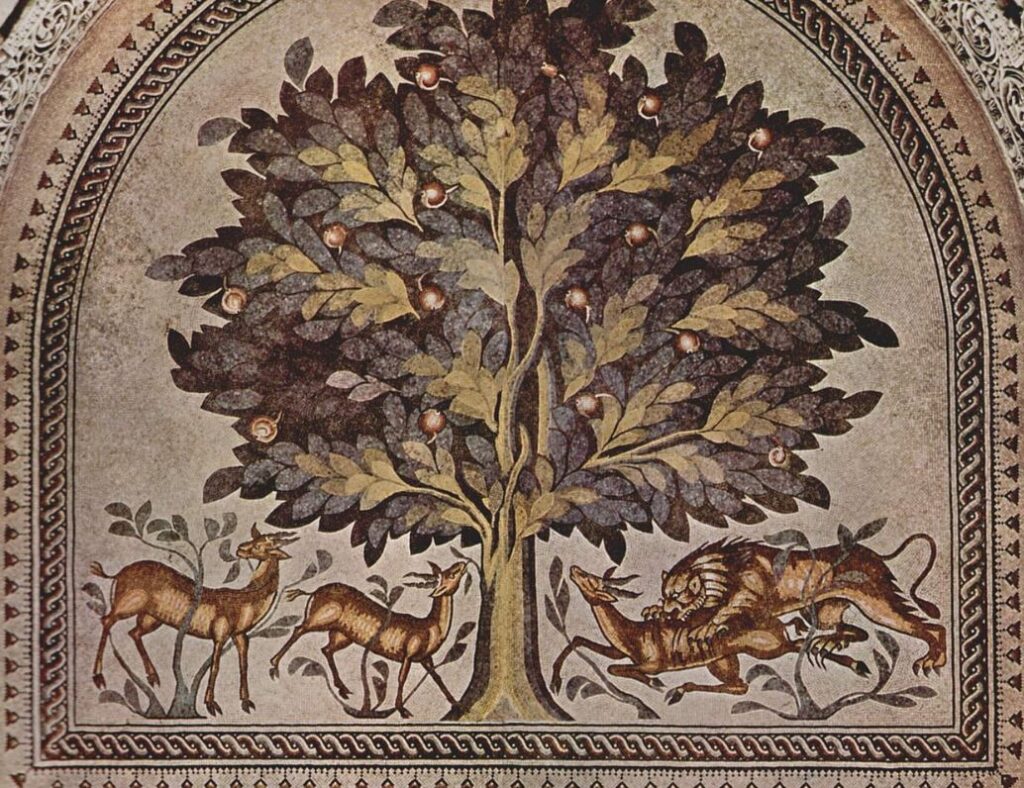
The Tree of Life mosaic in Hisham’s Palace
Arabischer Mosaizist um 735, Public domain, via Wikimedia Commons
The word tzvi became a synonym for choice or beautiful. The prophet Ezekiel says that the Land of Israel is tzvi to all the other lands:
בַּיּוֹם הַהוּא נָשָׂאתִי יָדִי לָהֶם לְהֽוֹצִיאָם מֵאֶרֶץ מִצְרָיִם אֶל־אֶרֶץ אֲשֶׁר־תַּרְתִּי לָהֶם זָבת חָלָב וּדְבַשׁ צְבִי הִיא לְכָל־הָאֲרָצֽוֹת׃
“That same day I swore to them to take them out of the land of Egypt into a land flowing with milk and honey, a land which I had sought out for them, the fairest of all lands.” (Ezekiel 20:6)
The Metzudat Zion explains that tzvi here means beautiful and dignified. The rabbis added that the land of Israel is like the gazelle: just like the gazelle’s skin expands when it is full of food, so too the land expands when it has many residents and contracts when it has few.
The gazelle was well known to the inhabitants of the Land of Israel but when Jews went into the Diaspora, particularly to northern Europe, the word tzvi was sometimes mistranslated as deer, an animal that was familiar to Europeans. But the deer and the gazelle come from different families and have different characteristics. Perhaps the most obvious one is their horns. Deer have antlers made of solid bone and they are often forked. The antlers are only on the male animals and they shed them every year. Gazelles on the other hand have horns that have an inner core of bone and an outer covering of keratin. The inner core can be removed and then you have a hollow horn, or a shofar. However, gazelles do not shed their horns. This confusion shows up in the Tosfot Yom Tov’s (Prague 17th century) explanation of the Mishnaic phrase “to put your money on the horns of the gazelle,” i.e., to lose it:
“He placed his money upon the horn of a gazelle. A gazelle is swift of foot—as we learned in Chapter 5 of Pirkei Avot: “Be swift as a gazelle.” Consequently, one who places his money on a gazelle’s horn is bound to lose it, for the gazelle will dash away instantly, and he will be unable to catch it. I have also heard that it is the nature of the gazelle to shed its antlers at a certain time; it might well shed them in some ravine or pit where they would never be found.” (Tosfot Yom Tov Mishnah Ketubot 13:2)

An ayal or deer
Kristjan Teär, CC BY-SA 4.0 <https://creativecommons.org/licenses/by-sa/4.0>, via Wikimedia Commons
With our return to the land, we can recognize and appreciate both the tzvi, the gazelle, and the ayal, the deer.

מינוזיג – MinoZig, CC BY-SA 4.0 <https://creativecommons.org/licenses/by-sa/4.0>, via Wikimedia Commons