“But when Avimi came from Bei Ḥozai he came and brought a baraita with him” (Chullin 68b)
Traveling was a way of life for many of the Sages. The nehutei traveled from Babylonia to the Land of Israel and back, bringing Torah teachings and halachic rulings from one center to another. Leaders traveled to Rome to intercede for the Jews before the government. Yet other rabbis made it their business to travel to far flung Jewish communities to teach and inspire. One of these places was Bei Hozai. This is the province of Khuzestan in southwestern Iran. It was also known in ancient times as Elam, one of the great empires, whose capital was Susa, or as we know it, Shushan:
“In those days, when King Ahasuerus occupied the royal throne in the fortress Shushan” (Esther 1:2)
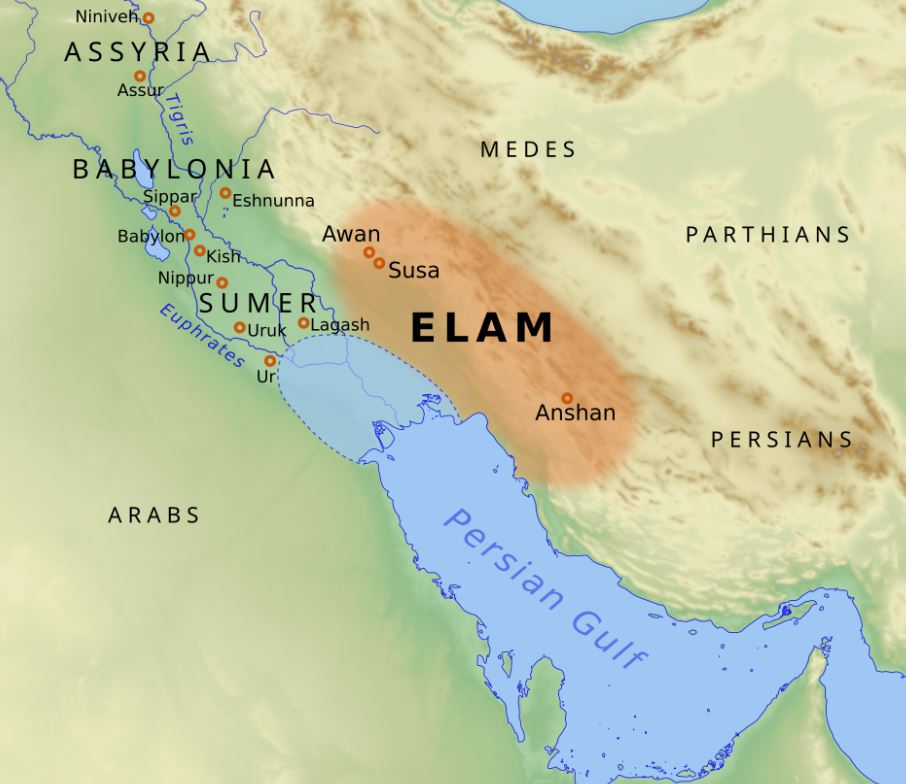
Near East topographic map-blank.svg: SémhurFile:Elam-map-PL.svg: Wkotwicaderivative work: Morningstar1814, CC BY-SA 3.0 <https://creativecommons.org/licenses/by-sa/3.0>, via Wikimedia Commons
Bei Hozai was a great distance from the centers of the yeshivot in Babylonia, more than five hundred miles. We hear about caravans traveling back and forth from Nehardea to Bet Hozai, but the round trip took a year:
“where Ravina delayed for the twelve months of the year before issuing a document of authorization for Mar Aḥa, until a caravan went to and returned from Bei Ḥozai.” (Bava Kama 112b)
Shmuel feared the spread of disease from Bet Hozai even though it was so distant:
“They said to Shmuel: There is pestilence in Bei Ḥozai,. Shmuel decreed a fast. They said to him: But it is far. He said: There is no crossing here that will stop” (Taanit 21b)
Bet Hozai was a strong economic center and the Sages had many and complex monetary dealings with the people there, as we see in this example:
“Rav Pappa had twelve thousand dinars that he lent to another in Bei Ḥozai.” (Bava Metzia 46a)
But while we have many references to Bet Hozai, the Rabbis do no look upon it very favorably. When they are discussing matters of geneaology, only the region of Mishon is considered more problematic in terms of lineage than Elam (Bet Hozai’s area):
“Babylonia is healthy. Mishon is dead, Media is sick, and Eilam is moribund.” (Kiddushin 71b)
Even worse, Bet Hozai was considered to be a place of violent and thuggish people as we see in this rather shocking story about Ulla and two Bet Hozai travelers:
“Ulla, on his ascent to Eretz Yisrael, had two residents of Ḥozai join him. one arose and slaughtered the other.” (Nedarim 22a)
But as we see countless times in history, the winners are the ones who get to tell the story. Perhaps the Babylonian Rabbis had an interest in downgrading Bet Hozai in order to elevate their communities? Yair Paz argues that Bet Hozai was not only an important economic center, it was an adnministrative center of the Sassanian Empire. Jews and Christians played significant roles in the government, although they were also persecuted. We have names of Rabbinic figures from Bet Hozai: Avram Hozaa (Gittin 50a), Ravnai Hozaa (Betzah 15b) and others. And we have this unusual story, told by Rabbi Beroka Hozaa about a man in another town in the region, Bei Lefet:
“Rabbi Beroka Ḥoza’a was often found in the market of Bei Lefet, and Elijah the Prophet would often appear to him. Once Rabbi Beroka said to Elijah: Of all the people who come here, is there anyone in this market worthy of the World-to-Come? He said to him: No. In the meantime, Rabbi Beroka saw a man who was wearing black shoes, , and who did not place the sky-blue, dyed thread of ritual fringes on his garment. Elijah said to Rabbi Beroka: That man is worthy of the World-to-Come. Rabbi Beroka ran after the man and said to him: What is your occupation? . . . The man said to him: I am a prison guard and I imprison the men separately and the women separately, and I place my bed between them so that they will not come to transgression. When I see a Jewish woman upon whom gentiles have set their eyes, I risk my life to save her. . . .What is the reason that you do not have threads of ritual fringes, and why do you wear black shoes? The man said to him: Since I come and go among gentiles, I dress this way so that they will not know that I am a Jew. When they issue a decree, I inform the Sages, and they pray for mercy and annul the decree.” (Taanit 22a)
While a story about a hidden Tzaddik is a classic trope in the Talmudic canon, this story has a few interesting and unusual elements. The holy man in this case is a Jew in a sensitive and important government position – a prison guard. He goes “undercover,” dressing like the Gentiles so that he can help Jews.He is able to intercede with the authorities when things go badly for the Jews. All this shows an integrated and relatively strong Jewish population. Perhaps most importantly, when there is trouble this man goes to “the Sages,” meaning there is a local Rabbinical elite in Bei Hozai that he can rely on. All these elements seem to contradict the impression that we had till now, that Bei Hozai is a frontier town, lawless and unlearned.
Bei Hozai: middle of the middle of nowhere or a forgotten center?