The nehutei, those who travel between Israel and Babylonia were a vital link between the two great Torah worlds (see here).Here in Chullin one of them, Ulla, tells us about his colleague חבריא, Rabba bar bar Hana:
“Who are the colleagues [to whom Ulla referred]? It is Rabba bar bar Ḥana, as Rabba bar bar Ḥana says that Rabbi Yoḥanan says: What did Rabbi Eliezer and Rabbi Yehoshua reply to each other?” (Chullin 34a)
Both Ulla and Rabba bar bar Hana were students of Rabbi Yohanan and both frequently traveled back and forth from Israel to Babylonia to transmit their master’s teachings. Rabba bar bar Hana, like Ulla was a member of the third generation of Amoraim. Sometimes they would disagree about what their teacher’s words were but they still would travel and study together::
“Ulla was riding on a donkey and going along, and Rabbi Abba was going along on his right and Rabba bar bar Ḥana on his left.” (Pesachim 53b)
Rabba bar bar Hana was very familiar with both Babylonia and the Land of Israel. He seems to have been originally from Babylonia. When he went to visit Rav Yehuda in Pumbedita, Rav Yehuda says that Hana, i.e, Rabba bar bar Hana’s father is “one of us,” i.e., a Babylonian. Even more telling is this encounter between Rabba bar bar Hana and Resh Lakish, Rabbi Yochanan’s friend and study partner:
“Resh Lakish was swimming in the Jordan River when Rabba bar bar Ḥana came and gave him a hand to help him out. Resh Lakish said to him: My God! I hate you Babylonians, as it is written: “If she be a wall we will build a silver turret upon her, if she be a door we will cover her with boards of cedar” (Song of Songs 8:9). Had you rendered yourselves a solid bloc like a wall and all ascended to Eretz Yisrael in the days of Ezra, you would have been likened to silver, which rot does not infest, Now that you ascended like doors, [and only some of you came to Eretz Yisrael], you are likened to cedar, which rot infests,” (Yoma 9b)
No matter where he was from originally, Rabba bar bar Hana clearly made his home in the Land of Israel. When he visits Babylonia and eats something permitted in Israel but forbidden there, he explains himself by saying that he is planning on returning to Israel and so he keeps those customs (Pesachim 51a)
Rabba bar bar Hana was a student of Rabbi Yochanan and Resh Lakish as well as Rabbi Elazar and Rabbi Yehoshua ben Levi. On his trips to Babylonia he could be found in all the major Torah centers: Pumbedita, Sura, Mahoza. He visited and was respected by the leading Babylonian teachers of the day. When visiting Mahoza, Rav Nahman’s wife Yalta made sure to have him be the one who answered her purity questions:
“Yalta, Rav Naḥman’s wife, brought blood before Rabba bar bar Ḥana, and he deemed her ritually impure.” (Niddah 20b)
His travels were very important in spreading Torah knowledge but it seems that he also loved to see the world. He is full of observations about the places where he has been. As a resident of the Land of Israel he would convey interesting and unusual facts about places in the land, including their distances one from the other (Gittin 4a) but also their characteristics:
“Rabba bar bar Ḥana said: from Jerusalem to Jericho is ten parasangs.. And the sound of the doors of the Sanctuary opening was heard from a distance of eight Shabbat limits, goats that were in Jericho would sneeze from smelling the fragrance of the incense “ (Yoma 39b)
“Rabba bar bar Ḥana said: I myself saw the region flowing with milk and honey of all Eretz Yisrael, and it was the same in area as that which stretches from the city of Bei Mikhsei until the fortress of Tulbanki: Its length twenty-two parasangs and its width six parasangs,” (Ketubot 111b-112a)
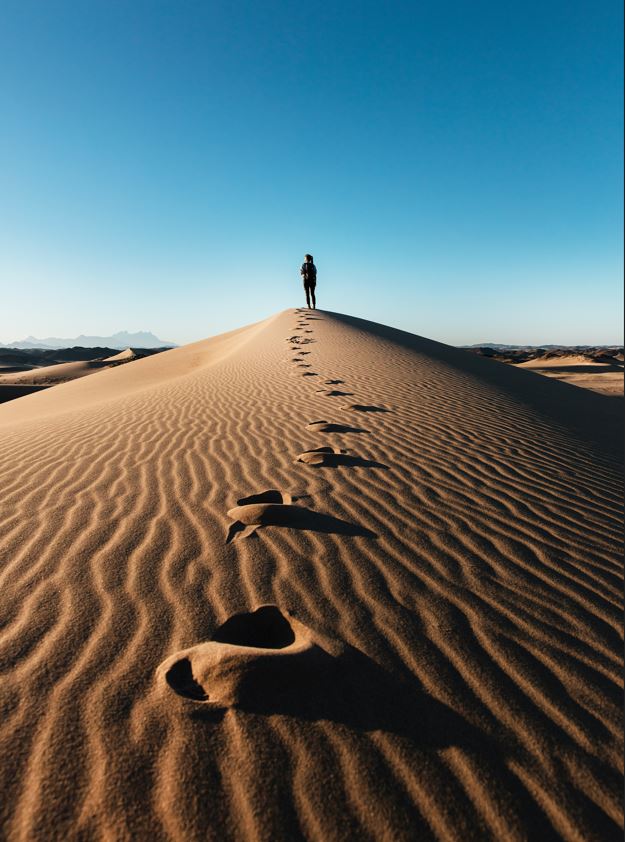
Rabba bar bar Hana is perhaps most famous for a series of travel stories he tells in Bava Batra (73-74). They are full of fantastical details and seem similar to (later) stories about Sinbad the Sailor: giant creatures who look like mountains, massive ocean waves and more. In these stories he visits Mount Sinai and sees the dead Children of Israel, learns about finding water from a wise Arab and is taken to the spot where the followers of Korach were swallowed alive:
“Come, I will show you those who were swallowed by the earth due to the sin of Korah. I saw two rifts in the ground that were issuing smoke. The Arab took a shearing of wool, and dipped it in water, and inserted it on the head of a spear, and placed it in there. And when he removed the wool, it was scorched. He said to me: Listen to what you hear; and I heard that they were saying: Moses and his Torah are true, and they, i.e., we in the earth, are liars.” (Bava Batra 74a)
Much ink has been spilled on trying to understand these stories. Some see them as true and a reflection of God’s wonders (like the Rashbam who comments on the stories in the Gemara). Others attribute the wild tales to exaggeration. Some understand them as allegorical, explaining things about the evil inclination, Israel’s fate in the world and more. Two important figures who follow this path are the Maharsha and Rabbi Abraham Isaac haKohen Kook. An unusual approach by Yaron Zilberstein reads the stories as a veiled biography of Rabba bar bar Hana’s life and his struggles with authority, his emigration and more.
Did Rabba bar bar Hana write one of the earliest travelogues or was he letting us into his inner world?
NEOM UnSplash