Were there Jewish kings after Biblical times? The closest thing to a king for the Jews of Babylonia was someone called the Resh Galuta, or Exilarch. He ruled the community, was very wealthy and sometimes his household was cavalier with halacha. On our daf we hear about some cooking in the Resh Galuta’s house:
“those thighs that were salted in the home of the Exilarch with the sciatic nerve Ravina ruled that they were forbidden, Rav Aḥa bar Rav Ashi ruled that they were permitted. They came and asked Mar bar Rav Ashi. He said to them: My father permitted” (Hullin 97b)
What is the office of Exilarch? Traditional texts like the Seder Olam Zuta say that from the first exile to Babylonia (597 BCE), under King Yehoyachin there was Jewish leadership, sanctioned by the Babylonians and appointed from the dynasty of King David. The first of these rulers is Yehoyachin himself:
“In the thirty-seventh year of the exile of King Yehoyachin of Judah, on the twenty-seventh day of the twelfth month, King Evil-merodach of Babylon, in the year he became king, took note of King Yehoyachin of Judah and released him from prison. He spoke kindly to him, and gave him a throne above those of other kings who were with him in Babylon” (Kings II 25: 27-28)
The name, both in Aramaic – Resh Galuta , the head of the exile – and in English – Exilarch, comes from the term galut. Today we use that word to describe all the many places Jews wandered to in their centuries of exile from the Land of Israel, but the original “galut” was in Babylonia. The prophet Jeremiah sends a letter to the “elders of the Golah” in Babylonia (Jeremiah 29:1) and the prophet Ezekiel’s book begins by telling us that he is ensconced in the community of the “Golah” by the Chebar River:
וַיְהִ֣י ׀ בִּשְׁלֹשִׁ֣ים שָׁנָ֗ה בָּֽרְבִיעִי֙ בַּחֲמִשָּׁ֣ה לַחֹ֔דֶשׁ וַאֲנִ֥י בְתֽוֹךְ־הַגּוֹלָ֖ה עַל־נְהַר־כְּבָ֑ר נִפְתְּחוּ֙ הַשָּׁמַ֔יִם וָאֶרְאֶ֖ה מַרְא֥וֹת אֱלֹהִֽים׃
“In the thirtieth year, on the fifth day of the fourth month, when I was in the community of exiles (Golah) by the Chebar Canal, the heavens opened and I saw visions of God.” (Ezekiel 1:1)
Despite the claim of antiquity of the Resh Galuta’s office, we do not hear about it from any sources until after the destruction of the Second Temple. Then a leadership begins to emerge in Babylonia, one that even challenges the Sages of the Land of Israel (see here). The Resh Galuta became more powerful and established under the Sassanian rulers in the third century CE. They were the de facto rulers of the large Jewish community in Babylonia. They collected the taxes, ran the courts, supported the yeshivot and gave charity to the needy.
The power of the Resh Galuta sometimes led to conflicts between them and the heads of the Rabbinical academies. These conflicts were sometimes about halacha, but they were also about authority and respect. There seems to have been a class of Sages that actually worked for the Resh Galuta and they had to mark their clothes as such, as we see in this passage in Shabbat:
“And this is like that which Shmuel said to Rav Ḥinnana bar Sheila: All of the Sages affiliated with the house of the Exilarch may not go out on Shabbat with sealed cloaks” (Shabbat 58a)
Rashi they would make seals for their Talitot like slaves to show that they were subject to the Resh Galuta.
Other Rabbis insisted on halachic independence and enforced their will on the Resh Galuta’s household, often to the dismay (and resistance) of his servants. When Rav Sheshet told his servant to remove the eiruv in the Resh Galuta’s house that Rav Nahman had permitted, the servants did not take kindly to this intervention:
“Rav Naḥman went and performed an action in the house of the Exilarch in accordance with his own opinion. [He constructed an opening in the form of a doorway such that the upper reed was not in contact with the lower reeds.] Rav Sheshet said to his attendant, Rav Gadda: Go, remove those reeds and throw them away. The attendant went, removed the reeds, and threw them away. Members of the Exilarch’s court found him and imprisoned him.” (Eruvin 11b)
Sometimes the stories about the actions of the Resh Galuta’s servants are extreme. Did they really roast a pig in the same oven as kosher meat?
“And Levi said: Even lean kosher meat that one roasted with fatty non-kosher meat is permitted. What is the reason, it is merely an aroma, and an aroma is nothing. Levi took action, in the house of the Exilarch with a kid and something else [a pig]” (Pesachim 76b)
Could they have tormented a respected teacher like Amram Hasid just because he was strict about their observance of the law?
“When the members of the Exilarch’s house would afflict Rav Amram the pious they would make him lie down to sleep on the snow. The next day they would say to him: What is preferable for the Master for us to bring him to eat? Rav Amram said to himself: Anything I say to them, they will do the opposite. He said to them: Bring me red meat roasted over coals and diluted wine. They brought him fatty meat roasted over coals and undiluted wine” (Gittin 67b)
In the story here in Chullin, the servants do seem to have acted dubiously but then they come and ask the Sages about the halacha. Who was the Resh Galuta in our story? In the time of Rav Ashi, who gives the final word on the kashrut of the meat, the Resh Galuta was named Huna bar Natan. We hear his name in a number of places in the Gemara and he seems to have been both a respected Sage and a powerful leader. The king in his time, Yazdegerd I, had great respect for him (see Zevachim 19a). Despite his knowledge and power he subjugates himself to Rav Ashi’s authority:
“Rav Aḥa, son of Rava, says: I also say from the days of Rabbi Yehuda HaNasi and until Rav Ashi, we do not find Torah and greatness in secular matters, in one place. But wasn’t there Huna bar Natan,? Huna bar Natan is different, as he himself was subordinate to Rav Ashi,” (Gittin 59a)
Some scholars suggest that Huna bar Natan’s favorable attitude to the Rabbis combined with his good relationship with the Sassanian authorities, created the conditions for the editing of the Talmud that took place under Ravina and Rav Ashi. Power has its advantages.
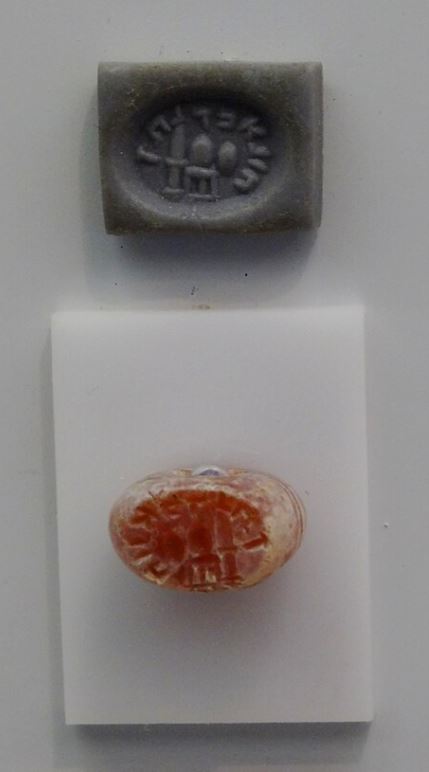
A seal with the name Huna bar Natan
Hanay, CC BY-SA 3.0 <https://creativecommons.org/licenses/by-sa/3.0>, via Wikimedia Commons