You just finished a hearty meal. Naturally, at the end of the meal you had some salt, following the rule in Berachot:
“And Rava bar Shmuel said in the name of Rabbi Ḥiyya: After all eating, eat salt and after all drinking, drink water and you will not be harmed.” (Berachot 40a)
Unfortunately, your host forgot to provide napkins. Using your dirty hands, you wipe something off your face, inadvertently hurting your eyes in the process. This is the situation the Rabbis were trying to prevent by instituting hand washing at the end of the meal as well as at the beginning:
“Rav Yehuda, son of Rabbi Ḥiyya, says: For what reason did the Sages say that final waters are an obligation? It is because Sdom salt is sometimes present, which blinds the eyes.” (Hullin 105b)
What is this Sdom salt and why is it particularly dangerous? Salt is made by evaporating sea water, collecting salt by the shores of the sea, or mining it from a mountain with salt deposits. The most obvious place to collect salt in Israel is the Dead Sea, known in Hebrew as the Salt Sea ים המלח, and the mountains nearby, like Mount Sdom.
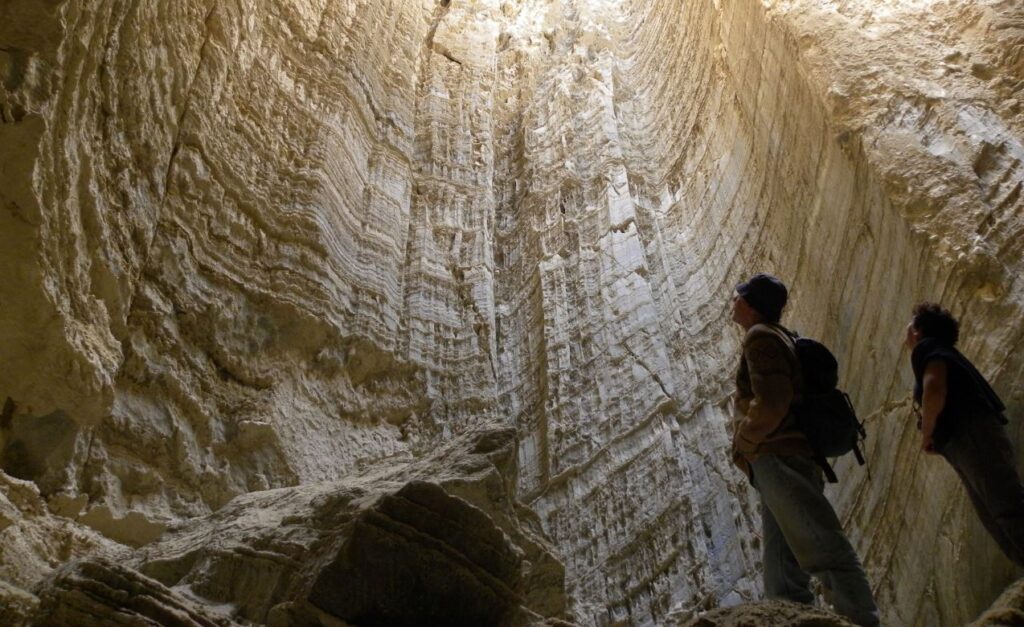
A salt cave inside Mount Sdom
Wilson44691, CC BY-SA 3.0 <https://creativecommons.org/licenses/by-sa/3.0>, via Wikimedia Commons
Sodom and Gomorrah, located nearby, are naturally associated with salt. When fleeing the city, Lot’s wife looks back and is turned into a pillar of salt:
“Lot’s wife looked back, and she thereupon turned into a pillar of salt.” (Bereshit 19:26)
When the Torah wants to refer to a place that has been devastated, it refers to Sodom and Gomorrah that have been burned by salt and sulphur:
“all its soil devastated by sulfur and salt, beyond sowing and producing, no grass growing in it, just like the upheaval of Sodom and Gomorrah, Admah and Zeboiim, which GOD overthrew in fierce anger” (Devarim 29:22)
Anyone who has been to the Dead Sea region has seen the massive salt deposits in and around the sea and smelled the heavy sulfur smell there. But salt is not only about destruction and harm. It was one of the most useful products in ancient times. Salt was used like we use it today, to improve taste. It was also an essential preservative in a world without refrigeration. Besides food, salt was used for industrial purposes: to tan leather, make glass and dye fabrics
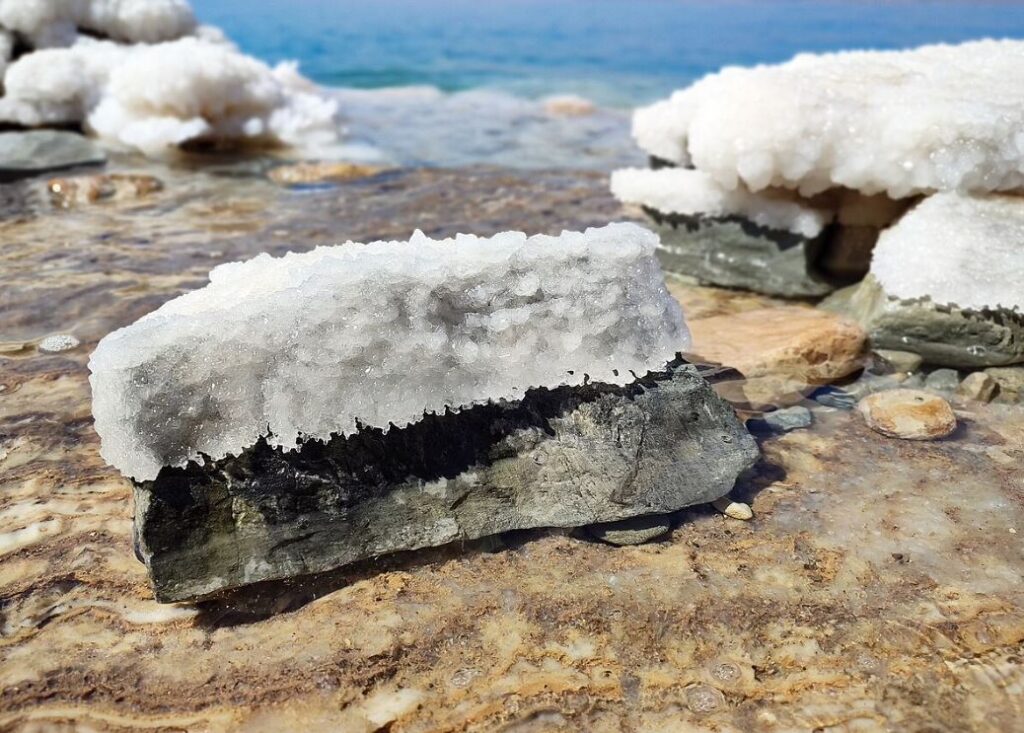
Salt encrusted rock at the Dead Sea
Petar Milošević, CC BY-SA 4.0 <https://creativecommons.org/licenses/by-sa/4.0>, via Wikimedia Commons
In the Torah, salt symbolizes something eternal. God’s covenant with Aaron is called brit melach, a covenant of salt, because it will last forever:
“All the sacred gifts that the Israelites set aside for GOD I give to you, to your sons, and to the daughters that are with you, as a due for all time. It shall be an everlasting covenant of salt before GOD for you and for your offspring as well.” (Bamidbar 18:19)
Rashi: This means that He made a covenant with Aaron by means of something which is wholesome and lasting and keeps other things wholesome
Because salt symbolizes permanence, it is always added to sacrifices, to show the power of our covenant with God.
“You shall season your every offering of grain with salt; you shall not omit from your grain offering the salt of your covenant with God; with all your offerings you must offer salt” (VaYikra 2:13)
The salt for the sacrifices was kept in a special chamber in the Temple courtyard (Mishnah Middot 5:3). Despite their warning about its dangers, the Rabbis explain that the salt used on the sacrifices is specifically Sdom salt:
“ ‘And you shall not omit [tashbit] salt from your meal offering,’ teaches that one should bring salt that never rests [shovetet]. And what is this? This is referring to salt of Sdom.” (Menachot 21a)
Rashi: that never rests – available in summer and winter
Sdom salt also appears in another Temple context. It was one of the ingredients used to prepare the incense. This is (perhaps) hinted at one of the verses about the incense, which uses the word .ממלחRashi explains that to mean mixed well but Ibn Ezra connects it to melach, and says it refers to the salt in the incense:
ָועשִׂ֤יתָ אֹתָהּ֙ קְטֹ֔רֶת רֹ֖קַח מַעֲשֵׂ֣ה רוֹקֵ֑חַ מְמֻלָּ֖ח טָה֥וֹר קֹֽדֶשׁ׃
“Make them into incense, a compound expertly blended, refined, pure, sacred.” (Shmot 30:35)
Ibn Ezra: Memullach means seasoned with salt from Sdom.
This salt is specifically Sdom salt as we see in the famous passage describing the incense ingredients:
“The Sages taught: How is the blending of the incense performed? . . Sdom salt is brought by the volume of a quarter-kav” (Keritot 6a)
Why would you need salt, and specifically Sdom salt, in the incense? Professor Zohar Amar suggests that the salt is a preservative, to keep the incense fresh and the smell strong. Incense was prepared once a year and you did not want the smell to dissipate or spoil. And why this particular kind? Amar suggests, based on a translation by Rabbi Saadia Gaon, that this Sdom salt (there are a few varieties) is carnalite. Carnalite’s value is that unlike regular table salt, it does not cause the spices to crackle and explode. This would have been a dangerous component in a situation that already could lead to accidents, as we see in this passage:
“They used to instruct him: Be careful not to begin immediately in front of you or else you may burn yourself.” (Mishnah Tamid 6:3)
What is the law today about Sdom salt and washing your hands at the end of the meal? Maimonides, and following him, the Shulhan Arukh, say we must do mayim achronim:
“Whenever bread [is eaten] with salt, it is necessary to wash one’s hands afterward, lest it contain Sdom salt or salt that resembles Sdom salt, and [after eating,] one [inadvertently] pass one’s hands over one’s eyes and blind them. This – [the possibility of acrid] salt – is the reason why we are obligated to wash after eating.” (Maimonides Hilchot Berachot 6:3)
However, a famous passage in Tosfot (Ervuin 17b) argues that we no longer need to keep this custom. We do not have Sdom salt say the Tosafists in northern France and we do not have the custom to dip our fingers in salt at the end of the meal.
And what about today, when we have returned to the Land of Israel, to Mount Sdom and the Salt Sea? Most of our salt is not from the Dead Sea but rather from the Meditterranean and the Red Sea. However, there are boutique companies that sell salt from the “lowest point on earth.” If you use that, should you be careful to do mayim achronim?
Faran Raufi, Unsplash