Outsiders were often curious about the Bible and Jewish interpretation of it. Here in Bechorot a Roman official questions Rabban Yohanan ben Zakkai about what he sees as Moses playing fast and loose with holy funds:
“was Moses your teacher a thief, or was he a kubiyostos, or was he not expert in accounting?” (Bechorot 5a)
The unusual word here is kubiyostus, translated by Steinsaltz as gambler. The word appears in other contexts as well; in fact we came across it recently in Chullin. When the man wrestling with Jacob demands to be let go before the dawn comes, Jacob challenges him and asks why he needs to leave before daybreak – is he a kubiyostos?
“And he said: Let me go, for the dawn has risen. Jacob said to the angel: Are you a thief, or are you a kubiyostos, who is afraid of dawn?” (Chullin 91b)
What does this intriguing word mean? Rashi and Tosfot have a disagreement. Rashi, in Bechorot and in Chullin, interprets the word to mean a thief of people, AKA a kidnapper. Tosfot is dissatisfied with that answer. It may fit in the story in Chullin but makes no sense in our context in Bechorot where clearly the Roman is talking about financial impropriety. Tosfot brings other reasons why kidnapper does not make sense and then he offers Rabbenu Chananel’s suggestion: a gambler:
Tosfot: “It therefore appears—as Rabbenu Chananel explained—that kubiyostos refers to a dice player. Regarding Jacob’s statement to the angel here—”Are you a dice player, that you fear the dawn?”—the reason is that a dice player often owes money to various people and hides from his creditors.”
This explanation fits very well with the name the Sages give a gambler – משחק בקוביה , playing with dice:
MISHNA: “And these are the ones who are disqualified by the Sages from bearing witness: One who plays with dice [bekubbiyya]” (Sanhedrin 24b)
The word kubiya and kubiyostos that is derived from it, come from the Greek kubos, a die, or kyboi, dice. Dice were made as cubes, hence our word for the shape, cube. In Greek literature, playing with dice was the shorthand for any type of gambling, not necessarily with dice.
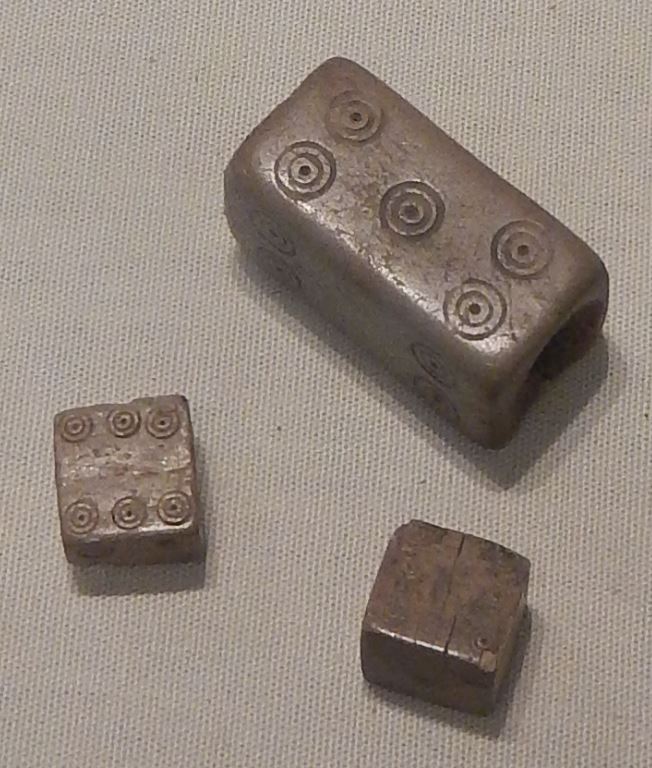
BabelStone, CC BY-SA 3.0 <https://creativecommons.org/licenses/by-sa/3.0>, via Wikimedia Commons
The attitude of the Sages to a gambler is negative. Gamblers were considered to be people who were irresponsible about money, losing it on a whim, as we see in this midrash:
“He said to him: ‘Come, let me tell you—regarding those items I placed in a chest or a cabinet and locked away, their owners do not demand them back immediately. But this man is a gambler; he goes off to play and loses his possessions, then comes back and demands his deposit [from you] right away.’ ” (Yalkut Shimoni Devarim 847)
There is also an element of theft to gambling, as you are taking money that has not fully been given to you, as we see in this first explanation of why gamblers are disqualified as witnesses:
“Rami bar Ḥama says: He is disqualified because gambling is a transaction with inconclusive consent [asmakhta],. And an asmakhta does not effect acquisition, [the one who wins takes money that is not legally his, and is considered a robber].”(Sanhedrin 24b)
The most powerful argument against gambling was that the gambler throws away not just his money but his time, doing nothing useful for the world or for himself:
“Rav Sheshet says: . . . Rather, those who play dice are disqualified because they are not involved in settling the world,” (Sanhedrin 24b)
Maimonides expands on this idea, explaining that gambling goes against humanity’s purpose in this world:
“This is forbidden because it involves engaging in an activity that yields no benefit to the civilized world. It is a fundamental principle of the Torah that a person should occupy themselves in this world with only one of two things: either the study of Torah—so that their soul may attain perfection through wisdom—or a vocation that sustains their livelihood, such as a trade or commerce.” (Maimonides commentary on the Mishnah Sanhedrin 3:3)
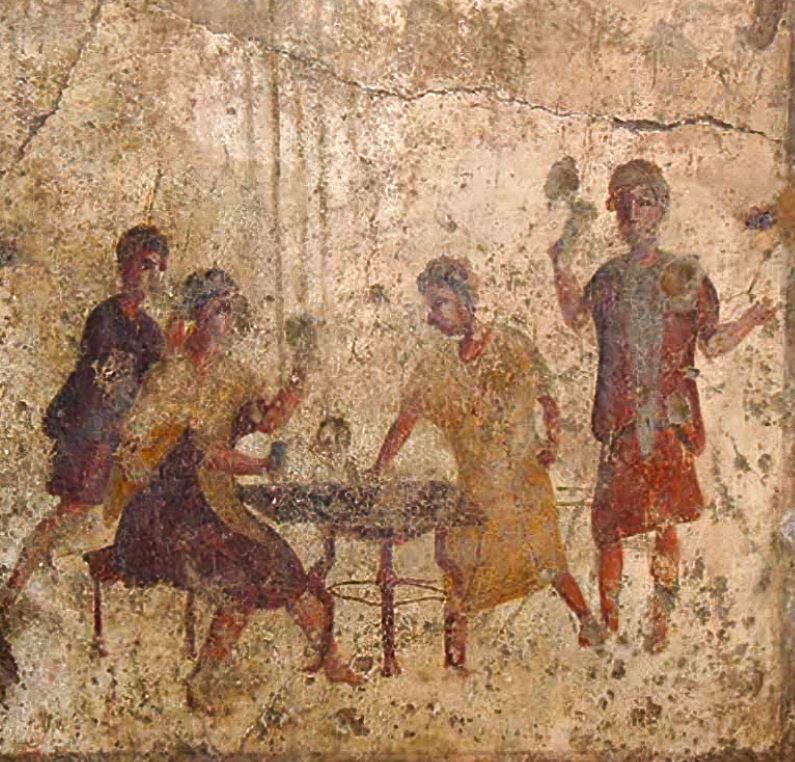
Fresco of gamblers from Pompeii
unknown 1st century Roman artist(s), Public domain, via Wikimedia Commons
While the Rabbis understood that gambling was addictive, they also acknowledged that the addiction could be broken and it was not an eternal moral stain. A gambler who forsakes games wholeheartedly can return to being qualified as a witness:
“And when is their repentance accepted? Once they break their pispasim (dice) and repent of them completely, where they do not do this even for nothing” (Sanhedrin 25b)
Throughout Jewish history we have texts and responsa dealing with gambling. Despite bans, ostracism and general disapproval it was very hard to uproot gambling from Jewish life, especially during festive occasions like Chanukah when people had time and money to burn. One of the most famous Jews who struggled with a gambling addiction was the Venetian rabbi Leone Modena (1571 – 1648). He was a brilliant scholar who wrote many books, among them his autobiography, Chayye Yehudah. In that work he candidly discusses gambling and how he tried many times to stop himself but was unsuccessful. He was plagued with terrible debts and family troubles, largely because of this vice.
Israeli law recognizes the pernicious effects of gambling and it is illegal, except for state sponsored lotteries and sports betting whose proceeds go for community projects. However, in a world with online betting this ban has essentially become useless.
Gambling was widespread in ancient times. There have been many game boards found etched into pavements around Israel, probably used by Roman guards to pass the time.
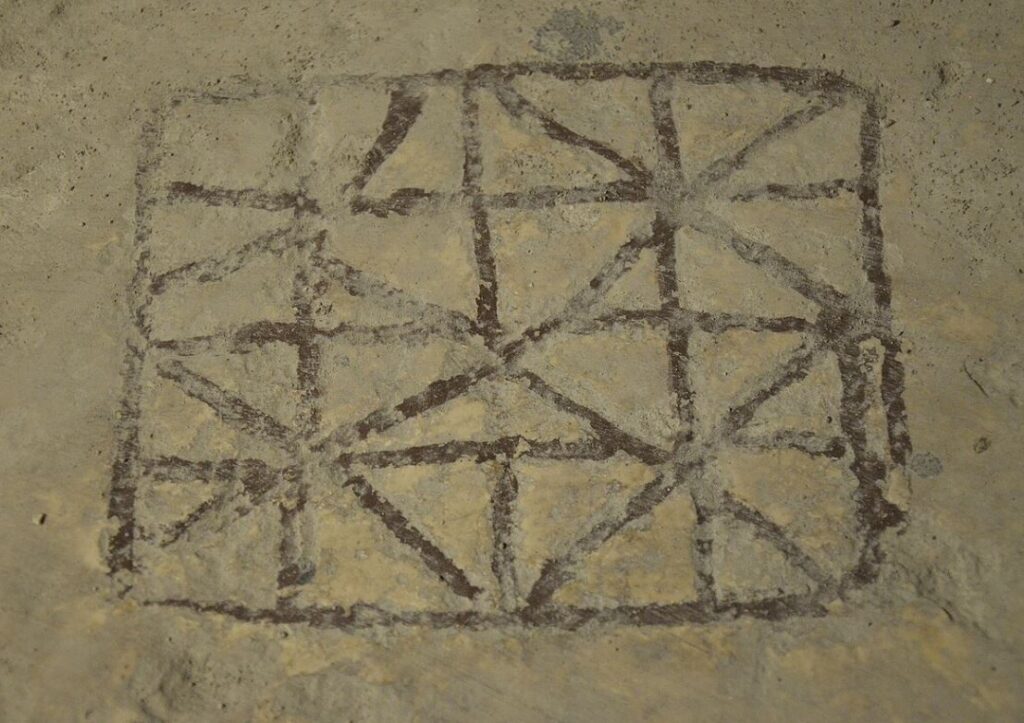
Gameboard by Damascus Gate
Carole Raddato from FRANKFURT, Germany, CC BY-SA 2.0 <https://creativecommons.org/licenses/by-sa/2.0>, via Wikimedia Commons
But recently excavations underneath the Western Wall plaza, near a Roman theater found an additional element of gaming. Archaeologists found a collection of thirty-five dice, an amount only exceeded by a cache of dice found in Caesarea. In a fascinating proof that gamblers were not only wasting time but actively stealing money, one die was “loaded.” Two of its sides had fours and none had threes, enabling the owner to be more in control of what numbers he rolled. The more things change, the more they stay the same.